
Skip to content
The Encyclopedia of Horology

Clock · Perpetual calendar mantel clock

French Ormolu and Porcelain-Mounted Perpetual Calendar Mantel Clock

Partially verified

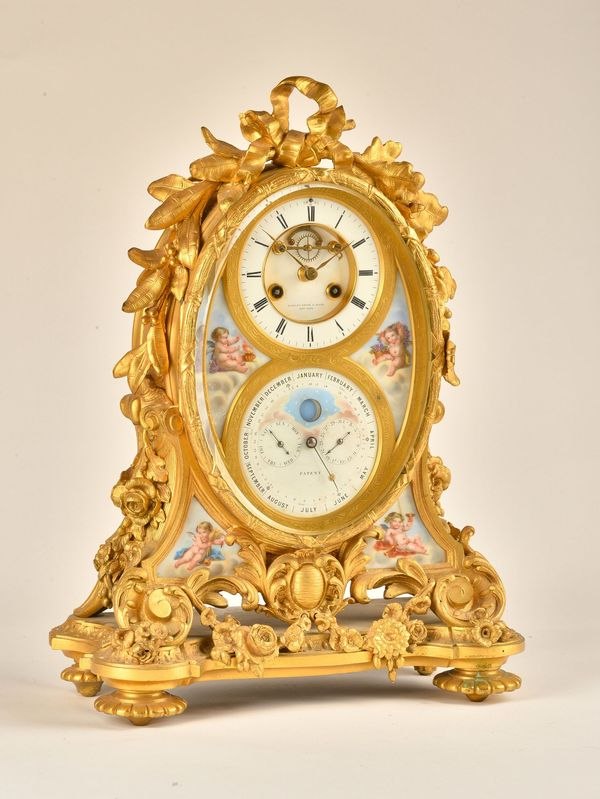
This French ormolu and porcelain-mounted perpetual calendar mantel clock was made by Louis-Achille Brocot in Paris circa 1850 and retailed by Tiffany, Young & Ellis of New York. The cast ormolu case is decorated with ribbon-tied laurels, scrolled feet, and painted porcelain panels depicting cloud-borne cherubs. The upper white enamel chapter ring displays Roman numerals and a visible Brocot escapement with jewelled pallets. Directly below is a circular enamel perpetual calendar dial indicating the months, solar time, day of the week, date, and moon phase. The twin-train drum-shaped movement strikes on a bell, with the dial plate stamped 'A. BROCOT A PARIS'.

French ormolu and porcelain-mounted perpetual calendar mantel clock retailed by Tiffany, Young & Ellis
French ormolu and porcelain-mounted perpetual calendar mantel clock retailed by Tiffany, Young & Ellis — Bellmans. Rights pending — permission not yet requested. Original source

Catalogue identity

Source
app.bellmans.co.uk
Category
Clock · Perpetual calendar mantel clock
Maker / attribution
Louis-Achille Brocot
Reference
Not recorded
Catalogue / lot identifier
39
Source-reported date
Circa 1850
Country
France
Source-reported serial
3832

Source-reported attribution and specifications are not independent authentication. A listing does not establish present ownership, current display, availability or permission to reproduce.

Object description

Case and Decorative Elements

The clock is housed in an oval-shaped cast ormolu case adorned with ribbon-tied laurels and foliate pendants. It rests on a plinth base supported by gadrooned, scrolled feet.

The facade incorporates shaped porcelain panels featuring painted depictions of cloud-borne cherubs. These panels are positioned flanking the dials and across the lower sections of the case.

Evidence for this section
  • “The oval-shaped case finely cast with ribbon-tied laurels and foliate pendants”
  • “on scrolled feet and shaped plinth base with gadrooned feet”
  • “two shaped porcelain panels painted with cloud-borne cherubs”
  • “flanked to each side by a porcelain panel painted with a cloud-borne cherub”

Dial Configuration and Timekeeping

The timekeeping display consists of an upper white enamel chapter ring with a recessed center. A visible Brocot escapement with jewelled pallets and a straight bridge is featured on the dial.

A circular enamel 'PATENT' perpetual calendar dial is positioned below, featuring an outer ring for months, a central sweep hand for solar time, and subsidiary dials for the day of the week and date, along with a moon phase aperture.

Evidence for this section
  • “the upper part with white enamel chapter ring, with recessed centre”
  • “Brocot visible escapement (jewelled pallets) and straight bridge”
  • “circular enamel ‘PATENT’ perpetual calendar dial”
  • “with outer ring for the months, and sweep central hand for solar time”
  • “two subsidiaries for the day of the week and date and circular opening for the moon phase”

Mechanism and Attribution

The object features a twin-train drum-shaped movement, with the dial plate stamped 'A. BROCOT A PARIS'. The movement is identified as No. 3832, while the perpetual mechanism is stamped 3873.

The source attributes the work to Louis-Archille Brocot, dating the clock to circa 1850. It was retailed by Tiffany, Young & Ellis of New York.

Evidence for this section
  • “the twin train drum-shaped movement, stamped to the dial plate A. BROCOT A PARIS”
  • “Movement No. 3832, the perpetual mechanism No 3873”
  • “By Louis-Archille Brocot, Paris”
  • “Circa 1850”
  • “Retailed by Tiffany, Young & Ellis, New York”

Open research questions

  • What are the specific technical distinctions between the '3832' movement and the '3873' perpetual mechanism?
  • Does the 'PATENT' mark on the calendar dial correspond to a registered Brocot patent from the mid-19th century?

Source evidence

Recorded claims and source quotations for French Ormolu and Porcelain-Mounted Perpetual Calendar Mantel Clock
FieldSource-reported valueSource quotation
MakerLouis-Archille Brocot, Paris“By Louis-Archille Brocot, Paris”
Movement Number3832“Movement No. 3832”
Perpetual Mechanism Number3873“the perpetual mechanism No 3873”
RetailerTiffany, Young & Ellis, New York“Retailed by Tiffany, Young & Ellis, New York”
Height42 cm“42 cm high”
Movement StampA. BROCOT A PARIS“stamped to the dial plate A. BROCOT A PARIS”
Retailer PeriodTiffany, Young & Ellis (1841-1853)“it became Tiffany, Young & Ellis until 1853”

Visible details

  • Gilt ormolu case surmounted by ribbon-tied laurels and foliage motifs, resting on gadrooned feet.
  • Upper time dial has Roman numerals, two winding arbors, and an exposed Brocot escapement under the 12 o'clock position.
  • Lower calendar dial displays an outer month ring, subsidiary day and date dials, and a moon phase opening.
  • Painted porcelain panels featuring cherubs are positioned flanking the dials and across the lower facade.

Research qualifications

  • The internal movement, strike bell, and adjustment knobs are housed within the drum case and not visible from the front view.
  • Source notes the maker as 'Louis-Archille Brocot' in the lot description while reporting the dial plate is stamped 'A. BROCOT A PARIS'.

Photograph identity and source facts were screened before import; rights clearance remains pending.

Consulted source

Reviewed 2026-10-22 · Record 25d39ab28a

Terms in this record

Glossary explanations for terms named in this object’s record.