
Skip to content
The Encyclopedia of Horology

Tool · English quadrant

Unsigned Copper Quadrant

Partially verified

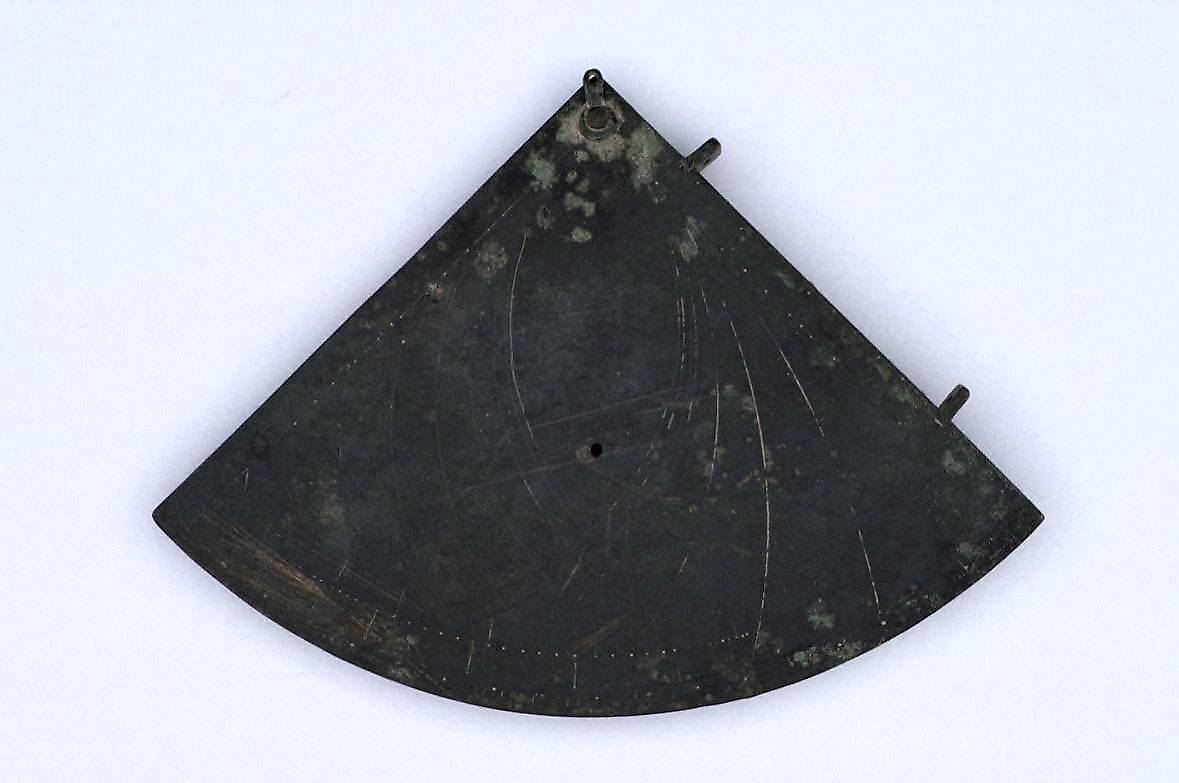
This unsigned quadrant, dating to approximately 1400 and attributed to English origin, is constructed from copper with a 79 mm radius. The instrument is characterized by an incomplete state of completion, featuring hour lines and graduations that appear as sketched outlines. The face includes two hole sights and a central perforation. A ring for suspending a plumb-bob is positioned near the apex. The reverse side features engraved concentric circles centered on the main perforation, with partial graduations present. The surface shows a distinct coloration and contains a dent near the edge. Now considered a historic artifact, the instrument's scientific utility is limited by the current legibility of its engravings, possibly due to corrosion or original incompleteness.

The obverse of the unsigned copper quadrant, showing the sketched hour lines, central hole, and the sighting holes along the edges.
The obverse of the unsigned copper quadrant, showing the sketched hour lines, central hole, and the sighting holes along the edges. — Museum of the History of Science, Oxford. Rights pending — permission not yet requested. Original source

Catalogue identity

Source
www.mhs.ox.ac.uk
Category
Tool · English quadrant
Maker / attribution
Not established
Reference
Not recorded
Catalogue / lot identifier
44178
Source-reported date
circa 1400
Source-reported place
England

Source-reported attribution and specifications are not independent authentication. A listing does not establish present ownership, current display, availability or permission to reproduce.

Object description

Physical Configuration and Construction

The instrument is a copper quadrant with a radius measuring 79 millimeters. It possesses two hole sights affixed to its perimeter to facilitate sighting. A singular, small perforation serves as the center point for various geometric engravings, including a series of concentric circles on the reverse side that are tangent to the edges of the plate.

The primary face of the quadrant is dominated by evidence of its production state, which consists largely of preliminary sketched outlines rather than finished, deep incisions. A suspension ring is located near the apex of the plate, intended to hold a plumb-bob for vertical alignment. The piece currently exhibits a notable dent near one of its edges, impacting the uniformity of the periphery.

Evidence for this section
  • “Copper; 79 mm in radius”
  • “two hole sights”
  • “In the centre of the quadrant is a small hole”
  • “The other side of the quadrant is engraved with concentric circles centred in the perforation”

Graduations and Inscriptions

The functional markings of the quadrant are currently difficult to read, which is attributed to either material degradation or an original lack of completion. On one face, the limb is graduated to 2 degrees. Additionally, there are markings interpreted as intended for a calendar scale.

Faint numerical engravings are visible along the inner section of the divisions, specifically indicating values from 6 to 12. These markings, like the hour lines, lack depth, supporting the assessment that the engraving may have been left in a sketched state.

Evidence for this section
  • “The hour lines and graduations on this quadrant are now difficult to decipher.”
  • “One side of the instrument is graduated on the limb to 2 degrees and has other divisions, probably intended for a calendar scale.”
  • “Numbers from 6 to 12 are engraved very faintly along the inner side of the divisions.”

Provenance and Documentation

The object is held in the collection of the Museum of the History of Science, Oxford, under the inventory number 44178. The documentation notes that the item was previously assigned the accession number 93-01, a record that remains visible as a stencil on the surface of the instrument.

The history of the object includes conflicting interpretations regarding its state of finish. While it is categorized as a scientific instrument, its current condition renders it useless for its original purpose. Records associate the quadrant with English production around 1400.

Evidence for this section
  • “Inventory number: 44178”
  • “The quadrant was previously identified as museum Accession no. 93-01”
  • “this number is stencilled next to one of the edges.”
  • “circa 1400; English”

Open research questions

  • Are the faint pencil-like lines characteristic of unfinished medieval instruments, or do they indicate a specific production technique?
  • Does metallurgical analysis of the copper confirm the English attribution?

Source evidence

Recorded claims and source quotations for Unsigned Copper Quadrant
FieldSource-reported valueSource quotation
MakerUnsigned“Unsigned”
MaterialCopper“Copper”
Dimensions79 mm in radius“79 mm in radius”
Accession Number44178“Inventory number: 44178”
Former ID93-01“The quadrant was previously identified as museum Accession no. 93-01”
Datecirca 1400“circa 1400”

Visible details

  • Two vertical hole sights attached to the edge
  • Visible dent located near one edge of the plate
  • Small hole centered on the quadrant body
  • Suspension ring for a plumb-bob located near the apex

Research qualifications

  • Uncertain whether the faint engravings are due to corrosion or original incompleteness
  • Function of specific divisions is speculative, possibly intended for a calendar scale

Photograph identity and source facts were screened before import; rights clearance remains pending.

Consulted source

Quadrant

Reviewed 2026-10-26 · Record 71615853d4

Terms in this record

Glossary explanations for terms named in this object’s record.