
Skip to content
The Encyclopedia of Horology

Tool · English quadrant

14th-Century English Brass Quadrant

Partially verified

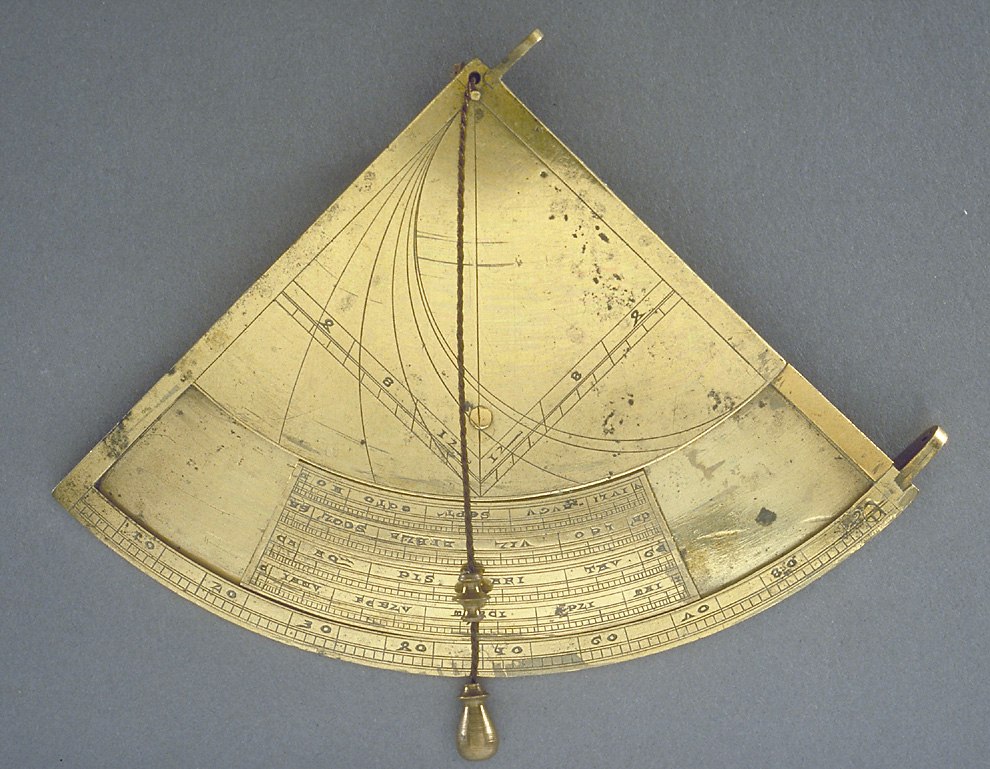
This 14th-century brass quadrant, held by the British Museum, is an unsigned example of a 'quadrans vetus'. Measuring 160 mm in radius, the instrument features intricate astronomical markings, including lines for unequal hours and a shadow square on its front face. A notable design element is the sliding scale along the curved edge, which contains the months and zodiacal signs, allowing for utility across various latitudes. The reverse side of the instrument displays dual circular scales representing the zodiac and the months, accompanied by a central disc engraved with a later shadow scale. An alidade featuring two sighting vanes is present, bearing the Latin inscription 'LINEA FIDUTIA'. While the plumb bob is considered a later replacement, the instrument’s Gothic lettering and overall design suggest an English origin from the 1300s, aligning with stylistic features documented in contemporary manuscripts of the period.

Front view of the 14th-century English brass quadrant, showing the altitude scale, the sliding zodiacal slider, and the hanging plumb bob.
Front view of the 14th-century English brass quadrant, showing the altitude scale, the sliding zodiacal slider, and the hanging plumb bob. — © British Museum, London. Rights pending — permission not yet requested. Original source

Catalogue identity

Source
www.mhs.ox.ac.uk
Category
Tool · English quadrant
Maker / attribution
Not established
Reference
Not recorded
Catalogue / lot identifier
MLA 1972,1-4.1
Source-reported date
14th century
Source-reported place
England

Source-reported attribution and specifications are not independent authentication. A listing does not establish present ownership, current display, availability or permission to reproduce.

Object description

Design and Astronomical Utility

The front of the quadrant is structured with lines calibrated for unequal hours, integrated with a base 12 shadow square that is marked in intervals of four. An altitude scale follows the curved edge of the device, ranging from 0 to 90 and subdivided into units of 5 and 1. To enhance versatility, a sliding scale containing Latin month names and their corresponding zodiacal signs moves along the edge in a groove, permitting calculations across different latitudes. The months are mapped with their respective day counts, including a notable notation of 30 days for February.

The reverse side offers further astronomical functionality with two concentric circular scales. The outermost scale lists the signs of the zodiac, while an eccentric inner scale records the months of the year. Each scale provides precise divisions to aid in solar and calendar tracking. A central disc was added later, featuring a unique shadow scale, upon which rotates an alidade fitted with two sighting vanes and the Latin phrase 'LINEA FIDUTIA'. This addition significantly alters the original intended use of the central area of the reverse face.

Evidence for this section
  • “The front of the quadrant is marked with lines for unequal hours, superimposed with a shadow square to the base 12”
  • “The scale of months and corresponding zodiacal signs slides along the altitude scale in a groove.”
  • “The reverse has two circular scales”
  • “A central disc has been engraved at a later date with a shadow scale”

Dating and Historical Attribution

Attribution to the 14th century is primarily supported by the paleographic evidence of the inscriptions. The use of Gothic-style letters and specific numeral forms is consistent with early English instrumentation from this timeframe. Historians have observed that these stylistic traits correlate closely with instruments and manuscripts from the period, most notably a manuscript attributed to John of Montpellier dating prior to 1350.

While the device is unsigned, its design configuration as a 'quadrans vetus' reinforces its connection to medieval scientific practices. The instrument is listed in the British Museum's records under the accession number MLA 1972,1-4.1 and has been formally documented in F. A. B. Ward's 1981 catalogue. These records affirm its provenance as a significant, albeit undated, specimen within the Department of Medieval and Later Antiquities.

Evidence for this section
  • “The Gothic letters and numerals of the original inscriptions make it likely that the quadrant was made in the 14th century.”
  • “The letter forms resemble those found on a number of early English instruments.”
  • “The quadrant 's design is very similar to the instrument described in a manuscript by John of Montpellier written before 1350.”

Condition and Component Integrity

The instrument exhibits signs of historical maintenance and modification. The plumb bob, currently suspended from the apex of the quadrant, is identified as a later replacement rather than an original component.

Further examination reveals that the reverse side incorporates later modifications, specifically the addition of the central disc shadow scale and the alidade inscription. These alterations suggest the quadrant remained in active use long after its manufacture, receiving updates to its features as observational needs changed. The brass remains the primary material throughout the construction, maintaining the original geometry of the 160 mm radius despite these secondary additions to the instrument's surface.

The instrument was purchased in 1972 and is described and illustrated in F. A. B. Ward, A Catalogue of European Scientific Instruments in the Department of Medieval and Later Antiquities of the British Museum (London, 1981), p. 55 (with plate XX).

Evidence for this section
  • “The plumb bob appears to be a later replacement.”
  • “A central disc has been engraved at a later date with a shadow scale to the base numbered 1 to 1, divided to 1/3.”
  • “Over this disc rotates an alidade with two sighting vanes and engraved at a later date 'LINEA FIDUTIA'.”

Open research questions

  • What is the function of the specific February notation of 30 days?
  • Can the 'LINEA FIDUTIA' addition be attributed to a specific workshop or era of refurbishment?

Source evidence

Recorded claims and source quotations for 14th-Century English Brass Quadrant
FieldSource-reported valueSource quotation
Radius160 mm“160 mm in radius”
OriginEnglish“English”
Date14th century“14th century”
Registration NumberMLA 1972,1-4.1“Registration no. MLA 1972,1-4.1”
Equinox dates (front)12 March and 15 September“The equinoxes are at 12 March and 15 September.”
Equinox dates (reverse)12 March and 18 September“The equinoxes are at 12 March and 18 September.”

Visible details

  • Curved edge altitude scale marked 0 to 90
  • Movable slider with month and zodiacal notations
  • Plumb line suspended from the apex
  • Engraved 'LINEA FIDUTIA' on the rotating alidade

Research qualifications

  • The plumb bob is described as a probable later replacement
  • The central shadow scale and 'LINEA FIDUTIA' inscription are noted as later additions

Photograph identity and source facts were screened before import; rights clearance remains pending.

Consulted source

Quadrant

Reviewed 2026-10-26 · Record d4d9bd4ccb

Terms in this record

Glossary explanations for terms named in this object’s record.