
Skip to content
The Encyclopedia of Horology

Tool · English quadrant

Charles Whitwell Quadrant

Partially verified

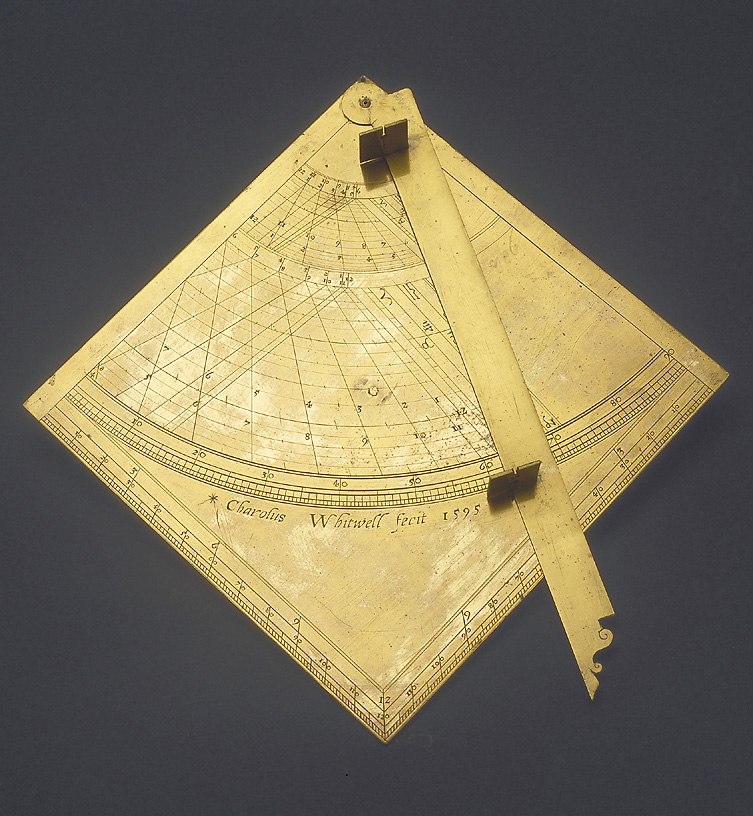
This brass square-shaped instrument, measuring 176 mm by 176 mm, is a signed horary quadrant created by Charles Whitwell in 1595. It was designed for surveying and stellar measurements. The obverse face features a shadow square and two straight-line horary quadrants. A pivoted alidade with sighting vanes is present, although the source identifies this component as not being original to the instrument. The reverse contains complex astronomical and navigation scales, including a zodiacal calendar, a double hour scale, a circle of compass directions, and a lunar volvelle with phase aperture and aspectarium. The engraving utilizes italic and roman scripts, with visible guide lines for letter and numeral placement. This instrument, held in the collection of the Istituto e Museo di Storia della Scienza in Florence, illustrates the technical output of Whitwell, who was known for producing instruments based on the designs of Robert Dudley.

Obverse face of the brass quadrant showing the shadow square, the horary quadrant with straight lines, and the signature of Charles Whitwell.
Obverse face of the brass quadrant showing the shadow square, the horary quadrant with straight lines, and the signature of Charles Whitwell. — Istituto e Museo di Storia della Scienza, Firenze. Rights pending — permission not yet requested. Original source

Catalogue identity

Source
www.mhs.ox.ac.uk
Category
Tool · English quadrant
Maker / attribution
Charles Whitwell
Reference
Not recorded
Catalogue / lot identifier
2159
Source-reported date
1595
Source-reported place
England

Source-reported attribution and specifications are not independent authentication. A listing does not establish present ownership, current display, availability or permission to reproduce.

Object description

Instrument Geometry and Obverse Features

The instrument is square in form, providing a base for multiple distinct computational diagrams. The primary functional engraving on the face consists of a shadow square arranged along the lower edges, which is decimally subdivided into 120 parts. Above this, the instrument features two horary quadrants defined by straight lines rather than the traditional curved arcs. The lower quadrant is numbered from 4 through 12 to 8, while the upper quadrant follows a 12 to 6 to 12 sequence.

These hour diagrams are intersected by parallel season arcs, which represent five-degree divisions of the zodiac. A degree scale is provided along the limb of the quadrant. A central diameter line extends from the apex to the 12/120 point of the shadow square, serving as a geometric reference. The maker's signature is engraved below the arc, and the device utilizes an alidade for sighting, though this element is recorded as a later addition.

Evidence for this section
  • “The instrument, which is square in shape, bears a shadow square on two adjacent sides.”
  • “A horary quadrant , with straight lines rather than the more frequent curves, is on the same face.”
  • “An alidade with two sights pivoted from the apex is not original.”

Reverse and Astronomical Scales

The reverse side of the quadrant displays an array of concentric astronomical scales intended for complex timekeeping and navigational calculations. Reading from the outer edge toward the center, the instrument includes a zodiacal calendar where the signs are subdivided into degrees and the months into days, with the 0-degree Aries point positioned at approximately March 11.

Inside this scale lies a double hour scale calibrated to 15-minute intervals, surrounding a circle of 32 compass directions. At the center is a lunar volvelle, which includes a lower disc with a pointer and a 30-day month scale. The upper disc features a pointer, an aperture for displaying lunar phases, and an integrated lunar aspectarium. The text on this side is executed in a mix of italic script for names and roman script for compass directions, with light guide lines still faintly visible.

Evidence for this section
  • “The reverse of the instrument is engraved with concentric scales”
  • “Within this is a double hour scale reading to 15 minutes and within this a circle of 32 compass directions”
  • “Within this a lunar volvelle, the lower disc with pointer and 30 day month scale reading to quarters”

Signatures and Construction

The instrument is signed on the face: 'Charolus Whitwell fecit 1595'. The quality of the engraving throughout the brass plate is characterized by restrained italic scripts for calendar information and formal roman scripts for compass notations. The documentation notes the survival of light guide lines on both sides of the plate, indicating the preparation methods used by the maker for the alignment of letters and numerals.

Charles Whitwell is noted as a significant producer of scientific instruments in the late sixteenth century, particularly those associated with the designs of Robert Dudley. The instrument's physical state includes an alidade that is not original, highlighting the repair history of the object. The item is currently curated in the Istituto e Museo di Storia della Scienza in Florence, providing a primary example of Whitwell's instrument-making style.

Evidence for this section
  • “Signed by Charles Whitwell”
  • “The quadrant was made by Charles Whitwell , who made many of the instruments designed by Robert Dudley .”
  • “On both sides of the instrument the remains of light guide lines for the height of the letters and numerals can be seen.”

Open research questions

  • What is the specific provenance of this instrument before its entry into the Istituto e Museo di Storia della Scienza?
  • Were the astronomical scales on the reverse designed for a specific latitude, and if so, which one?

Source evidence

Recorded claims and source quotations for Charles Whitwell Quadrant
FieldSource-reported valueSource quotation
MakerCharles Whitwell“Signed by Charles Whitwell”
Date1595“Dated 1595”
Dimensions176 mm x 176 mm“176 mm x 176 mm”
CollectionIstituto e Museo di Storia della Scienza, Firenze“Istituto e Museo di Storia della Scienza, Firenze”
Inventory Number2159“Inventory number: 2159”
ProvenanceEnglish“English”
Condition noteThe alidade is a replacement“An alidade with two sights pivoted from the apex is not original.”

Visible details

  • Shadow square engraved along the lower edges
  • Straight line horary diagrams with 30-minute divisions
  • Zodiacal calendar with Aries at nearly 11 March
  • Lunar volvelle with pointers and phase aperture

Research qualifications

  • The alidade with sighting vanes is reported as not original to the instrument
  • The exact function of the lunar aspectarium is described but its current mechanical condition is not specified

Photograph identity and source facts were screened before import; rights clearance remains pending.

Consulted source

Quadrant

Reviewed 2026-10-26 · Record 46c4c48afb

Terms in this record

Glossary explanations for terms named in this object’s record.