
Skip to content
The Encyclopedia of Horology

Tool · English quadrant

Double Quadrant by Thomas Gemini

Partially verified

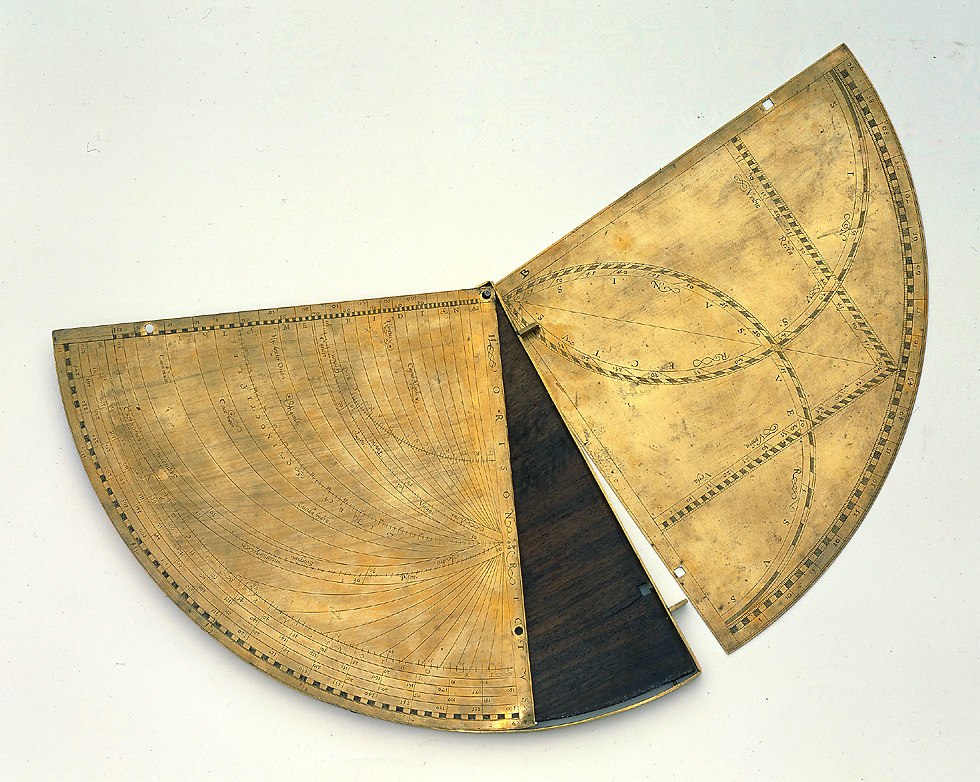
This double quadrant, signed by Thomas Gemini, dates to the mid-16th century. It is constructed from two brass plates and a central wooden core, with an overall radius of 270 mm. The assembly is held together by three iron bolts with square shanks and flattened pyramidal ends. Designed for astronomical and trigonometric operations, the instrument includes varied scales for calculating moveable feasts, measuring elevation, and performing astrological predictions. One side features a stereographic projection of celestial coordinates, including the ecliptic and various stars, while others include a zodiacal calendar, an hour scale, and a shadow square. The current mounting arrangement, featuring a wooden core, is documented in the 1654 Medici inventories, though it is considered a non-original modification to the plates, potentially performed within a Medici workshop.

A brass double quadrant with a central wooden core, signed by Thomas Gemini, featuring multiple engraved scales for astronomical calculations.
A brass double quadrant with a central wooden core, signed by Thomas Gemini, featuring multiple engraved scales for astronomical calculations. — © Istituto e Museo di Storia della Scienza, Firenze. Rights pending — permission not yet requested. Original source

Catalogue identity

Source
www.mhs.ox.ac.uk
Category
Tool · English quadrant
Maker / attribution
Thomas Gemini
Reference
Not recorded
Catalogue / lot identifier
2509
Source-reported date
mid 16th century
Source-reported place
England

Source-reported attribution and specifications are not independent authentication. A listing does not establish present ownership, current display, availability or permission to reproduce.

Object description

Construction and Assembly

The instrument functions as a double quadrant, composed of two brass plates positioned on either side of a central wooden core. These components are secured at the apex pivot point, though they are further held in their present form by three square-shanked iron bolts that penetrate the assembly. The wooden core is 8 mm thick and features a non-functional hole at its centre, suggesting it was adapted for the plates rather than created specifically for them.

The presence of a screw hole that obscures part of the original engraving on the horizontal quadrant plate indicates that the current mounting is not original. This configuration was already in place by the time the instrument appeared in the 1654 Medici inventories. It is proposed that this structural modification was undertaken in a Medici workshop prior to the mid-17th century.

Evidence for this section
  • “The instrument is composed of two quadrants each engraved on both sides now mounted within a quadrantal frame pinned to the edges of a central wood core 8 mm thick by three square shanked, screw fastening, iron bolts with flattened pyramidal ends.”
  • “Since the wood core has a non-functional hole at its centres, and one of the screw holes breaks the engraving on the edge of the horizontal quadrant plate, it seems probable that the mounting arrangement is not original”
  • “It is perhaps not unlikely that the transformation was carried out in the Medici workshop.”

Astronomical and Calendrical Features

The quadrant is engraved with a variety of mathematical and astronomical scales across its multiple faces. Side one of the first quadrant contains a doubled zodiacal calendar, a scale of 90 degrees, and a list of seventeen festivals related to the liturgical year. These are accompanied by concentric semi-circular scales for leap year calculations, the solar cycle, and the dominical letter.

Side two of the first quadrant presents a stereographic projection of celestial coordinates, functioning similarly to an astrolabe plate. This surface displays the ecliptic, the horizon, and the meridian, alongside the positions of specific stars such as Caput Algol and Hircus. The second quadrant provides a 90-degree limb scale and a shadow square, enabling calculations related to sines and versed sines.

Evidence for this section
  • “The entire plate is filled with the diagram of an horizontal quadrant, that is a stereographic projection of the celestial co-ordinates onto the plane of the observer's horizon.”
  • “The limb is divided with a 90? scale numbered in groups of five and reading to 30' of arc. Within this is a shadow square marked 'Umbra recta', 'umbra versa' each divided to 60 parts”
  • “The festivals named are written sometimes in the direction of the limb, sometimes in the direction of the apex of the instrument, presumably so that they may be readily associated with the appropriate half year”

Signatures and Attribution

The authorship of the instrument is established through the specific engraving of the symbol 'II' upon the brass plates. This mark represents the sign of Gemini, which serves as a signature for the maker Thomas Gemini.

The provenance of the object is linked to the historical Medici collection, as the instrument is documented in their inventories as early as 1654. The inventory entry provides a description of the instrument's components, specifically noting the brass plates, the wooden core, and the iron screws, confirming that the transformation of the piece was finalized at least by the mid-17th century.

Evidence for this section
  • “The symbol 'II', representing the sign Gemini, reveals the author to be Thomas Gemini , a maker of observational and measuring instruments.”
  • “This instrument is mentioned in its present form in the Medici Inventories for 1654: 'Un quadrante composto di due lastre d'ottone, e anima di legno e due traguardi, ferme le piastre con tre viti di ferro, serve a molte operazioni astronomiche'.”

Open research questions

  • What specific observational tasks was the original, pre-transformation instrument intended to perform?
  • Was the wooden core salvaged from a different instrument entirely, or specifically fabricated to house the Gemini plates?

Source evidence

Recorded claims and source quotations for Double Quadrant by Thomas Gemini
FieldSource-reported valueSource quotation
MakerThomas Gemini“Signed by Thomas Gemini”
Inventory Number2509“Inventory number: 2509”
DateMid 16th century“Mid 16th century”
Dimensions270 mm radius, 8 mm core thickness“Brass; 270 mm in radius”
MaterialsBrass, wood, iron“The instrument is a double quadrant , made up of two brass plates between which is a wooden table of the same shape”
Attributed OriginEnglish“English”
Medici Inventory Reference1654“This instrument is mentioned in its present form in the Medici Inventories for 1654”

Visible details

  • Central wooden core measuring 8 mm in thickness
  • Brass plates with engraved scales and star names
  • Iron bolts with flattened pyramidal ends
  • Sighting vanes with open and pinnule sights on a radial side

Research qualifications

  • The mounting of the plates onto the wooden core is considered a non-original transformation
  • The exact date of the instrument's transformation remains unverified

Photograph identity and source facts were screened before import; rights clearance remains pending.

Consulted source

Quadrant

Reviewed 2026-10-26 · Record 30d225016d

Terms in this record

Glossary explanations for terms named in this object’s record.