
Skip to content
The Encyclopedia of Horology

Clock · Turret clock

Turret Clock Movement - Victorian Railways, Flinders Street Station

Partially verified

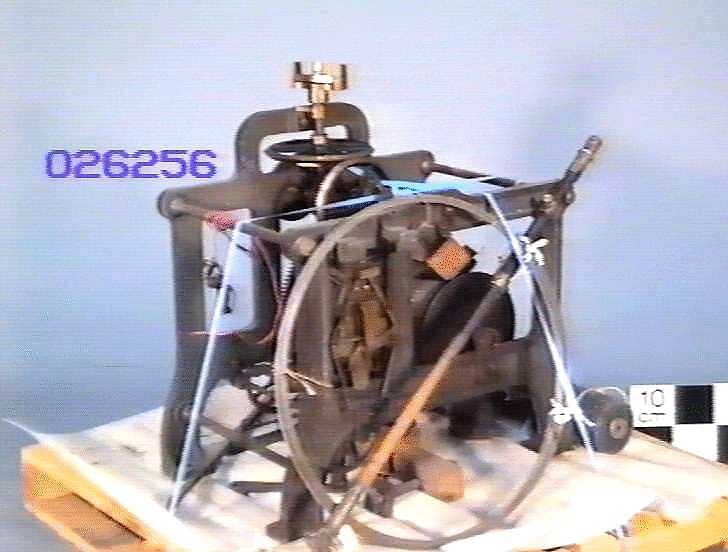
This turret clock movement was produced by the Melbourne-based maker Thomas Ambrose Gaunt (Thomas Gaunt & Co) in 1882. The movement was commissioned by the Victorian Railways and initially installed at the Elizabeth Street entrance of Flinders Street Station, Melbourne, where it became a noted local landmark. Measuring 122 cm in length, 94 cm in width, and 114 cm in height, with a weight of 360 kg, the movement is constructed from metal components. Following its initial placement, the clock was relocated to Princes Bridge Station in 1901 and subsequently to Spencer Street Station in 1910. It remained at the latter site until its removal in 1967. The movement was eventually donated to the museum collection by the Victorian Railways in 1967. It is distinct from the original tower structure and clock faces, which were later restored with an electric movement for use at Southern Cross Station.

The turret clock movement from Flinders Street Station, viewed from an angle displaying the frame and gear train, identified with accession number ST 26256.
The turret clock movement from Flinders Street Station, viewed from an angle displaying the frame and gear train, identified with accession number ST 26256. — Museums Victoria. Rights pending — permission not yet requested. Original source

Catalogue identity

Source
collections.museumsvictoria.com.au
Category
Clock · Turret clock
Maker / attribution
Thomas Ambrose Gaunt - Thomas Gaunt & Co
Reference
Not recorded
Catalogue / lot identifier
ST 26256
Source-reported date
1882
Source-reported place
Australia
Source-reported serial
ST 26256

Source-reported attribution and specifications are not independent authentication. A listing does not establish present ownership, current display, availability or permission to reproduce.

Object description

Construction and Design

The turret clock movement is constructed as a substantial mechanical assembly designed for heavy-duty timekeeping. Its frame provides support for an array of gears and pinions that facilitate the transfer of motion from the power source to the external clock faces. The overall dimensions of 122 cm by 94 cm by 114 cm suggest a robust design intended for stationary installation within a clock tower.

Visual examination indicates the movement utilizes a series of large, toothed wheels, which are visible within the iron frame. The architecture is consistent with late 19th-century turret clock construction, emphasizing durability and mechanical accessibility for maintenance purposes within a tower environment.

Evidence for this section
  • “122 cm (Length), 94 cm (Width), 114 cm (Height)”

Institutional Provenance and Relocations

The movement served several Victorian Railways locations in Melbourne over its operational life. It began its service in 1882 at the Elizabeth Street entrance of Flinders Street Station. In 1901, the mechanism and its corresponding tower were moved to the Princes Bridge Station site.

Following its time at Princes Bridge, the clock was moved to Spencer Street Station in 1910. It remained in this position until its eventual dismantling in 1967. The Victorian Railways subsequently donated the item to the museum collection later that same year.

Evidence for this section
  • “installed by the Victorian Railways on a tower at the Elizabeth Street entrance of Flinders Street Station, Melbourne, in 1882-3”
  • “In 1901 the clock and tower was relocated to Princes Bridge Station, Melbourne. In 1910 to clock and tower was relocated to Spencer Street Station, Melbourne, where it remained until dismantled in 1967.”
  • “Donation from Victorian Railways (VR), 15 Dec 1967”

Historical Context

This clock movement was a notable piece of urban infrastructure, often referred to as the water tower clock during its tenure at Flinders Street Station.

While the mechanical movement housed in the museum collection represents the original horological apparatus, the associated tower structure and exterior clock faces underwent a separate history, including private ownership and subsequent restoration with a modern electric drive system at Southern Cross Station.

Evidence for this section
  • “It became a Melbourne landmark and was commonly known at "the water tower clock".”
  • “The structure holding the four clock faces passed into private hands, but was subsequently purchased by the Victorian Government. Restored with an electric movement, it is now installed in the main concourse of Southern Cross Station.”

Open research questions

  • What specific type of escapement was used in this movement?
  • Does the movement retain its original winding mechanisms or drive weights?

Source evidence

Recorded claims and source quotations for Turret Clock Movement - Victorian Railways, Flinders Street Station
FieldSource-reported valueSource quotation
MakerThomas Ambrose Gaunt - Thomas Gaunt & Co“Thomas Ambrose Gaunt - Thomas Gaunt & Co”
LocationMelbourne“Melbourne”
Registration numberST 26256“ST 26256”
Dimensions122 cm (Length), 94 cm (Width), 114 cm (Height), 360 kg (Weight)“122 cm (Length), 94 cm (Width), 114 cm (Height), 360 kg (Weight)”
Original LocationElizabeth Street entrance of Flinders Street Station“installed by the Victorian Railways on a tower at the Elizabeth Street entrance of Flinders Street Station, Melbourne, in 1882-3”
AcquisitionDonation from Victorian Railways (VR), 15 Dec 1967“Donation from Victorian Railways (VR), 15 Dec 1967”

Visible details

  • Metal frame construction with exposed gear train
  • Mounting points for central vertical transmission
  • Significant gear reduction mechanisms visible

Research qualifications

  • The current state of mechanical completeness is not explicitly detailed beyond the presence of the movement.
  • The relationship between the current state of the movement and the 'wooden and glass case with lead roof' mentioned in the physical description requires further verification as it is not depicted in the provided images.

Photograph identity and source facts were screened before import; rights clearance remains pending.

Consulted source

Turret Clock Movement - Victorian Railways, Flinders Street Station, Victoria, 1882

Reviewed 2026-10-26 · Record 122e91630e

Terms in this record

Glossary explanations for terms named in this object’s record.