
Skip to content
The Encyclopedia of Horology

Clock · Table or bracket clock

Table or bracket clock by George Graham

Partially verified

This table or bracket clock is attributed to the English clockmaker George Graham. Dated circa 1720, the clock features a case constructed of walnut veneer over an oak carcass, ornamented with brass hardware. The dial is composed of gilded and silvered brass. The internal mechanism consists of brass and steel components. The overall dimensions of the object are 24 1/2 by 16 3/4 by 8 3/4 inches (62.2 by 42.5 by 22.2 cm). It is currently part of the collection of The Metropolitan Museum of Art, having been gifted to the institution by Irwin Untermyer in 1964. The signature "Geo. Graham London" appears on the dial. The design incorporates a silvered chapter ring, subsidiary dials, and decorative brass corner mounts. The movement is mounted within the wooden casing, which includes side panels featuring ornate brass fretwork.

Front dial view of the George Graham table clock showing the signature, chapter ring, and subsidiary dials.
Front dial view of the George Graham table clock showing the signature, chapter ring, and subsidiary dials. — The Metropolitan Museum of Art — Gift of Irwin Untermyer, 1964. Rights pending — permission not yet requested. Original source

Catalogue identity

Source
orbiscollectibles.com
Category
Clock · Table or bracket clock
Maker / attribution
George Graham
Reference
Not recorded
Catalogue / lot identifier
64.101.872
Source-reported date
ca. 1720
Source-reported place
British, London

Source-reported attribution and specifications are not independent authentication. A listing does not establish present ownership, current display, availability or permission to reproduce.

Object description

Case and Dial

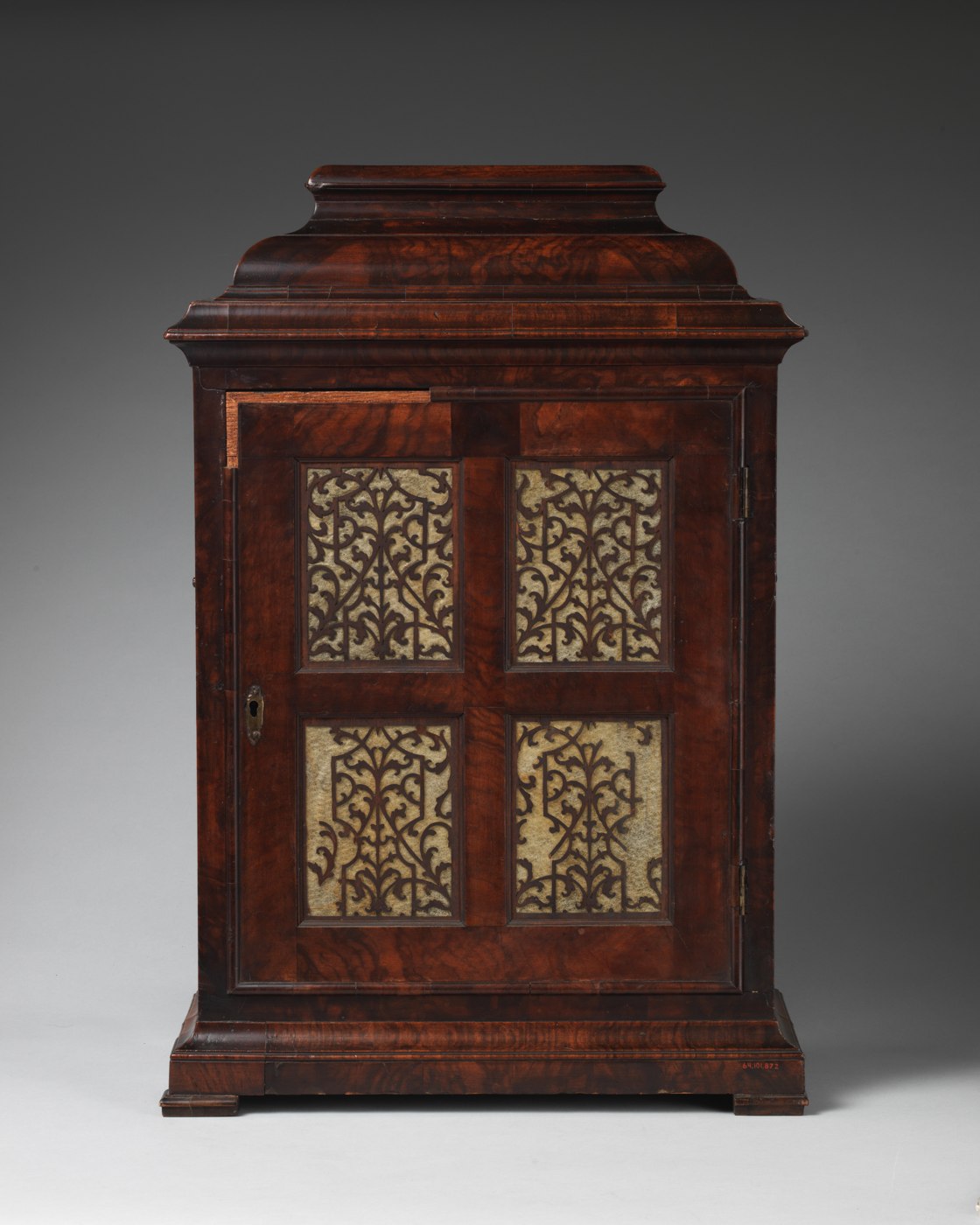
The clock is housed in a wooden case characterized by walnut veneers applied over an oak structure. The case design includes a pedestal base and a top molding. The front door features glass panels and brass hardware, while the sides incorporate panels decorated with complex, symmetrical brass fretwork that allows for sound transmission from the internal chime.

The dial assembly is constructed primarily of gilded and silvered brass. It displays a central silvered chapter ring with engraved Roman and Arabic numerals. The upper portion of the dial contains two smaller subsidiary dials, and the maker's signature, "Geo. Graham London," is inscribed in the upper field. Decorative brass spandrels are applied to the four corners of the square dial plate.

Evidence for this section
  • “Case: walnut veneered on oak, with brass hardware”
  • “Dial: gilded and silvered brass”

Movement and Construction

The internal movement is composed of brass and steel components. The structure is supported by a heavy brass back plate mounted within the wooden carcass. The arrangement includes various levers and plates necessary for the timekeeping and potentially striking functions.

The overall construction follows proportions consistent with 18th-century English table clock design. The assembly measures approximately 24 1/2 inches in height and 16 3/4 inches in width, reflecting the scale required to accommodate both the dial mechanism and the internal striking train.

Evidence for this section
  • “Movement: brass and steel”
  • “Overall: 24 1/2 × 16 3/4 × 8 3/4 in.”

Provenance and Identification

The clock is identified by the Metropolitan Museum of Art as object number 64.101.872. It entered the collection in 1964 as a gift from Irwin Untermyer. The attribution to George Graham is supported by the dial signature, consistent with his active working period in London during the early 18th century.

The specific identification and historical context of this clock rely on the archival records provided by the museum, which categorize the piece as a standard table or bracket clock produced during Graham's professional career.

Evidence for this section
  • “The Metropolitan Museum of Art holds this object as 64.101.872”
  • “Gift of Irwin Untermyer, 1964”
  • “George Graham (1673–1751) was an English clockmaker”

Open research questions

  • Determine the specific type of escapement used in the 64.101.872 movement.
  • Identify if this clock features a striking or repeating complication beyond the standard timekeeping display.

Source evidence

Recorded claims and source quotations for Table or bracket clock by George Graham
FieldSource-reported valueSource quotation
MakerGeorge Graham“George Graham”
Dateca. 1720“ca. 1720”
CultureBritish, London“British, London”
Dimensions24 1/2 × 16 3/4 × 8 3/4 in.“24 1/2 × 16 3/4 × 8 3/4 in. (62.2 × 42.5 × 22.2 cm)”
MaterialsWalnut, oak, brass, steel“Case: walnut veneered on oak, with brass hardware; Dial: gilded and silvered brass; Movement: brass and steel”
Museum Number64.101.872“64.101.872”

Visible details

  • Dial signed 'Geo. Graham London'
  • Silvered chapter ring with roman numerals
  • Ornate pierced brass corner spandrels
  • Side door panels with intricate metal fretwork

Research qualifications

  • Research required to confirm the full mechanism type
  • Attribution based on museum record

Photograph identity and source facts were screened before import; rights clearance remains pending.

Consulted source

Table or bracket clock, George Graham, ca. 1720

Reviewed 2026-11-02 · Record d47b6d81d7

Terms in this record

Glossary explanations for terms named in this object’s record.