
Skip to content
The Encyclopedia of Horology

Clock · Table or bracket clock

Table or bracket clock by John Andrews

Partially verified

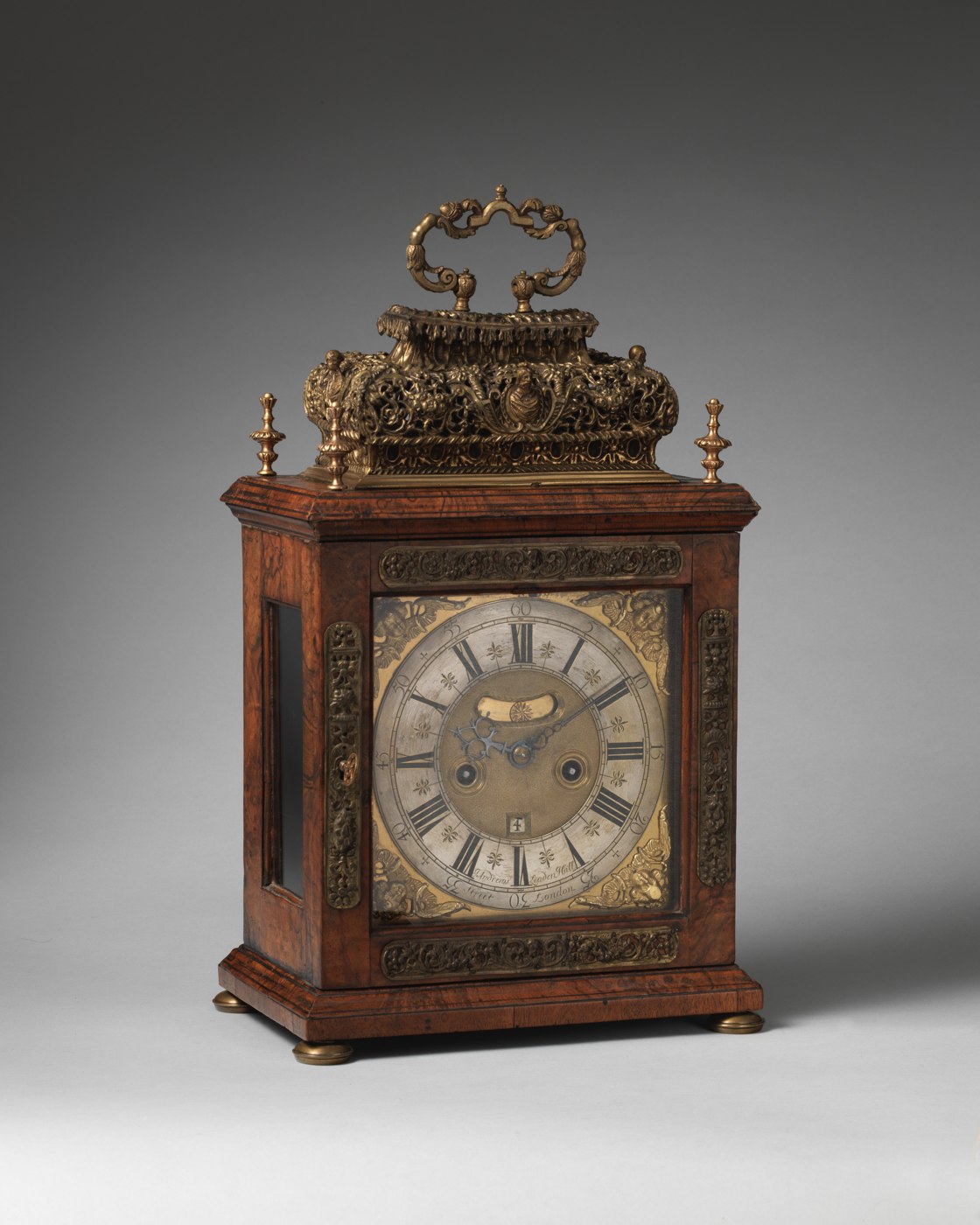
This table or bracket clock is identified as the work of London-based maker John Andrews, active between 1680 and 1708. Dated to 1690, the timepiece is constructed from gilded brass and steel. The housing features a case made of walnut and walnut veneer, decorated with gilded brass elements. Its dimensions are recorded as 15 1/2 by 10 by 6 1/2 inches (approximately 39.4 by 25.4 by 16.5 cm). The clock is currently held by The Metropolitan Museum of Art as part of the gift of Irwin Untermyer in 1964. The dial shows a date aperture, and the backplate is engraved.

Front view of the table or bracket clock by John Andrews, dated 1690.
Front view of the table or bracket clock by John Andrews, dated 1690. — The Metropolitan Museum of Art. Rights pending — permission not yet requested. Original source

Catalogue identity

Source
orbiscollectibles.com
Category
Clock · Table or bracket clock
Maker / attribution
John Andrews
Reference
Not recorded
Catalogue / lot identifier
64.101.861
Source-reported date
1690
Source-reported place
British, London

Source-reported attribution and specifications are not independent authentication. A listing does not establish present ownership, current display, availability or permission to reproduce.

Object description

Construction and Materials

The table or bracket clock is constructed from a combination of gilded brass and steel components, housed within a wooden case. The exterior of the clock is defined by the use of walnut and walnut veneer, which provides the primary structural and decorative finish for the case. Gilded brass elements are applied throughout the design, including the mounts and the carrying handle located at the top of the clock.

The dimensions of the object are stated as 15 1/2 inches in height, 10 inches in width, and 6 1/2 inches in depth. These measurements describe the overall footprint and scale of the bracket clock as preserved in the museum collection. The combination of metal and wood materials is consistent with the production methods of the era.

Evidence for this section
  • “Gilded brass and steel; Case: walnut, walnut veneer, and gilded brass”
  • “Overall: 15 1/2 × 10 × 6 1/2 in. (39.4 × 25.4 × 16.5 cm)”

Maker and Documentation

The clock is attributed to John Andrews, a maker recorded as active in London between 1680 and 1708. The Metropolitan Museum of Art attributes the work to this maker and has dated the piece to 1690. The record confirms the identity of the maker and the location of manufacture as London, British.

The object is catalogued under the accession number 64.101.861. It entered the collection as a gift from Irwin Untermyer in 1964. The details provided represent the specific specimen held by the institution, with the source noting that the broader context of this object as a type has not been independently verified beyond the provided records.

Evidence for this section
  • “Clockmaker: John Andrews (British, recorded 1680–1708)”
  • “The Metropolitan Museum of Art holds this object as 64.101.861”
  • “Gift of Irwin Untermyer, 1964”

Condition and Appearance

The clock features a dial that includes a visible date aperture, while the rear of the clock is fitted with a glazed door that exposes an engraved backplate. The photographs confirm the presence of gilded metal mounts and a distinct carrying handle, as well as the walnut veneer finish of the wooden case.

The documentation serves as a record of this specific museum specimen, provided for reference purposes under a public domain license.

Evidence for this section
  • “Photograph of museum specimen 64.101.861”
  • “The Metropolitan Museum of Art Collection Online”

Open research questions

  • What is the specific type of escapement used in this 1690 John Andrews clock?
  • How does the engraving on the backplate compare to other recorded examples by John Andrews from the same period?

Source evidence

Recorded claims and source quotations for Table or bracket clock by John Andrews
FieldSource-reported valueSource quotation
MakerJohn Andrews“Clockmaker: John Andrews (British, recorded 1680–1708)”
MaterialsGilded brass, steel, walnut, walnut veneer“Gilded brass and steel; Case: walnut, walnut veneer, and gilded brass”
Dimensions15 1/2 x 10 x 6 1/2 in.“Overall: 15 1/2 × 10 × 6 1/2 in. (39.4 × 25.4 × 16.5 cm)”
Museum Number64.101.861“64.101.861”
OriginLondon“British, London”
ProvenanceGift of Irwin Untermyer“Gift of Irwin Untermyer, 1964”

Visible details

  • Case features walnut veneer with gilded brass mounts
  • Dial includes a calendar aperture
  • Engraved backplate is visible through the rear glazed door
  • Gilded metal carrying handle atop the clock

Research qualifications

  • Authentication of the wider type relative to this specific specimen is not provided
  • Specific movement details beyond the exterior description are not detailed in the source

Photograph identity and source facts were screened before import; rights clearance remains pending.

Consulted source

Table or bracket clock, John Andrews, 1690

Reviewed 2026-11-02 · Record 996aafba6c

Terms in this record

Glossary explanations for terms named in this object’s record.