
Skip to content
The Encyclopedia of Horology

Clock · Table clock

Table Clock with Saint George Figure

Partially verified

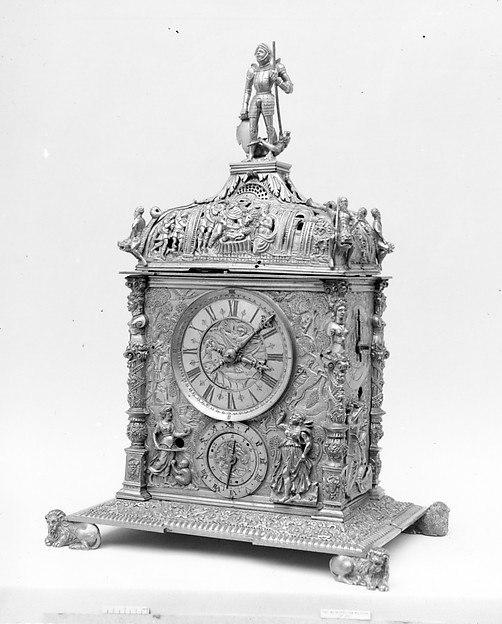
This table clock, currently held by The Metropolitan Museum of Art (accession number 17.190.640), is a composite object constructed from components originating in different eras. The museum records the case date as 16th and 19th century, while the movement is documented as 16th century with additions from the 17th and 19th centuries. The case is fashioned from gilt bronze, and the movement is constructed of iron. Overall, the clock measures 13 1/8 inches in height, 9 1/8 inches in width, and 6 3/8 inches in depth. The exterior features intricate decorative motifs including lion-shaped feet, female nudes, and a crowning figure of Saint George. The dial indicates time with a primary chapter ring and a secondary lower dial. The museum's subject classification for the piece includes specific thematic tags such as Animals, Female Nudes, Lions, and Saint George.

Table clock with Saint George figure, accession 17.190.640.
Table clock with Saint George figure, accession 17.190.640. — The Metropolitan Museum of Art, New York. Rights pending — permission not yet requested. Original source

Catalogue identity

Source
orbiscollectibles.com
Category
Clock · Table clock
Maker / attribution
Not established
Reference
Not recorded
Catalogue / lot identifier
17.190.640
Source-reported date
16th and 19th century
Source-reported place
Not established

Source-reported attribution and specifications are not independent authentication. A listing does not establish present ownership, current display, availability or permission to reproduce.

Object description

Construction and Materials

The clock is a multi-material assembly primarily featuring a case of gilt bronze. The structural integrity and base of the clock are supported by four feet cast in the form of lions. The overall dimensions of the object are recorded as 13 1/8 by 9 1/8 by 6 3/8 inches.

The internal mechanisms are predominantly made of iron. The object is a composite of components from various centuries, reflecting a complex history of assembly and potential modification over time. The primary movement components date to the 16th century, with documented modifications and additions made during the 17th and 19th centuries.

Evidence for this section
  • “Case: gilt bronze; movement: iron”
  • “Overall: 13 1/8 × 9 1/8 × 6 3/8 in. (33.3 × 23.2 × 16.2 cm)”
  • “movement: 16th century with 17th and 19th century additions”

Decorative Iconography

The exterior of the clock is heavily decorated with relief work and sculptural elements. The dome of the clock is topped with a figure of Saint George. The four corners of the case are embellished with vertical columns featuring female nude figures.

The museum categorizes the ornamental program of the clock through specific subject tags. These include references to the animal kingdom, specifically lions, as well as the human form and religious iconography.

Evidence for this section
  • “Subject tags assigned by the museum: Animals, Female Nudes, Lions, Saint George.”

Institutional Record

This object is part of the collection of The Metropolitan Museum of Art in New York, filed under the European Sculpture and Decorative Arts department. It is assigned the accession number 17.190.640.

The museum provides open-access data regarding the clock, confirming its status within their permanent collection. The physical description and dating provided are based on the museum's internal records.

Evidence for this section
  • “Clock in The Metropolitan Museum of Art, New York (accession 17.190.640), catalogued by the museum's European Sculpture and Decorative Arts department.”
  • “These details are transcribed from the museum's open-access record”

Open research questions

  • Which specific components of the movement are attributable to the 17th and 19th-century additions?
  • What is the physical connection between the 16th-century case structure and the later modifications?

Source evidence

Recorded claims and source quotations for Table Clock with Saint George Figure
FieldSource-reported valueSource quotation
Museum Object Number17.190.640“17.190.640”
Case MaterialGilt bronze“Case: gilt bronze”
Movement MaterialIron“movement: iron”
Dimensions13 1/8 × 9 1/8 × 6 3/8 in.“13 1/8 × 9 1/8 × 6 3/8 in. (33.3 × 23.2 × 16.2 cm)”
Case Dating16th and 19th century“case: 16th and 19th century”
Movement Dating16th, 17th, and 19th centuries“movement: 16th century with 17th and 19th century additions”
Subject TagsAnimals, Female Nudes, Lions, Saint George“Animals, Female Nudes, Lions, Saint George”

Visible details

  • Crowning figure depicts a knight in armor on horseback, identified as Saint George.
  • The clock sits on four lion-shaped feet at the corners of the base.
  • Dial face features a central engraving and two separate time indicators.
  • Decorative elements include relief figures on the corner pillars and dome.

Research qualifications

  • The extent of the 17th and 19th-century additions to the 16th-century movement is not detailed.
  • The exact provenance or original assembly of the components is not documented in the source.
  • The attribution of specific manufacture dates for individual decorative elements remains subject to further research.

Photograph identity and source facts were screened before import; rights clearance remains pending.

Terms in this record

Glossary explanations for terms named in this object’s record.