
Skip to content
The Encyclopedia of Horology

Clock · Table clock

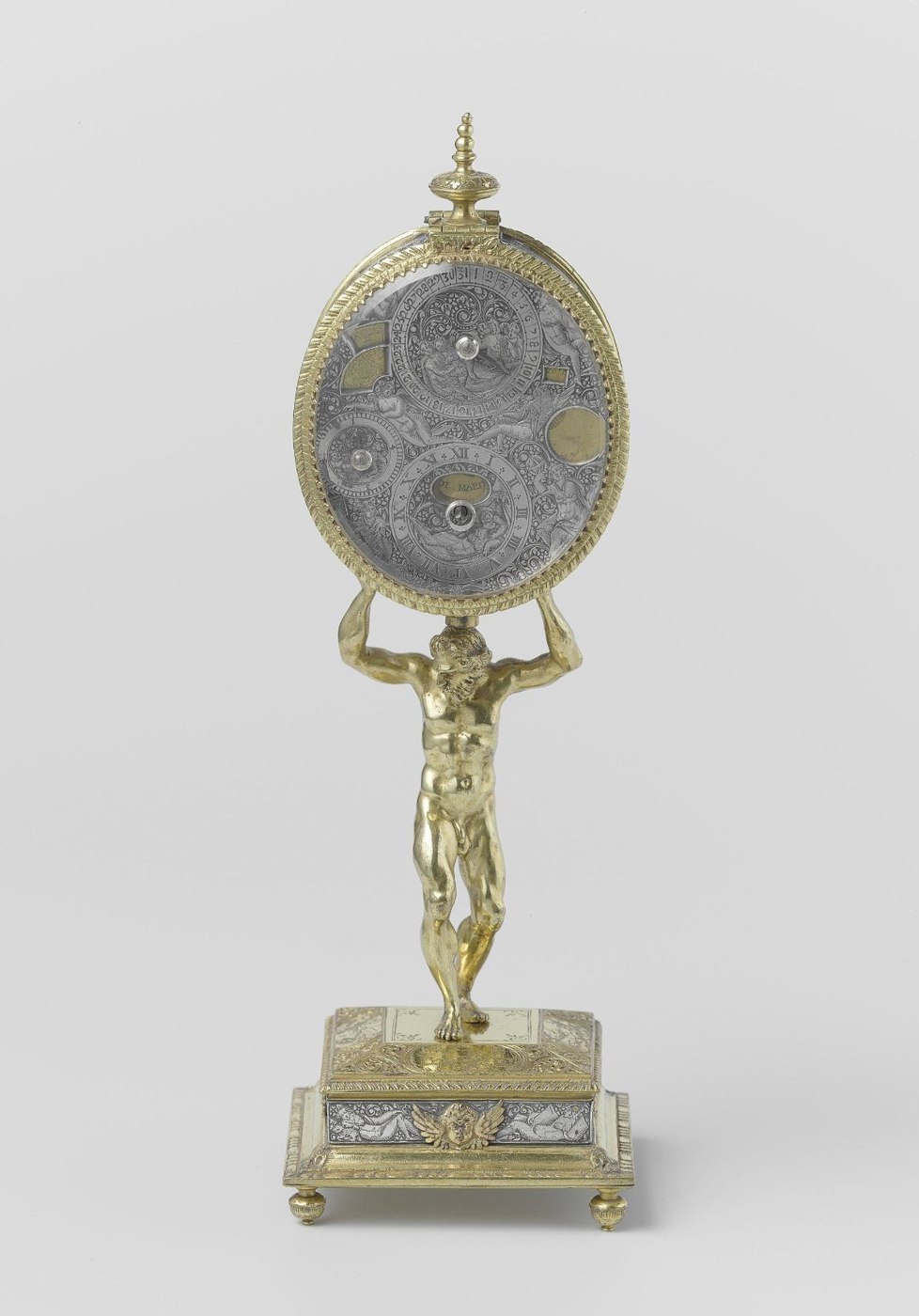
Table clock in the shape of Atlas

Partially verified

This table clock is crafted from silver, gilt bronze, and niello, featuring a figure of Atlas standing upon a square base. The base is supported by four acorn-shaped feet and decorated with engravings and a cast angel's head on both the front and rear sides. The figure of Atlas holds an oval clock case above his head with both hands. The clock case itself, as well as the dial and the glass rim, are finished with detailed engravings. The lines of the engraving are filled with niello, an alloy of silver, copper, and sulfur, which provides a deep black contrast against the metal surfaces. The movement is signed on the back plate as 'Pierre Louteau ALion', indicating an attribution to the maker Pierre Louteau of Lyon, with a date range between 1603 and 1628.

Table clock in the shape of Atlas (BK-17012)
Table clock in the shape of Atlas (BK-17012) — Rijksmuseum. Rights pending — permission not yet requested. Original source

Catalogue identity

Source
www.rijksmuseum.nl
Category
Clock · Table clock
Maker / attribution
Pierre Louteau
Reference
Not recorded
Catalogue / lot identifier
BK-17012
Source-reported date
ca. 1603 - ca. 1628
Source-reported place
France

Source-reported attribution and specifications are not independent authentication. A listing does not establish present ownership, current display, availability or permission to reproduce.

Object description

Design and Construction

The table clock is designed as a figural sculpture where Atlas serves as the support for the timekeeping mechanism. The base is a square, tiered structure raised on four feet shaped like acorns. The surface of the base features intricate engravings, accented at the front and back by the inclusion of a cast angel's head. The figure of the nude Atlas is positioned atop this base, physically supporting the oval clock case with his raised arms.

The clock case is an oval form surmounted by a finial knob. The aesthetic unity of the piece is achieved through the use of silver, gilt bronze, and black niello inlay. The niello, an alloy composed of silver, copper, and sulfur, is applied within the lines of the engravings on the dial, base, and case to provide a high-contrast decorative finish.

Evidence for this section
  • “Tafelklok van zilver en verguld brons in de vorm van Atlas.”
  • “Het vierkante voetstuk rust op vier eikelvormige poten.”
  • “Om het graveerwerk op wijzerplaat en voet beter te doen uitkomen, zijn de lijnen gevuld met niëllo”

Signatures and Attribution

The clock is attributed to the maker Pierre Louteau, who was based in Lyon. This attribution is supported by the signature found on the back plate of the internal movement, which reads 'Pierre Louteau ALion'. This is interpreted as referring to Pierre Louteau of Lyon.

The creation of this object is dated to the early seventeenth century, specifically assigned to the period between circa 1603 and 1628. The engraving work, particularly the niello-filled lines on the dial and exterior, characterizes the decorative approach of this piece.

Evidence for this section
  • “toegeschreven aan Pierre Louteau, Lyon”
  • “De achterplatine is gesigneerd: Pierre Louteau ALion.”
  • “‘Pierre Louteau ALion’ (Pierre Louteau à Lyon.)”

Provenance and History

The object has an extensive ownership history throughout the 20th century. It was part of the collection of Maximilian Benedikt Hayum Freiherr von Goldschmidt-Rothschild before passing to the collection of Dr. Fritz Mannheimer in Amsterdam and Paris in 1936.

Following the death of Mannheimer, the object was purchased from his estate by the Dienststelle Mühlmann in 1940 for the planned Führermuseum in Linz. In 1945, it was recovered as part of war recuperation efforts and handled by the SNK. The clock was subsequently placed on loan by the DRVK to the museum in 1952 before being formally transferred into the collection in 1960.

Evidence for this section
  • “collection Maximilian Benedikt Hayum Freiherr von Goldschmidt-Rothschild”
  • “collection Dr Fritz Mannheimer (1890-1939), Amsterdam and Paris, 1936”

Open research questions

  • What is the specific functionality of the engraved dials on the oval face?
  • Are there any other known clock movements signed by Pierre Louteau?

Source evidence

Recorded claims and source quotations for Table clock in the shape of Atlas
FieldSource-reported valueSource quotation
MakerPierre Louteau“toegeschreven aan Pierre Louteau”
Materialsilver, gilt bronze, niello“zilver, verguld brons en niello”
SignaturePierre Louteau ALion“‘Pierre Louteau ALion’”
Dateca. 1603 - ca. 1628“ca. 1603 - ca. 1628”
Base constructionsquare base with four acorn-shaped feet“Het vierkante voetstuk rust op vier eikelvormige poten.”
Decorationengraved dial and case with niello fill“Om het graveerwerk op wijzerplaat en voet beter te doen uitkomen, zijn de lijnen gevuld met niëllo”
Accession numberBK-17012“BK-17012”

Visible details

  • Atlas figure is depicted in a nude pose
  • Engraved dial includes niello inlay
  • Four acorn-shaped feet support the square base
  • Clock case is capped with a finial

Research qualifications

  • Maker is attributed to Pierre Louteau, not definitively confirmed
  • Provenance details between 1933 and 1945 may be incomplete

Photograph identity and source facts were screened before import; rights clearance remains pending.

Consulted source

Table clock in the shape of Atlas

Reviewed 2026-11-02 · Record c948e0b6d2

Terms in this record

Glossary explanations for terms named in this object’s record.