
Skip to content
The Encyclopedia of Horology

Clock · Table clock

Table clock by John Ellicott

Partially verified

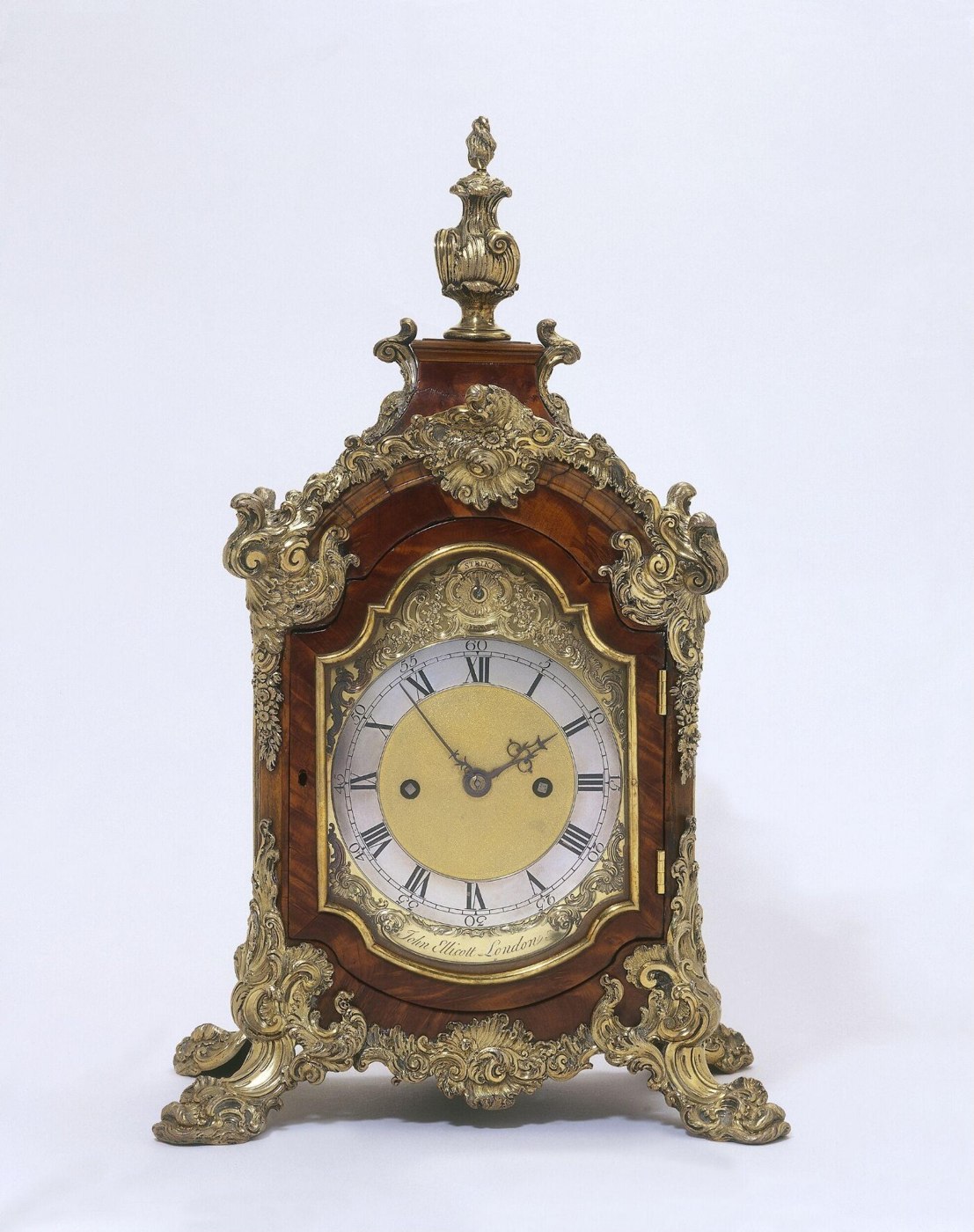
This table clock, created in London between 1740 and 1750 by John Ellicott, features a rectangular walnut case with silver-gilt mounts. The timepiece is equipped with an eight-day verge movement and a repeating mechanism that strikes the hour and the nearest quarter on six bells of varying tones when a cord at the rear is pulled. The dial is constructed with a silver chapter ring and a matted gilt center, displaying hours in Roman numerals and five-minute intervals in Arabic numerals, with blued steel hands. A subsidiary 'STRIKE' and 'SILENT' dial is positioned at the top of the silver-gilt dial plate. While the original maker remains documented, the escapement, crown-wheel, and pallet have been replaced. The clock is signed by John Ellicott on the dial and the rear movement plate, where the serial number 36803 is also scratched.

Table clock with walnut case and silver-gilt mounts by John Ellicott, London, circa 1740-1750.
Table clock with walnut case and silver-gilt mounts by John Ellicott, London, circa 1740-1750. — Victoria and Albert Museum, London. Rights pending — permission not yet requested. Original source

Catalogue identity

Source
collections.vam.ac.uk
Category
Clock · Table clock
Maker / attribution
John Ellicott
Reference
Not recorded
Catalogue / lot identifier
M.22-1970
Source-reported date
1740-1750
Source-reported place
London
Source-reported serial
36803

Source-reported attribution and specifications are not independent authentication. A listing does not establish present ownership, current display, availability or permission to reproduce.

Object description

Case and Dial Design

The clock is housed in a rectangular walnut case designed with an arched top that serves as a plinth for the flaming urn finial. Each side of the case incorporates glazed panels. The exterior is decorated with silver-gilt mounts featuring rocailles, flowers, and foliage, which are cast and chased.

The dial is a broken-arch design in silver-gilt. It features a silver chapter ring with Roman hour numerals and Arabic five-minute indicators. Below the chapter ring, a cartouche is engraved with the maker's signature, and the upper section contains a subsidiary 'STRIKE' and 'SILENT' dial with a blued steel indicator.

Evidence for this section
  • “Rectangular case with arched top drawn up to form a plinth for the finial”
  • “Broken-arch silver-gilt dial with silver chapter ring framing a matted gilt centre”
  • “Elaborate silver-gilt mounts cast and chased with rocailles and secured by iron screws and pins”

Movement and Repeating Mechanism

The movement is constructed between two brass plates and features plain pillars. It is an eight-day verge movement, although the escapement, crown-wheel, and pallet are recorded as modern replacements. The rear plate is engraved with foliated scrollwork and signed by John Ellicott.

The clock includes a repeating mechanism operated by a cord located at the back of the case. When activated, the mechanism strikes the last hour on a single bell, followed by the nearest quarter, indicated by strikes on six bells of different tones. A brass bob pendulum is used with the movement, which can be secured to a locking hook on the rear plate.

Evidence for this section
  • “verge eight-day movement with four quarter repeating mechanism operated by a cord at the back”
  • “The escapement, crown-wheel and pallet are modern replacements”
  • “When this is pulled, the clock strikes the last hour on the bell and the nearest quarter past it on six bells of different tones.”

Provenance and Attribution

The piece features a serial number, '36803', which is scratched onto the rear plate of the movement. Documentation regarding the object's history notes that it was acquired from dealer Ronald Lee, having previously been owned by Lord Kenyon and the antique clock dealer Percy Webster.

There is an unconfirmed historical association linking this clock to Catherine the Great of Russia. Additionally, the high quality of the silver-gilt mounts has led to suggestions that they may have been executed after designs by G.M. Moser.

Evidence for this section
  • “According to an unconfirmed tradition, the clock originally belonged to Catherine the Great of Russia”
  • “It has been suggested that the very fine silver-gilt mounts may be after designs by G.M. Moser (1706-83)”
  • “The rear plate is engraved with foliated scrollwork and signed John Ellicott London scratched below the signature, apparently with a pin, is the number '36803'.”

Open research questions

  • Are there records confirming the origin of the serial number 36803 in relation to Ellicott's production logs?
  • Can the provenance of the piece be traced beyond Percy Webster to support or refute the association with Catherine the Great?

Source evidence

Recorded claims and source quotations for Table clock by John Ellicott
FieldSource-reported valueSource quotation
MakerJohn Ellicott“Maker: Ellicott, John (maker)”
Date1740-1750“Date: 1740-1750”
Serial number36803“the number '36803'”
Dimensions44.4 cm height, 19.5 cm width“Height: 44.4 cm; Width: 19.5 cm”
MovementEight-day verge movement“verge eight-day movement”
ProvenancePercy Webster“This clock came originally from the well-known dealer and horologist Percy Webster”

Visible details

  • Silver-gilt rocailles mounts are applied to the walnut case exterior
  • Front and back feature hinged, shaped glazed doors
  • Silver chapter ring frames a matted gilt dial center
  • Repeating cord mechanism exits through the lower right-rear of the case

Research qualifications

  • The provenance linking the clock to Catherine the Great remains an unconfirmed tradition
  • The escapement components are confirmed as modern replacements

Photograph identity and source facts were screened before import; rights clearance remains pending.

Consulted source

Clock

Reviewed 2026-10-26 · Record ddba3ef2bd

Terms in this record

Glossary explanations for terms named in this object’s record.