
Skip to content
The Encyclopedia of Horology

Tool · Sundial

Solar Chronometer - Pilkington-Gibbs, Gibb's Heliochronometer

Partially verified

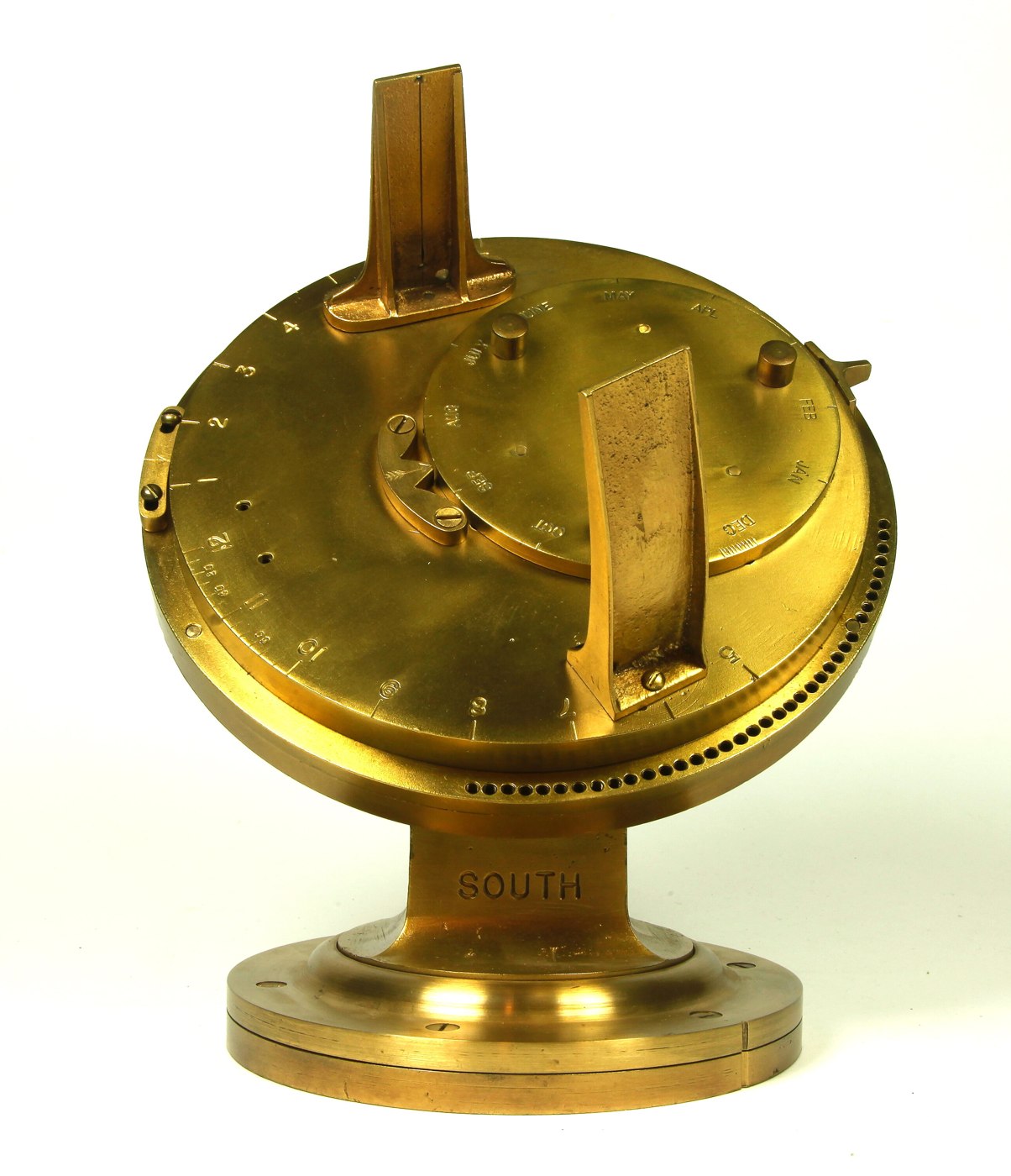
This solar chronometer, known as a Heliochronometer or universal sundial, was manufactured by Pilkington-Gibbs of Preston, Lancashire, circa 1910. The instrument was invented by George James Gibbs and patented in 1907. It consists of a brass assembly featuring two sighting arms and adjustable discs designed to calculate time to a fraction of a minute. The device required individual factory adjustment based on the purchaser's specific latitude and longitude. The instrument functions by aligning the upper disc until sunlight passes through holes in the upper arm to fall on a line on the lower arm, with time indicated by an arrow at the side. The base is marked with cardinal directions. Distribution was handled by O. Nelson of London. Production of these instruments ceased in 1914 with the outbreak of World War I.

Front view of the Pilkington-Gibbs Heliochronometer showing the sighting arms, monthly adjustment disc, and the cardinal orientation markings on the base.
Front view of the Pilkington-Gibbs Heliochronometer showing the sighting arms, monthly adjustment disc, and the cardinal orientation markings on the base. — Museums Victoria. Rights pending — permission not yet requested. Original source

Catalogue identity

Source
collections.museumsvictoria.com.au
Category
Tool · Sundial
Maker / attribution
Pilkington-Gibbs
Reference
Not recorded
Catalogue / lot identifier
ST 26054
Source-reported date
circa 1910
Source-reported place
England

Source-reported attribution and specifications are not independent authentication. A listing does not establish present ownership, current display, availability or permission to reproduce.

Object description

Construction and Design

The Heliochronometer is a brass instrument designed for precise solar timekeeping. Its configuration includes a rotating circular base marked with cardinal directions to facilitate orientation. The upper assembly features two sighting arms that interact with a central disc marked with the months, allowing the operator to adjust the device for the current solar position.

A quadrant mechanism passes through the base, enabling the user to tilt the discs to match the specific latitude of their location. The time is determined by rotating the upper disc until direct sunlight passes through two holes in the upper arm, landing on a line on the lower arm. A side-mounted arrow then provides the reading.

Evidence for this section
  • “Brass instrument rotates on circular base, marked north east south west.”
  • “Angle of discs is adjusted to suit latitude by quadrant that passes through base.”
  • “Upper disc is rotated until sunlight through holes in upper arm falls on line on lower arm. Time is shown by arrow at side.”

Manufacturing and Market

This device was developed and patented by George James Gibbs in 1907. Manufacturing was conducted by Pilkington-Gibbs in Preston, Lancashire, while distribution was managed by O. Nelson in London. Each individual unit was calibrated at the factory to correspond with the exact latitude and longitude provided by the purchaser.

Production of the Heliochronometer came to an end in 1914, following the onset of World War I.

Evidence for this section
  • “Each heliochronometer was adjusted at the factory to the purchaser's latitude and longittude.”
  • “The instrument was promoted as being sold to 'His Majesty the King, Royal Naval College, the Meteorological Office, and the Best Families in the United Kingdom, India, Colonies, etc.'”
  • “Production ceased with the advent of World War I in 1914.”

Provenance and Registration

The object is held under the registration number ST 26054 within the Science & Measurement collection. It was acquired by the museum via a donation from the Swan Hill Pioneer Settlement in March 1967.

The documentation provided by the institution confirms the object's classification as a sundial and specifies its horological category. The association with the inventor George J. Gibbs is noted as beginning circa 1906, with production dating to circa 1910.

Evidence for this section
  • “Registration number: ST 26054”
  • “Acquisition: Donation from Swan Hill Pioneer Settlement, Mar 1967”
  • “Association: type: Inventor, name: Mr George J. Gibbs, date: circa 1906”

Open research questions

  • What is the specific serial number of this unit if one is stamped on the base?
  • Are there any records confirming the original purchaser of this specific registration number?

Source evidence

Recorded claims and source quotations for Solar Chronometer - Pilkington-Gibbs, Gibb's Heliochronometer
FieldSource-reported valueSource quotation
MakerPilkington-Gibbs“made by Pilkington-Gibbs”
InventorGeorge James Gibbs“Invented by George James Gibbs”
Patent date1907“patented in 1907”
DistributorO. Nelson“distributed by O. Nelson”
Production cessation1914“Production ceased with the advent of World War I in 1914”
Dimensions30 cm height, 22 cm diameter“30 cm (Height), 22 cm (Outside Diameter)”
Registration numberST 26054“Registration number: ST 26054”

Visible details

  • The brass base is marked with the cardinal directions 'NORTH', 'SOUTH', and 'EAST'.
  • An adjustable quadrant allows for the angle of the discs to be set according to the user's latitude.
  • The upper disc contains markings for the months of the year for solar adjustment.
  • Two sighting arms are mounted on the main disc assembly.

Research qualifications

  • The exact provenance or original owner of this specific specimen is not identified in the source.
  • It is uncertain if all original components or accessories, such as a separate tripod or specialized mounting base, are present with this specific registration.

Photograph identity and source facts were screened before import; rights clearance remains pending.

Consulted source

Solar Chronometer - Pilkington-Gibbs, Gibb's Heliochronometer, circa 1910

Reviewed 2026-10-26 · Record ce8644c4c9

Terms in this record

Glossary explanations for terms named in this object’s record.