
Skip to content
The Encyclopedia of Horology

Tool · Sundial

Beringer and Seyfried Polyhedral Sundial

Partially verified

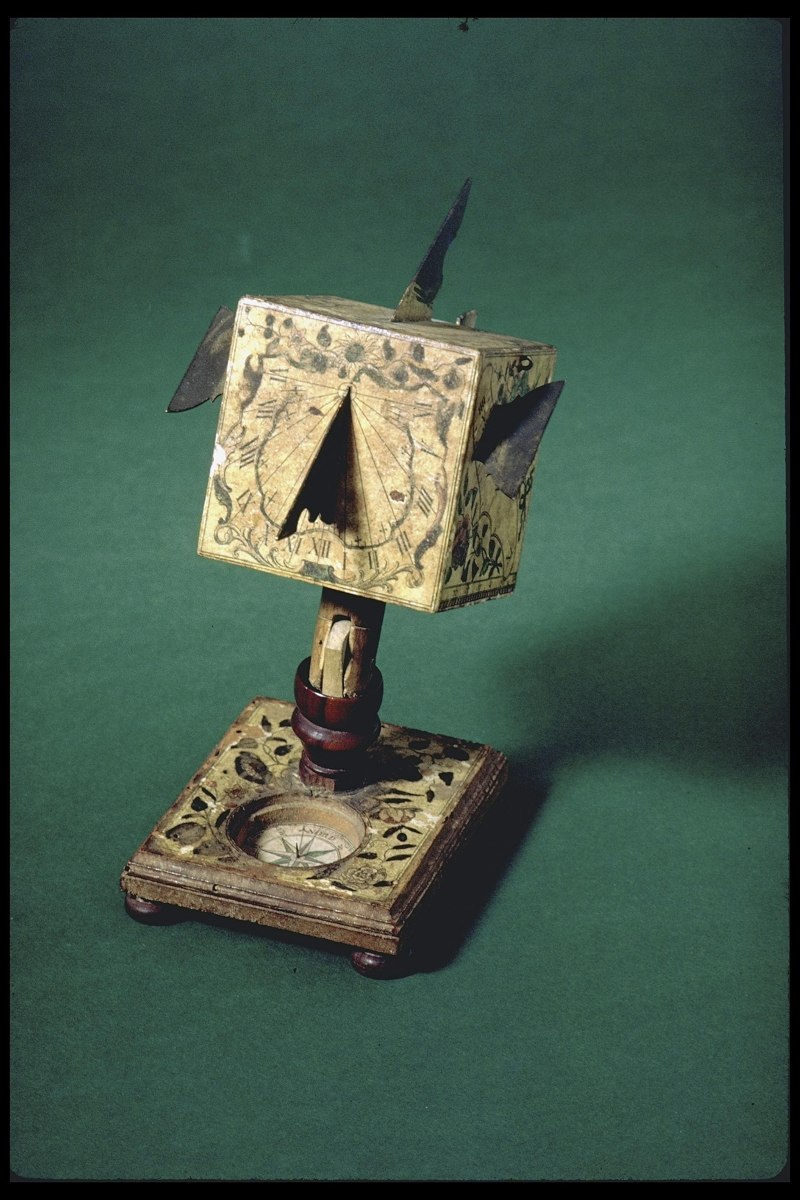
The National Museum of American History preserves this wooden polyhedral cube dial, attributed by the source to David Beringer and Georg Paulus Seyfried in Nuremberg, Germany, dating to the 1730s. The cubic dial head is mounted on a hinged wooden pillar adjustable for latitude above a decorated square base. Paper sheets bearing dial scales and decorative floral borders are pasted to five of the six faces, configured as horizontal, vertical south, vertical north, east, and west dials with projecting gnomons. The square wooden base features a circular well intended for a compass.

Three-quarter perspective view of the Beringer and Seyfried polyhedral cube sundial mounted on a hinged pillar and square base
Three-quarter perspective view of the Beringer and Seyfried polyhedral cube sundial mounted on a hinged pillar and square base — National Museum of American History. Rights pending — permission not yet requested. Original source

Catalogue identity

Source
www.si.edu
Category
Tool · Sundial
Maker / attribution
David Beringer and Georg Paulus Seyfried
Reference
MA.330844
Catalogue / lot identifier
Source URL identifies the listing
Source-reported date
1730s
Country
Germany

Source-reported attribution and specifications are not independent authentication. A listing does not establish present ownership, current display, availability or permission to reproduce.

Object description

Physical Configuration

The instrument features a wooden cubic dial head mounted on a hinged pillar, which allows for adjustment relative to latitude. The cube is supported by a square wooden base, which contains an inset well originally designed for a compass.

The compass needle and glass cover are currently missing from the base. Triangular gnomons extend from the faces of the cube.

Evidence for this section
  • “The cube is on a hinged pillar that can be adjusted for latitude.”
  • “This cube dial has a wooden base with a space for a compass needle inset in it. The needle and glass are missing.”

Dial Faces and Scales

Sundial scales are presented on paper sheets applied to five of the six faces of the cube. The arrangement includes a horizontal dial on the top, a vertical south dial, a vertical north dial, an east dial, and a west dial.

The east dial includes a latitude scale along the bottom edge, ranging from 80 degrees to 10 degrees at 10-degree intervals. A hook is present on the east dial side, though the associated leveling bob is missing.

Evidence for this section
  • “There are sundial scales on pieces of paper attached to five of the six sides of the cube.”
  • “This side also has a hook for a leveling bob (no leveling bob) and a scale of latitudes along the bottom edge that runs from 80 degrees to 10 degrees, marked at 10 degree intervals.”

Attribution and Identification

The sundial is attributed to David Beringer and Georg Paulus Seyfried and is dated to the 1730s. The object was manufactured in Nuremberg, Bavaria, Germany.

The instrument is identified in the National Museum of American History collection under catalog number MA.330844.

Evidence for this section
  • “maker Beringer, David Seyfried, Georg Paulus”
  • “date made 1730s”
  • “place made Germany: Bavaria, Nuremberg”
  • “catalog number 330844”

Open research questions

  • What is the physical composition of the 'compass rose card' mentioned in observations, given the source only explicitly confirms a space for a needle?
  • Does the source confirm the existence of floral borders on the paper scales, or is this an unsupported observation?

Source evidence

Recorded claims and source quotations for Beringer and Seyfried Polyhedral Sundial
FieldSource-reported valueSource quotation
MakersDavid Beringer and Georg Paulus Seyfried“maker Beringer, David Seyfried, Georg Paulus”
Date Made1730s“date made 1730s”
Place MadeGermany: Bavaria, Nuremberg“place made Germany: Bavaria, Nuremberg”
Catalog Number330844“catalog number 330844”
Measurements17.5 cm x 10 cm x 12 cm“Measurements overall: 17.5 cm x 10 cm x 12 cm; 6 7/8 in x 3 15/16 in x 4 23/32 in”
Measurements17.5 cm x 10 cm x 12 cm“Measurements overall: 17.5 cm x 10 cm x 12 cm”

Visible details

  • Cubic wooden head mounted atop a turned wooden pillar with an articulated joint
  • Paper dial faces printed with Roman numeral chapter rings and foliate borders applied to the cube faces
  • Square base decorated with paper motifs and resting on small ball feet
  • Circular inset well in the base containing a compass rose card
  • Dark triangular gnomons extending outward from multiple facets of the cube

Research qualifications

  • The source notes that the compass needle and glass cover are missing
  • The source notes that the leveling bob is absent despite a hook being present on the east dial side

Photograph identity and source facts were screened before import; rights clearance remains pending.

Consulted source

Polyhedral Sundial | Smithsonian Institution

Reviewed 2026-10-25 · Record c75bc2ecc7

Terms in this record

Glossary explanations for terms named in this object’s record.