
Skip to content
The Encyclopedia of Horology

Tool · Sundial

Carved stone sundial supported by angels

Partially verified

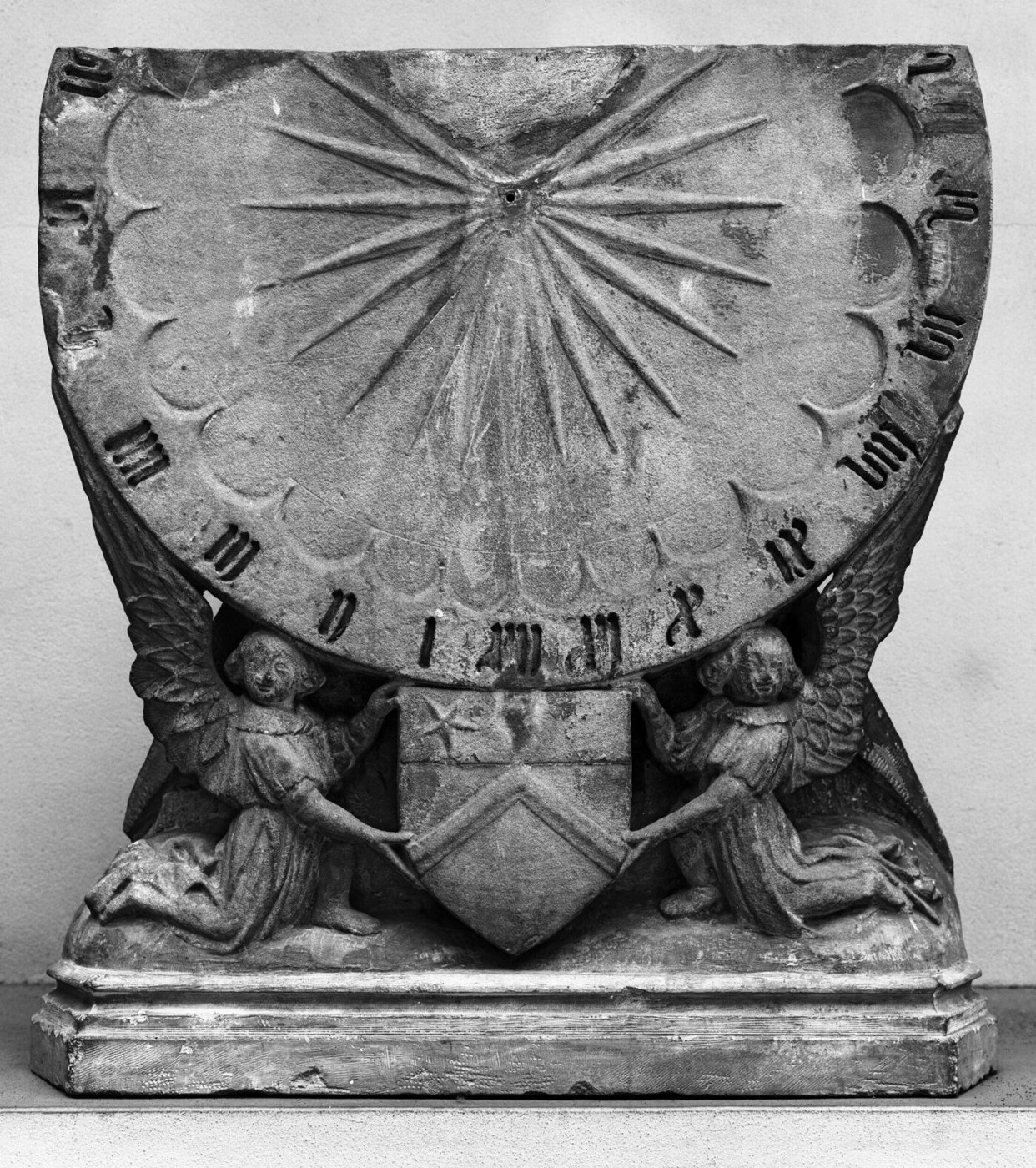
This late 15th-century sundial is a carved stone object of French origin. The dial itself consists of a stone disc with the upper section removed, featuring a scalloped border and a central star-shaped device. The original gnomon is missing. The dial is supported at the base by two kneeling angels, whose wings hold the dial aloft while they collectively support a heraldic shield between them. The shield is depicted with a chevron and a chief featuring a mullet in the dexter canton. While the current numeral arrangement on the dial perimeter spans 5 am to 7 pm, evidence suggests these markings were incised at a later date, specifically for horizontal use in London, deviating from an implied original vertical orientation. Indecipherable traces of original painted numerals remain on the surface. The object stands 76.2 cm high and measures 71.12 cm wide.

The sundial is carved from stone and supported by two kneeling angels holding a heraldic shield.
The sundial is carved from stone and supported by two kneeling angels holding a heraldic shield. — Victoria and Albert Museum, London. Rights pending — permission not yet requested. Original source

Catalogue identity

Source
collections.vam.ac.uk
Category
Tool · Sundial
Maker / attribution
Not established
Reference
Not recorded
Catalogue / lot identifier
476-1905
Source-reported date
late 15th century
Source-reported place
France

Source-reported attribution and specifications are not independent authentication. A listing does not establish present ownership, current display, availability or permission to reproduce.

Object description

Construction and Design

The sundial is constructed from carved stone and is supported by two kneeling angels. The angels are depicted kneeling on a base, with their wings extended upwards to support the dial disc. Between the two figures, they grasp a heraldic shield, which is detailed with a chevron and a chief that includes a mullet in the dexter canton.

The upper portion of the stone disc is cut away, creating an incomplete circular face. The border of the dial is finished with a scalloped edge, and the center features a star-shaped carving where the original gnomon was once positioned.

Evidence for this section
  • “Sundial supported by two angels.”
  • “The dial is in the shape of a stone disc with the upper third cut off”
  • “there is a star shaped device in the centre, and a scalloped border.”
  • “Below are two kneeling angels supporting the dial on their wings and holding between them a heraldic shield: a chevron, and a chief charged in the dexter canton with a mullet”

Numerical Markings and Alterations

The dial is inscribed with numbers along its perimeter, representing the hours from 5 am to 7 pm. Analysis suggests that these specific incisions were not original to the dial's primary creation. The configuration of these numerals indicates they were intended for horizontal use specifically within the London area.

If the dial had been used in its presumed original vertical orientation, the numbering would have followed a different layout. Beyond the incised numbers, there are faint, undecipherable traces of painted numerals, which may represent the original configuration of the timepiece before the later modifications were applied.

Evidence for this section
  • “The position of the numerals indicates that they were incised at a later date, when the dial was being used horizontally and in London”
  • “If used vertically, as presumably was originally intended, the numerals would be differently arranged.”
  • “There are traces of painted numerals (undecipherable) and these may be the original ones.”

Provenance and Documentation

The object is held in the museum collection under the accession number 476-1905. The object was provided to the collection through the contribution of J. H. Fitzhenry, Esq. The records categorize the object as having been made in northern France during the late 15th century.

The object is documented in internal museum registers which confirm the accession details and the general dating provided in the collection records.

Evidence for this section
  • “Accession number: 476-1905”
  • “Given by J. H. Fitzhenry, Esq.”
  • “Sundial, stone, northern France, late 15th century”

Open research questions

  • What is the identification of the heraldic shield depicted on the base?
  • What is the full extent of the traces of the original painted numerals remaining under scientific light analysis?

Source evidence

Recorded claims and source quotations for Carved stone sundial supported by angels
FieldSource-reported valueSource quotation
Object typeSundial“Object type: Sundial”
Datelate 15th century“Date: late 15th century”
Place of originFrance“Place of origin: France (made)”
MaterialsCarved stone“Materials and techniques: Carved stone”
DimensionsHeight: 76.2 cm; Width: 71.12 cm“Dimensions: Height: 76.2 cm; Width: 71.12 cm”
Inscription layout5 am to 7 pm“numbered round the edge from 5 am to 7 pm”

Visible details

  • Missing gnomon device
  • Two kneeling angels holding a heraldic shield
  • Star shaped device located in the center of the dial disc
  • Scalloped border along the top edge of the dial

Research qualifications

  • The exact origin of the painted numeral traces is undecipherable
  • The primary purpose of the heraldic shield remains unidentified

Photograph identity and source facts were screened before import; rights clearance remains pending.

Consulted source

Sundial

Reviewed 2026-10-26 · Record 171f59e0a9

Terms in this record

Glossary explanations for terms named in this object’s record.