
Skip to content
The Encyclopedia of Horology

Clock · Skeleton mantel clock

Skeleton Calendar Clock

Partially verified

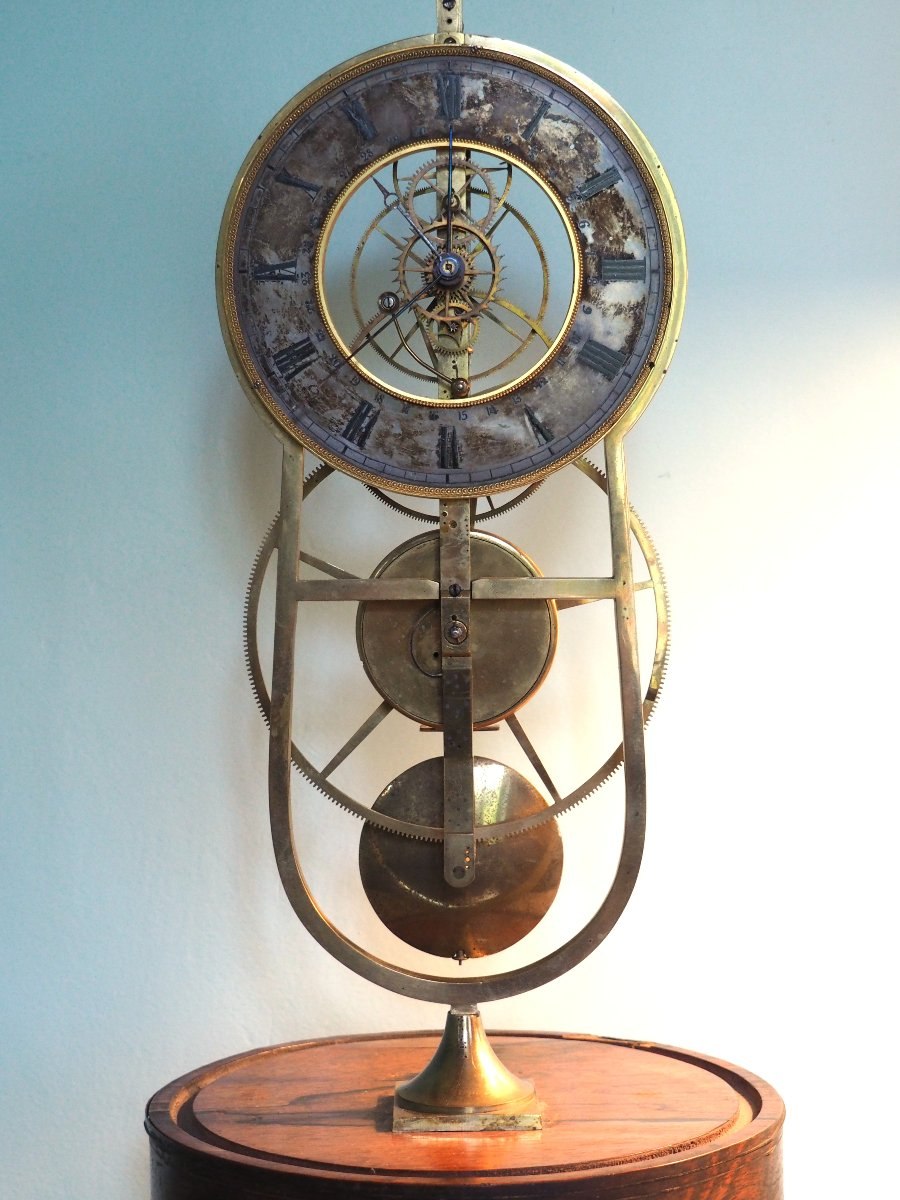
This antique skeleton clock is attributed by the seller to circa 1830, during the Louis Philippe or Charles X period in France. Supported on a circular wooden plinth veneered in rosewood and housed under a glass dome according to dealer documentation, the clock features an openwork brass framework accented with Greek friezes and beaded borders in chiseled, gilded bronze. The seller records an anonymous movement fitted with a pin escapement, heavy pendulum, and leaf suspension. A silvered bronze dial ring indicates hours and minutes with Roman numerals and calendar dates along an inner Arabic numeral track.

Front view of the French skeleton calendar clock mounted on a rosewood plinth
Front view of the French skeleton calendar clock mounted on a rosewood plinth — Laurent Antiques / Proantic. Rights pending — permission not yet requested. Original source

Catalogue identity

Source
www.proantic.com
Category
Clock · Skeleton mantel clock
Maker / attribution
Not established
Reference
Not recorded
Catalogue / lot identifier
1835701
Source-reported date
circa 1830
Country
France

Source-reported attribution and specifications are not independent authentication. A listing does not establish present ownership, current display, availability or permission to reproduce.

Object description

Framework and Mounting

The clock is configured as a skeleton mantel clock constructed from an openwork brass framework. In the listing description, it is recorded as being "decorated with Greek friezes and pearls inchiseled and gilded bronze". Visual inspection shows the framework supporting an exposed center train, mainspring barrel, and a lower pendulum bob.

The open frame assembly terminates in a flared conical brass foot secured to a circular wooden base. The listing notes this foundation is "mounted on a wooden base veneered with rosewoodand covered by a glass dome." The wooden plinth exhibits a grooved channel for a glass dome, though the dome itself is not pictured in the catalog photograph.

Evidence for this section
  • “decorated with Greek friezes and pearls inchiseled and gilded bronze”
  • “mounted on a wooden base veneered with rosewoodand covered by a glass dome.”
  • “The movement is mounted via a flared conical brass foot onto a circular wooden base with a grooved channel for a glass dome.”

Dial and Indication

Indications are displayed across a circular chapter ring described by the source as a "Silvered bronze dial indicating hours, minutes,and dates." Direct examination confirms outer Roman numerals for tracking the hours and an inner ring graduated 1 through 31 for calendar dates.

Visible observation indicates the dial surface exhibits severe oxidation, mottling, and tarnishing across the silvered bronze chapter ring.

Evidence for this section
  • “Silvered bronze dial indicating hours, minutes,and dates.”
  • “The dial features outer Roman hour numerals and an inner ring graduated 1 through 31 for calendar dates.”
  • “Circular silvered dial ring displays severe oxidation, mottling, and tarnishing across the chapter ring.”

Reported Movement and Documented Limitations

The seller reports an unsigned mechanism, catalogued as an "Anonymous movement of greatfinesse, with a pin escapement, heavy pendulum, andleaf suspension." No maker marks, signatures, or serial numbers are recorded in this source or discernible in the photograph.

The seller dates the clock to "around 1830" under categories including Louis Philippe and Charles X. The listing notes the item is in "Good condition, in need of servicing." Operational performance and mechanical completeness are unverified beyond seller statements.

Evidence for this section
  • “Anonymous movement of greatfinesse, with a pin escapement, heavy pendulum, andleaf suspension.”
  • “Skeleton clockfrom around 1830”
  • “Good condition, in need of servicing.”

Open research questions

  • Are there any maker stamps, workshop initials, or serial marks stamped on the movement plates or under the base that were unrecorded in the listing?
  • What are the dimensions and condition of the glass dome mentioned in the listing description?
  • What specific mechanical repairs or cleaning are required to address the seller's note that the movement is in need of servicing?

Source evidence

Recorded claims and source quotations for Skeleton Calendar Clock
FieldSource-reported valueSource quotation
Datecirca 1830“Skeleton clockfrom around 1830”
EscapementPin escapement“with a pin escapement”
Dial Material and FunctionsSilvered bronze indicating hours, minutes, and dates“Silvered bronze dial indicating hours, minutes,and dates.”
Base and CoveringRosewood veneered base and glass dome“mounted on a wooden base veneered with rosewoodand covered by a glass dome.”
Decorative MotifsGreek friezes and pearls in chiseled and gilded bronze“decorated with Greek friezes and pearls inchiseled and gilded bronze”
Suspension TypeLeaf suspension“andleaf suspension”

Visible details

  • Openwork brass frame supporting a visible center train, mainspring barrel, and lower pendulum bob.
  • Circular silvered dial ring displays severe oxidation, mottling, and tarnishing across the chapter ring.
  • The dial features outer Roman hour numerals and an inner ring graduated 1 through 31 for calendar dates.
  • The movement is mounted via a flared conical brass foot onto a circular wooden base with a grooved channel for a glass dome.

Research qualifications

  • Maker is anonymous and undocumented.
  • The dealer listing describes the movement as needing servicing.
  • The glass dome mentioned in the listing is not shown in the primary photograph.

Photograph identity and source facts were screened before import; rights clearance remains pending.

Consulted source

Proantic: Skeleton Calendar Clock

Reviewed 2026-10-21 · Record 05dc4c3bbb

Terms in this record

Glossary explanations for terms named in this object’s record.