
Skip to content
The Encyclopedia of Horology

Tool · Sundial

Scottish Regency Bronze Sundial

Partially verified

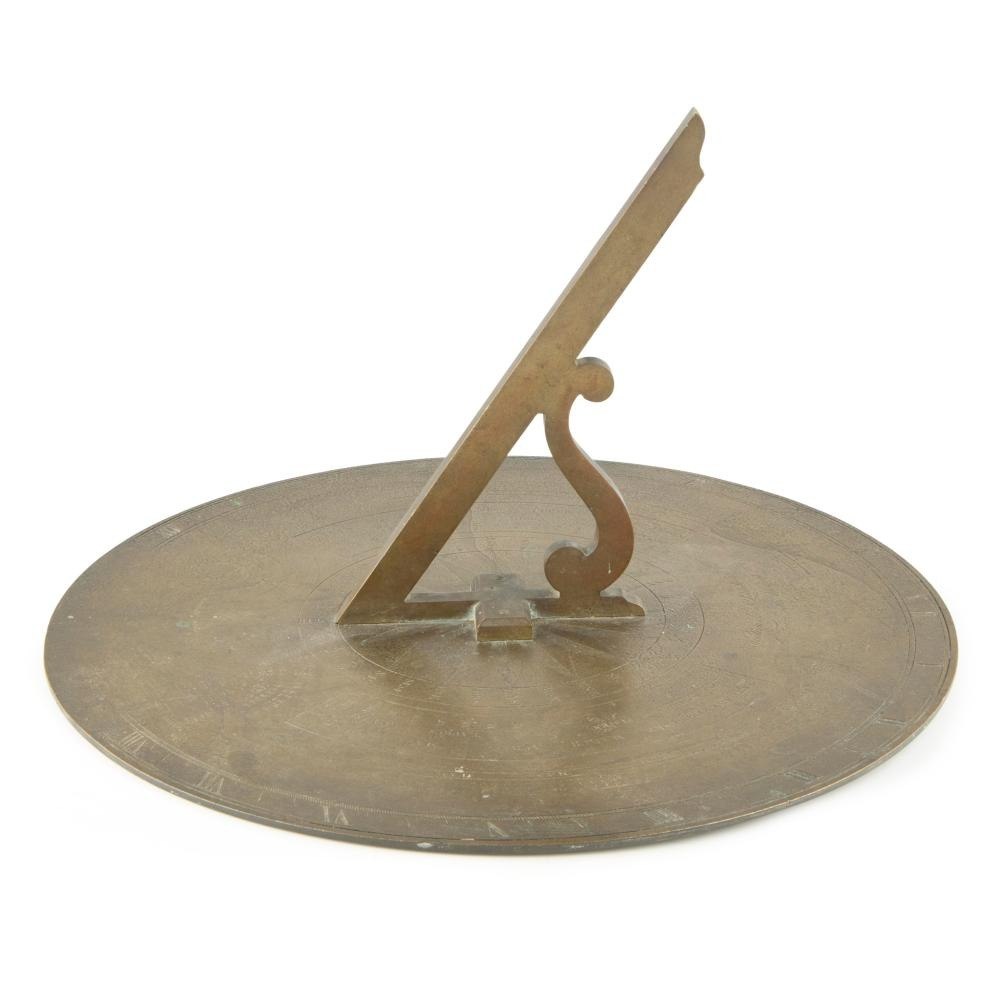
This Scottish Regency period sundial is crafted from bronze and measures 38cm in diameter with a total height of 22cm. The dial plate features a central compass rose, a calendrical equation of time, and hours indicated by Roman numerals. It includes a pierced, scrolling gnomon. The plate bears an engraving: 'Woodhouselee, N. Latitude 55.558, Alexander Fraser Tytler, delivered 1805'. While the engraving is noted as being rubbed throughout, the object is documented as having a strong resemblance to other Regency bronze sundials by the makers Adie and Miller. This instrument functions as a timekeeping device, utilizing the sun's position to mark hours and seasonal equations, representing a period-specific example of Scottish scientific metalwork intended for outdoor installation at a designated latitude.

Scottish Regency bronze sundial viewed from a three-quarter angle showing the dial plate, compass rose, and scrolling gnomon.
Scottish Regency bronze sundial viewed from a three-quarter angle showing the dial plate, compass rose, and scrolling gnomon. — Lyon & Turnbull / Invaluable. Rights pending — permission not yet requested. Original source

Catalogue identity

Source
orbiscollectibles.com
Category
Tool · Sundial
Maker / attribution
Not established
Reference
Not recorded
Catalogue / lot identifier
202227817
Source-reported date
1805
Source-reported place
Scotland

Source-reported attribution and specifications are not independent authentication. A listing does not establish present ownership, current display, availability or permission to reproduce.

Object description

Design and Configuration

The sundial consists of a 15-inch circular bronze plate mounted with a vertical, pierced, and scrolling gnomon. The dial layout includes a central compass rose and a calendrical equation of time to adjust for solar variations. Hours are marked in Roman numerals along the outer perimeter, divided by markers to facilitate readings.

The construction relies on the stability of the bronze plate, which provides the foundation for the shadow-casting gnomon. The orientation of the gnomon is specifically calibrated for the latitude of 55.558, aligning with the location of Woodhouselee in Scotland.

Evidence for this section
  • “the 15 inch sundial plate engraved with central compass rose, calendrical equation of time, hours marked with Roman numerals and divided by markers, pierced scrolling gnomon”
  • “Latitude 55.558”

Inscriptions and Provenance

The plate features a detailed engraved inscription that identifies its original context and date. It references 'Woodhouselee', the latitude, the owner, and the delivery year of 1805. This inscription links the object to Alexander Fraser Tytler, Lord Woodhouselee, who was a prominent Scottish judge, advocate, and historian based at the University of Edinburgh.

The engraving serves as both a functional indicator for the latitude setting and a historical record of the instrument's original provenance. While the engraving has become rubbed over time, it remains legible enough to provide a clear timeline for the production of the piece at the turn of the 19th century.

Evidence for this section
  • “engraved 'Woodhouselee, N. Latitude 55.558, Alexander Fraser Tytler, delivered 1805'”
  • “Alexander Fraser Tytler, Lord Woodhouselee, (Scottish 1747-1813) was a Scottish advocate, judge, writer, and historian”

Attribution and Condition

The auction description notes that while the engraving is worn, the overall construction bears a strong resemblance to other known Regency bronze sundials produced by Adie and Miller. These makers were active in Edinburgh, aligning with the geographical context of the sundial's original installation. The piece is categorized as a Scottish Regency object based on these stylistic comparisons and the provided provenance data.

The condition of the metalwork is reported to show signs of age, specifically with the engraving being rubbed throughout. Despite this, the primary structural elements, including the gnomon and the dial plate, remain intact. The attribution to a specific workshop remains a point of research, as the current identification is based on visual similarity to other catalogued specimens sold by the same house.

Evidence for this section
  • “engraving rubbed throughout”
  • “bares a strong resemblance to several examples of both Adie and Miller Regency bronze sundials sold in these rooms”

Open research questions

  • Are there archived design records for Adie or Miller that match the specific dimensions and scrolling gnomon profile of this piece?
  • Can the specific latitude of 55.558 be definitively mapped to the historical grounds of Woodhouselee to confirm the original placement?

Source evidence

Recorded claims and source quotations for Scottish Regency Bronze Sundial
FieldSource-reported valueSource quotation
MaterialBronze“BRONZE”
Diameter38cm“38cm diameter”
Height22cm“22cm high”
Inscribed LocationWoodhouselee“engraved 'Woodhouselee, N.”
Inscribed Date1805“delivered 1805'”
Inscribed Latitude55.558“Latitude 55.558”
Inscribed NameAlexander Fraser Tytler“Alexander Fraser Tytler”

Visible details

  • Pierced scrolling gnomon design
  • Engraved central compass rose
  • Visible Roman numeral hour markers
  • Visible wear and rubbing to surface engravings

Research qualifications

  • Independent confirmation of type attribution remains research required
  • Condition of the engraving is described as rubbed throughout

Photograph identity and source facts were screened before import; rights clearance remains pending.

Consulted source

SCOTTISH REGENCY BRONZE SUNDIAL

Reviewed 2026-11-02 · Record d278d84779

Terms in this record

Glossary explanations for terms named in this object’s record.