
Skip to content
The Encyclopedia of Horology

Pocket watch · Repeating watch

Repeating Watch with Sourdine and Ars Amatoria

Partially verified

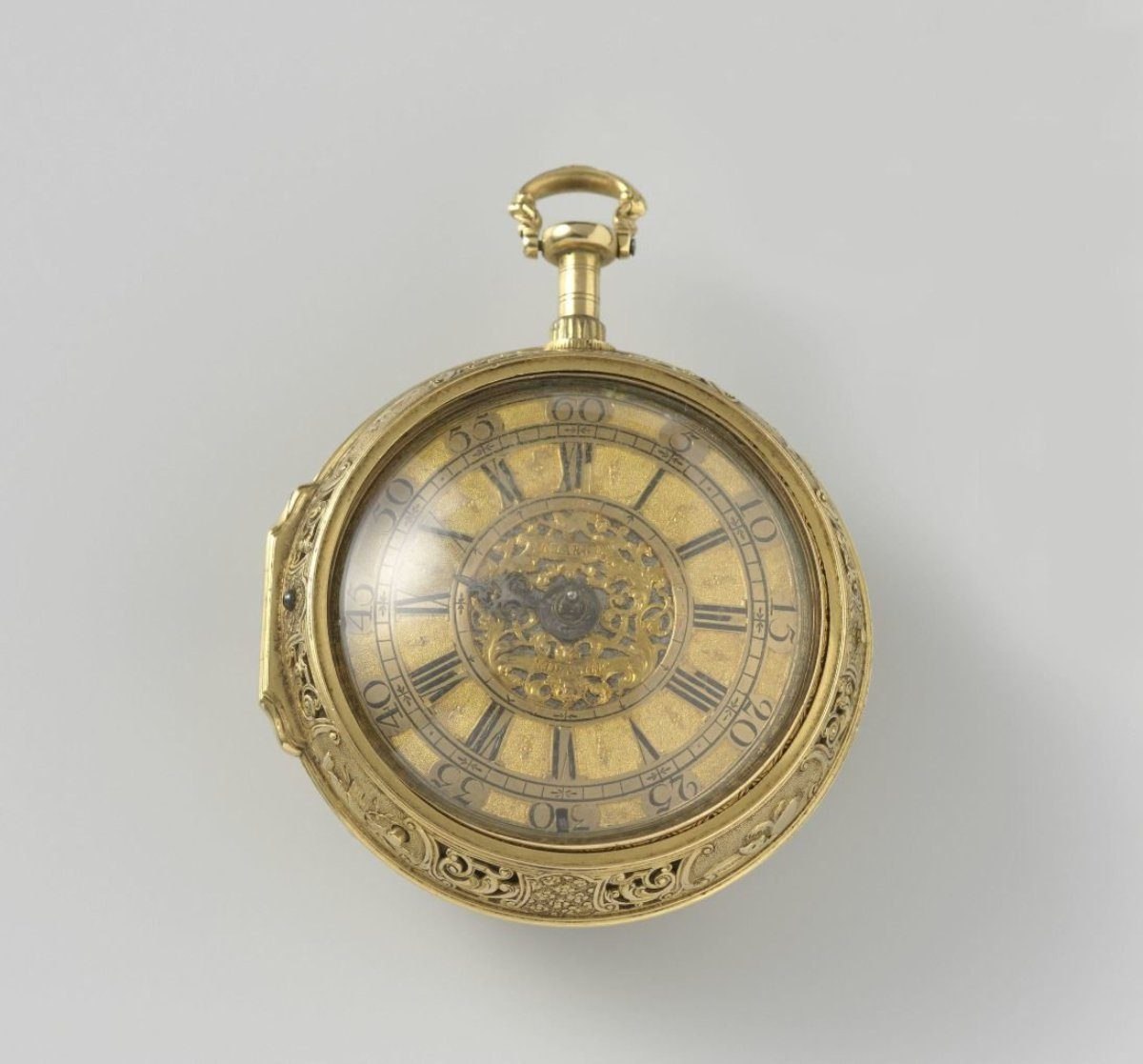
This repeating watch, designated BK-NM-7299, originates from Amsterdam and is attributed to the makers Clarke & Dunster, dating to approximately 1725. The timepiece is constructed from gold and glass and features a repeating mechanism with a 'sourdine' (mute) function. A significant feature is the opulently pierced gold outer case. The secondary case displays a chased relief scene, which documentation suggests represents 'Music'. Furthermore, the watch includes an additional relief plaque depicting a music-making group, attributed to an Amsterdam artisan of French descent. This plaque is believed to illustrate a scene from Ovid's Ars Amatoria, indicated by an inscription on an open book held by the figures. The assembly of the outer case is attributed to the Dutch casemaker Thauvet Beslay, who utilized his maker's mark 'TB' on the interior.

Front view of the repeating watch showing the pierced gold case, chapter ring, and internal decorative elements.
Front view of the repeating watch showing the pierced gold case, chapter ring, and internal decorative elements. — Rijksmuseum. Rights pending — permission not yet requested. Original source

Catalogue identity

Source
www.rijksmuseum.nl
Category
Pocket watch · Repeating watch
Maker / attribution
Clarke & Dunster
Reference
Not recorded
Catalogue / lot identifier
BK-NM-7299
Source-reported date
ca. 1725
Source-reported place
Amsterdam

Source-reported attribution and specifications are not independent authentication. A listing does not establish present ownership, current display, availability or permission to reproduce.

Object description

Case Construction and Decoration

The watch features an elaborate outer case manufactured from gold. Complementing the structure is a secondary gold case, which serves as a canvas for a relief-chased scene of a musical nature.

This element is credited to an Amsterdam-based chaser of French origin. The narrative content of this plaque is linked to Ovid's Ars Amatoria, as identified by an inscription found on an open book depicted within the scene. The watchmaker Thauvet Beslay is credited with the assembly of the pierced outer case.

Evidence for this section
  • “Gouden horloge met prachtig opengewerkte gouden kast”
  • “Op de tweede kast is gedreven een voorstelling van de Muziek.”
  • “Het plaatje met het musicerende gezelschap is vermoedelijk gemaakt door een Amsterdamse drijver van Franse herkomst.”

Signatures and Marks

The internal components of the case bear specific hallmarks and maker's marks that assist in the identification and dating of the watch. An official mark, described as a lion representing the gold grade, is present inside the case. Additionally, there is an unclear mark recorded in this same area.

A master's mark is identified as 'TB' conjoined, which is attributed to the casemaker Thauvet Beslay. The reference suggests this mark corresponds to listings found in the Voet Amsterdam archives for the period between 1718 and 1734. The movement itself carries the signature of the makers Clarke & Dunster.

Evidence for this section
  • “gehalteteken, binnenkant kast: ‘leeuw’”
  • “meesterteken, binnenkant kast: ‘TB aaneen’ (Mogelijk Voet Amsterdam p. 123, bij de tekens tussen 1718 en 1734.)”
  • “Het merk is van Clarke en Dunster.”

Mechanism and Functionality

This timepiece is identified as a repeating watch, a complex mechanism designed to chime the time on demand. A specific feature noted in the documentation is the inclusion of a 'sourdine' or mute function, which allows the user to silence the strike mechanism as required.

The watch is composed of various materials, primarily gold for the exterior and glass, with the internal movement constructed from a combination of unspecified materials consistent with watchmaking of the period. The dial displays a traditional arrangement of Roman numerals, centering an ornate, pierced golden element that obscures parts of the dial surface.

Evidence for this section
  • “Repetitiehorloge met sourdine met Ars Amatoria”

Open research questions

  • What is the specific nature of the unclear mark found inside the case?
  • Does the movement contain additional maker signatures hidden beneath the dial or bridge components?

Source evidence

Recorded claims and source quotations for Repeating Watch with Sourdine and Ars Amatoria
FieldSource-reported valueSource quotation
MakerClarke & Dunster“uurwerkmaker: Clarke & Dunster, Amsterdam”
Dateca. 1725“Datering ca. 1725”
AttributionThauvet Beslay“edelsmid: toegeschreven aan Thauvet Beslay, Amsterdam”
MaterialsGold and glass“goud, glas; uurwerk: diverse materialen”
Accession numberBK-NM-7299“Objectnummer BK-NM-7299”
MarkTB“meesterteken, binnenkant kast: ‘TB aaneen’”
SubjectArs Amatoria“Volgens de gegraveerde tekst op het opengeslagen boek is de voorstelling een scène uit Ovidius’ handleiding voor de verleider, de Ars Amatoria.”

Visible details

  • Pierced gold outer case construction
  • Golden dial with engraved Roman numeral chapter ring
  • Visible filigree central element on dial

Research qualifications

  • Maker's mark is identified as potentially corresponding to Voet Amsterdam, but this is not confirmed
  • The scene depicted is based on an interpretation of an inscription on a small book held by the figures

Photograph identity and source facts were screened before import; rights clearance remains pending.

Consulted source

Repeating Watch, c. 1725

Reviewed 2026-11-02 · Record 90ebc5e4a4

Terms in this record

Glossary explanations for terms named in this object’s record.