
Skip to content
The Encyclopedia of Horology

Pocket watch · Repeating watch

Repeating watch by George Goodman

Partially verified

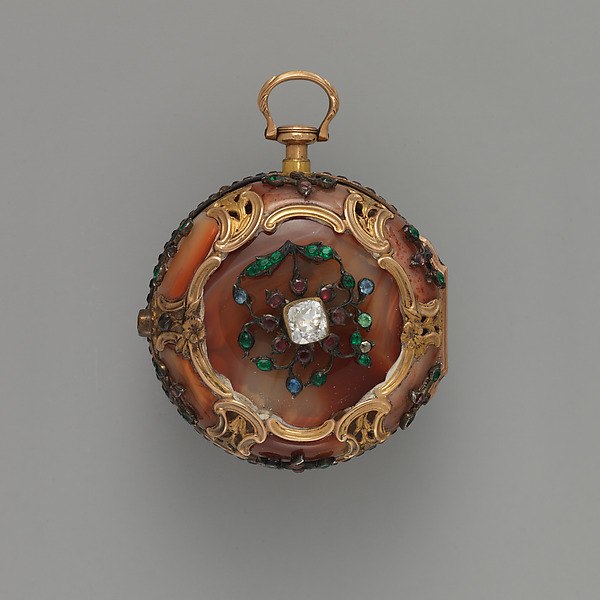
This repeating watch was made by George Goodman in London, circa 1780. Goodman was a watchmaker active between 1771 and 1785. The watch features a complex exterior construction utilizing gold as a base material, heavily decorated with red agate and an array of precious stones, including diamonds, emeralds, rubies, sapphires, topazes, and amethysts. It measures 1 3/4 inches (4.4 cm) in diameter. The Metropolitan Museum of Art holds the object under accession number 17.190.1430a, b, and it is categorized within their European Sculpture and Decorative Arts department. The watch is a repeating model, a mechanism used to sound the time on demand. The watch remains in the collection of the Metropolitan Museum of Art as a gift from J. Pierpont Morgan.

The reverse of the repeating watch showing the red agate case back with floral gemstone inlay.
The reverse of the repeating watch showing the red agate case back with floral gemstone inlay. — The Metropolitan Museum of Art, Gift of J. Pierpont Morgan, 1917. Rights pending — permission not yet requested. Original source

Catalogue identity

Source
orbiscollectibles.com
Category
Pocket watch · Repeating watch
Maker / attribution
George Goodman
Reference
Not recorded
Catalogue / lot identifier
17.190.1430a, b
Source-reported date
ca. 1780
Source-reported place
British

Source-reported attribution and specifications are not independent authentication. A listing does not establish present ownership, current display, availability or permission to reproduce.

Object description

Construction and Decoration

The watch is constructed with a gold case as its primary housing, which serves as a frame for decorative elements. The back of the case is heavily inlaid with red agate, creating a deep-toned background for the applied gemstone arrangements. This ornamentation includes a variety of precious stones including diamonds, emeralds, rubies, sapphires, topazes, and amethysts. These stones are set in patterns that emulate botanical or floral motifs against the polished agate.

Complementing the stone inlay is an ornate gold frame that secures the red agate segments to the case structure. The metalwork displays scrolled designs that transition between the outer rim of the case and the central decorative panel. The bow, located at the top of the watch, allows for suspension and provides a finished appearance to the watch case.

Evidence for this section
  • “Gold, red agate, diamonds, emeralds, rubies, sapphires, topazes, amethysts”
  • “Diameter: 1 3/4 in. (4.4 cm)”

Dial and Timekeeping

The dial of the watch is presented in white enamel, featuring standard Roman numerals for the primary hour markers. An outer track provides numerical indicators in increments of five minutes, represented by Arabic numerals. The hands are dark-toned and appear to be of a distinct, slender design suitable for the dial's layout.

The movement is a repeating type, though the specific internal mechanics of this complication are not externally visible. The repeating function is designed to audibly signal the time, a feature that was commonly integrated into watches during the late eighteenth century. The dial and hands are positioned under a glass cover within the hinged bezel of the gold case.

Evidence for this section
  • “Repeating watch”

Provenance and Documentation

This repeating watch is part of the collection at the Metropolitan Museum of Art in New York. It was received by the museum as a gift from J. Pierpont Morgan in 1917. The object is currently held within the museum's European Sculpture and Decorative Arts department.

The object is recorded as 17.190.1430a, b in the museum's documentation. The record maintains that George Goodman, a British watchmaker active from 1771 to 1785, is the maker of the watch. Information regarding the watch is categorized based on museum registration, and historical verification of the type is suggested for further study.

Evidence for this section
  • “The Metropolitan Museum of Art, Gift of J. Pierpont Morgan, 1917”
  • “Museum object number 17.190.1430a, b”
  • “Watchmaker: George Goodman (British, active 1771–85)”

Open research questions

  • What specific repeating mechanism does the movement utilize (e.g., quarter-repeater, pulse piece)?
  • Are there hallmarks present on the gold casing that confirm a London assay date for the circa 1780 period?

Source evidence

Recorded claims and source quotations for Repeating watch by George Goodman
FieldSource-reported valueSource quotation
MakerGeorge Goodman“Repeating watch made by George Goodman (British, active 1771–85)”
Dateca. 1780“dated ca. 1780”
CountryBritish“from British, London”
MaterialsGold, red agate, diamonds, emeralds, rubies, sapphires, topazes, amethysts“Gold, red agate, diamonds, emeralds, rubies, sapphires, topazes, amethysts”
Dimensions1 3/4 in. (4.4 cm)“Diameter: 1 3/4 in. (4.4 cm)”
Museum Object Number17.190.1430a, b“17.190.1430a, b”

Visible details

  • White enamel dial with Roman numerals and outer Arabic numeral minutes
  • Exterior case inset with a central faceted stone surrounded by floral-like gem arrangements
  • Gold-colored metal case featuring ornate scrolled framework
  • Bow-style suspension ring at the top of the case

Research qualifications

  • The full extent of the repeating mechanism's functionality is not specified
  • The precise nature of the gem settings and their original configuration remains unverified
  • The provenance beyond the gift from J. Pierpont Morgan is not detailed

Photograph identity and source facts were screened before import; rights clearance remains pending.

Consulted source

Repeating watch by George Goodman, British, London, ca. 1780

Reviewed 2026-11-02 · Record 796e794b70

Terms in this record

Glossary explanations for terms named in this object’s record.