
Skip to content
The Encyclopedia of Horology

Clock · Bracket clock

Regency Rosewood Quarter-Chiming Bracket Clock

Partially verified

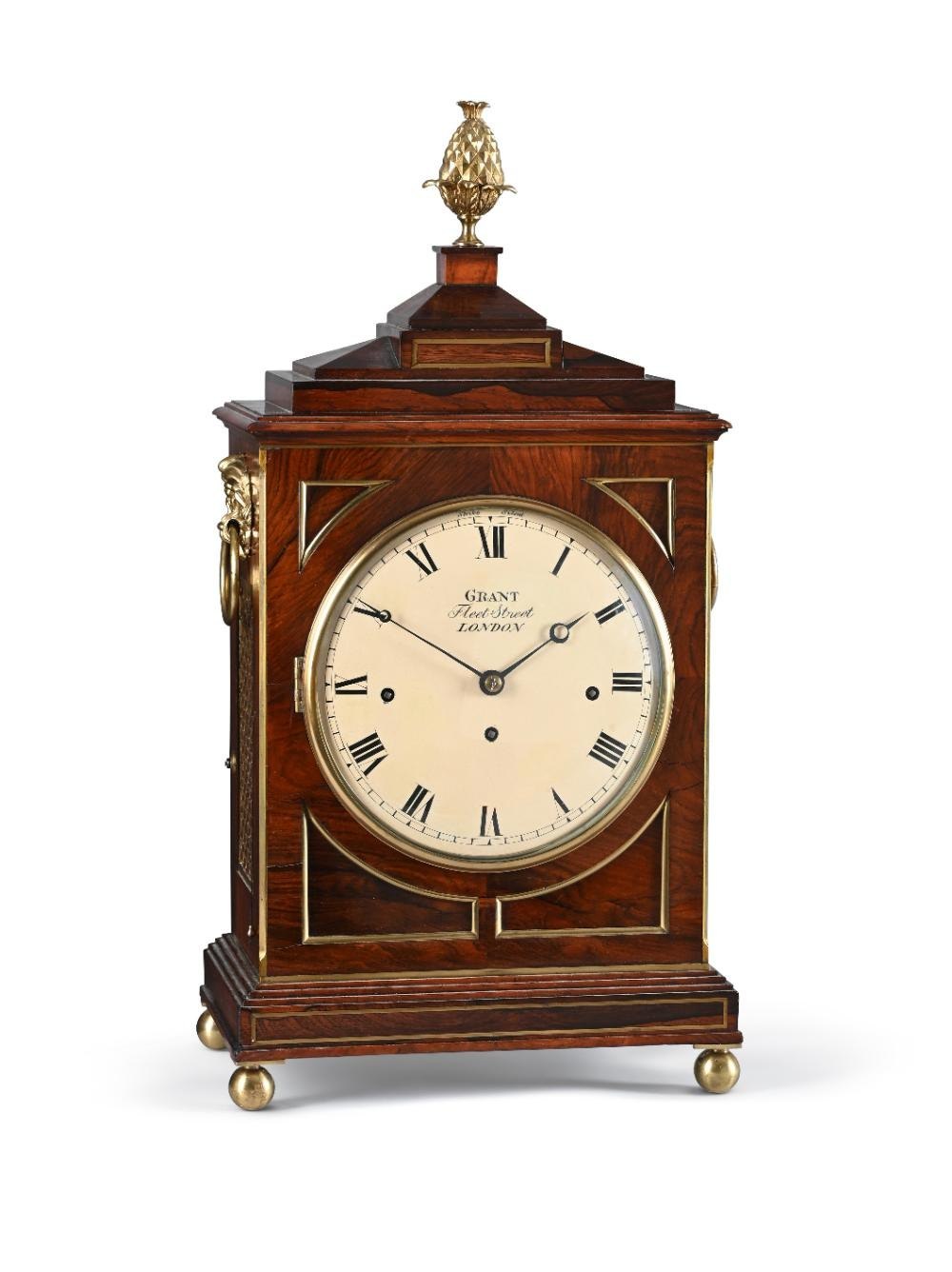
This Regency-period bracket clock, attributed to the maker John Grant, is composed of rosewood with brass embellishments. Measuring 57.5cm in height, the clock features a cream-painted, 8-inch circular convex dial with Roman numerals and blued steel moon hands. A strike/silent lever is positioned at twelve o'clock. The movement is a six-pillar triple chain fusee mechanism featuring an anchor escapement and a heavy lenticular bob pendulum supported by a wide-jaw T-bar. The clock functions as a quarter-chimer, striking the quarters on a graduated nest of eight bells, with the hour struck on a separate ninth bell. The case is detailed with a brass pineapple finial, brass-inlaid chamfered top, and fish-scale sound frets. The base stands on ball feet with stepped molding, while the backplate is geometrically engraved and signed.

Front view of the Regency rosewood bracket clock by John Grant, showing the cream dial, brass mounts, and pineapple finial.
Front view of the Regency rosewood bracket clock by John Grant, showing the cream dial, brass mounts, and pineapple finial. — Dreweatts 1759 Fine Sales, via Invaluable. Rights pending — permission not yet requested. Original source

Catalogue identity

Source
orbiscollectibles.com
Category
Clock · Bracket clock
Maker / attribution
John Grant
Reference
Not recorded
Catalogue / lot identifier
Source URL identifies the listing
Source-reported date
c. 1825
Source-reported place
London

Source-reported attribution and specifications are not independent authentication. A listing does not establish present ownership, current display, availability or permission to reproduce.

Object description

Case Construction and Exterior

The exterior of this bracket clock is constructed from rosewood, integrated with extensive brass decorative elements. The top of the case features a brass pineapple finial set above a chamfered crown. The dial area is framed by recessed brass fillet-edged quadrant panels, and the front corners include brass panel-fronted upstands.

The sides of the clock are fitted with brass fish-scale sound frets to facilitate the transmission of the chiming sequence, accompanied by foliate ring handles. The clock rests upon a skirted base with stepped molding, supported by ball feet. A glazed door is present at the rear for access to the internal mechanism.

Evidence for this section
  • “constructed from rosewood and features extensive brass mounts”
  • “brass pineapple finial, a chamfered top, brass panel-fronted upstands”
  • “sides are adorned with foliate ring handles and brass fish-scale sound frets”

Dial and Timekeeping

The time is indicated on an 8-inch cream-painted circular convex dial, which features black Roman numerals. The clock utilizes blued steel moon hands. A strike/silent lever is positioned at the twelve o'clock mark, allowing the user to manage the chiming function of the clock.

The movement is a six-pillar triple chain fusee system regulated by an anchor escapement. The pendulum is a heavy lenticular bob type, utilizing a wide-jaw T-bar suspension. The audible output consists of a quarter-chiming sequence played on a nest of eight bells, with the hour struck on a ninth, larger bell.

Evidence for this section
  • “cream-painted 8-inch circular dial is convex, featuring Roman numerals, blued steel moon hands”
  • “substantial six-pillar triple chain fusee movement with an anchor escapement”
  • “quarter-chiming timepiece, sounding the quarters on a graduated nest of eight bells and the hour on a larger ninth bell”

Signature and Backplate

The clock is identified by its signature, which is located on both the dial and the backplate of the movement. The signature is rendered as "GRANT, Fleet Street, LONDON."

The backplate itself is finished with geometric engraving, identifying the maker alongside the signature. These inscriptions serve as the primary documented evidence for the clock's maker and historical association with the Fleet Street location.

Evidence for this section
  • “The backplate is geometrically engraved and signed "GRANT, Fleet Street, LONDON," a signature also found on the dial.”

Open research questions

  • Does archival evidence verify the movement serial number or specific production records for this Grant clock?
  • Are there recorded modifications to the brass finial or suspension system over the clock's history?

Source evidence

Recorded claims and source quotations for Regency Rosewood Quarter-Chiming Bracket Clock
FieldSource-reported valueSource quotation
MakerJohn Grant“John Grant, London”
Datec. 1825“c. 1825”
Movement typeSix-pillar triple chain fusee“substantial six-pillar triple chain fusee movement”
EscapementAnchor“anchor escapement”
Chiming mechanismQuarter-chiming on nine bells“quarter-chiming timepiece, sounding the quarters on a graduated nest of eight bells and the hour on a larger ninth bell”
Case materialsRosewood and brass“constructed from rosewood and features extensive brass mounts”

Visible details

  • Brass pineapple finial atop a chamfered lid
  • Blued steel moon hands on a convex dial
  • Foliate ring side handles
  • Brass fish-scale sound frets on side panels

Research qualifications

  • The exact provenance of this specific clock is not provided in the source text
  • The use of the term 'Regency' implies a period date rather than a specific chronological certification

Photograph identity and source facts were screened before import; rights clearance remains pending.

Consulted source

Regency Rosewood Quarter-Chiming Bracket Clock, John Grant, London, c. 1825

Reviewed 2026-11-02 · Record 03cd482641

Terms in this record

Glossary explanations for terms named in this object’s record.