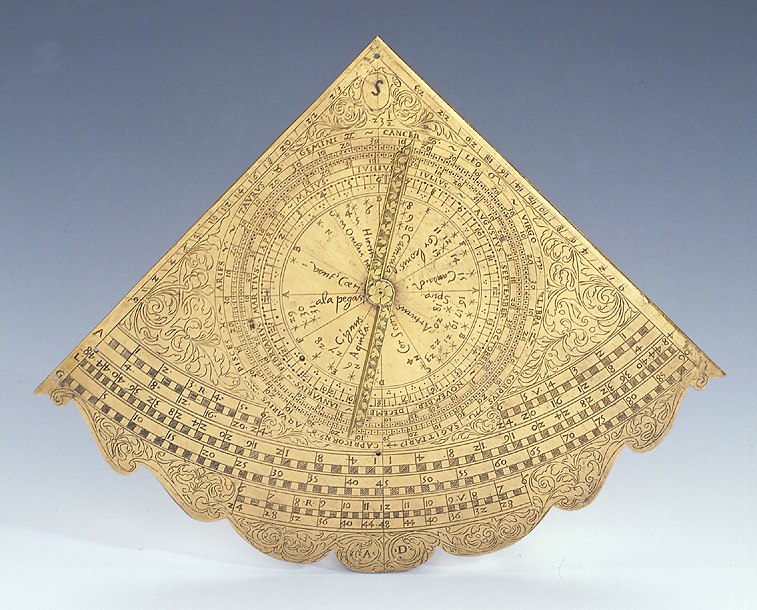
Construction and Inscriptions
The quadrant is fabricated from brass and measures 172 mm along its side. The circular arc is marked by elaborate foliate tracery and arabesque patterns. The upper portion of the instrument contains an inscription reading 'SYDERA VOLVV{N}TVR, FUGIVNT, HORA?, FVGIT VNA, VITA VELOX PERNIX SEQVITVR MORS, OMNIA STERNENS. + T + R +', which concerns the passage of time and the arrival of death.
The upper edge features a riveted brass strip engraved with the latitudes of several British cities: London, Bristol, York, Berwick, and Edinburgh. The instrument also contains a list of 31 stars, some listed within a projection and others outside it.
Evidence for this section
- “Brass; 172 mm along side”
- “The circular arc is highly ornamental and decorated with curls and arabesque patterning”
- “The upper of these carries the inscription 'SYDERA VOLVV{N}TVR, FUGIVNT, HORA?, FVGIT VNA, VITA VELOX PERNIX SEQVITVR MORS, OMNIA STERNENS. + T + R +'”
- “Engraved on this strip are the latitudes of 'Londinv{m} 52', 'Bristo [Bristowe ?] 53', 'Eboracv{m} [York] 55', 'Barwick 57', 'Edinbvrg 58'.”
Scales and Functions
The front and reverse faces are densely populated with scales for varied timekeeping and astronomical calculations. The front contains lines for unequal, Italian, and 'hor? nostrates' hours, as well as a star list. A rectangular protractor scale is positioned around the projection, with a central hole intended for a thread cursor or brachiolus.
The reverse side features a zodiacal calendar with Aries at 10 March, a 24-hour scale, and three main scales for Altimetria, Longometria, and Graduum, indicated by the letters 'A', 'L', and 'G'. The scales are visually differentiated by varied hatching techniques.
Evidence for this section
- “The front of the quadrant bears a circle with three graduations for the zodiacal calendar”
- “The horizontal parallel lines crossing the diagram are lines of equal altitude above the equator”
- “On the reverse the centre of the instrument is filled by a zodiacal calendar”
- “is marked in the left hand sectors of the scale 'R{ecta}' and in the right, 'V{ersa}'.”
Provenance and Attribution
The instrument is catalogued under inventory number 2522 in the collection of the Istituto e Museo di Storia della Scienza in Florence. The monogram 'A. D.' appears on the instrument, though the identity of this maker is not definitively known. Researchers have noted the similarity of the work to that of Flemish-trained engravers working in Naples.
The presence of British place-names suggests that the piece may have been commissioned as a presentation gift for a courtier accompanying Philip II of Spain to England for his marriage to Mary Tudor.
Evidence for this section
- “Inventory number: 2522”
- “At the centre of one of the flourishes is the monogram 'A. D.' , which may refer to the instrument maker, who has yet to be identified.”
- “The unexpected series of British place-names inscribed on the instrument might be explained by the hypothesis that the instrument was made to the order of, or (as its complexity might suggest), as a presentation piece to a Neapolitan or Spanish courtier expecting to follow Philip II of Spain to England”