
Skip to content
The Encyclopedia of Horology

Tool · Sundial

Ptolemaic Shadow Clock

Partially verified

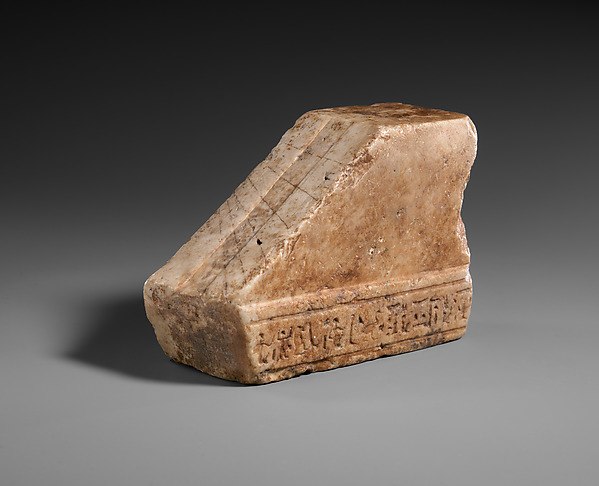
This marble shadow clock is a fragmentary instrument for tracking the time by measuring the length of a sun-cast shadow. Attributed to the Ptolemaic period in Egypt, the object was recovered from the Theban necropolis. The surviving piece consists of a narrow block featuring a sloped surface incised with a grid of parallel and oblique lines used to calculate the time of day and the seasonal progression. An inscription is present along the base of the block. The object is incomplete, with the forward portion of the base broken away; in its original state, the device would have included an integrated perpendicular block acting as a gnomon to cast the shadow. The device functioned by being set level in direct sunlight, allowing the shadow of the gnomon to traverse the marked sloping face, which tracked the hours of the day according to the season.

Marble shadow clock from the Ptolemaic period with an engraved sloping face for reading sun shadows.
Marble shadow clock from the Ptolemaic period with an engraved sloping face for reading sun shadows. — The Metropolitan Museum of Art, New York. Rights pending — permission not yet requested. Original source

Catalogue identity

Source
www.metmuseum.org
Category
Tool · Sundial
Maker / attribution
Not established
Reference
Not recorded
Catalogue / lot identifier
12.181.307
Source-reported date
305–30 BCE
Source-reported place
Egypt

Source-reported attribution and specifications are not independent authentication. A listing does not establish present ownership, current display, availability or permission to reproduce.

Object description

Structural Design and Function

The shadow clock consists of a marble block featuring a distinctively sloping face used to measure the sun's shadow. The current state is fragmentary, with the front of the base broken away. When intact, the instrument would have featured a perpendicular block placed forward of the slope to serve as a gnomon, the component responsible for casting the shadow required to read the device.

Operation required the instrument to be positioned on a perfectly level surface while facing the sun. As the sun shifted position, the shadow cast by the gnomon would land upon the engraved grid of parallel and oblique lines. These lines allowed a user to determine the hour of the day and, based on the specific parallel line utilized, account for the seasonal shift in the sun's height across a six-month cycle.

Evidence for this section
  • “a narrow block with three perpendicular sides and one sloping face engraved with parallel and oblique lines”
  • “a perpendicular block would have been set before the sloping face to serve as the gnomon”
  • “The shadow clock would have been held or placed so that it was perfectly level and faced the sun directly”

Markings and Inscriptions

The primary surface of the clock is marked with six parallel lines. These lines functioned as seasonal indicators, where each line corresponded to a two-month period of the year. The cycle began at one edge during the winter solstice, moved across the face over the course of six months, and reached the opposing edge by the summer solstice, before reversing the pattern.

The reading of the time occurred at the intersection of the seasonal line and the shadow cast on the surface. Oblique lines engraved into the face served to segment the time into individual hours. In addition to these technical markings, a single line of hieroglyphic inscription is preserved along the side of the object's base, providing a decorative and identifying element to the stone.

Evidence for this section
  • “Each of the six parallel lines on the face of our example would have corresponded with two months of the year”
  • “The user would read the hour at the intersection of the line corresponding to the relevant month and the sun’s shadow”
  • “a single line of inscription around the base.”

Discovery and Preservation

The object was discovered in the Theban necropolis by Howard Carter and Lord Carnarvon. It is currently held by the Metropolitan Museum of Art, having entered the collection in 1912 through the Rogers Fund. The item is identified as a representative example of shadow clocks dating to the Ptolemaic period.

The preservation of the item is limited, as the front of the base is partially broken. Despite the missing sections, the object remains a clear example of the portable timekeeping instruments that were used in Egypt, particularly during the Greco-Roman era when these types of shadow clocks and sundials became more commonly documented in the archaeological record.

Evidence for this section
  • “Discovered in the Theban necropolis by Howard Carter and Lord Carnarvon”
  • “this partial shadow clock, which counted the hours by measuring the length of the sun's shadow, dates to the Ptolemaic period”
  • “The front of the base, beneath the sloping face, is partially broken away”

Open research questions

  • What specific text is contained within the hieroglyphic inscription on the base?
  • How does the accuracy of this specific Ptolemaic-era clock compare to contemporaneous water clocks in the same region?

Source evidence

Recorded claims and source quotations for Ptolemaic Shadow Clock
FieldSource-reported valueSource quotation
Object nameSun Dial; sundial; shadow clock“Object name: Sun Dial; sundial; shadow clock”
Date305–30 BCE“305–30 BCE”
Place of originUpper Egypt, Thebes, Egypt“Place / culture: Upper Egypt, Thebes, Egypt”
MaterialMarble“Medium: Marble”
Dimensions9.3 x 5.2 x 14.7 cm“H. 9.3 × W. 5.2 × D. 14.7 cm”
ProvenanceTheban necropolis“Discovered in the Theban necropolis by Howard Carter and Lord Carnarvon”
Accession Number12.181.307“12.181.307”

Visible details

  • Sloping face engraved with a grid of lines
  • Single line of hieroglyphic inscription along the base
  • Partial loss of material at the front of the base
  • Visible weathered stone surface with natural veining

Research qualifications

  • The exact original appearance of the missing gnomon is inferred
  • The total number of hours the device could track remains partially dependent on reconstruction

Photograph identity and source facts were screened before import; rights clearance remains pending.

Consulted source

Shadow Clock

Reviewed 2026-10-26 · Record 3ffbd40806

Terms in this record

Glossary explanations for terms named in this object’s record.