
Skip to content
The Encyclopedia of Horology

Tool · Latin-inscribed astrolabe

Philippe Danfrie paper-covered wood astrolabe

Partially verified

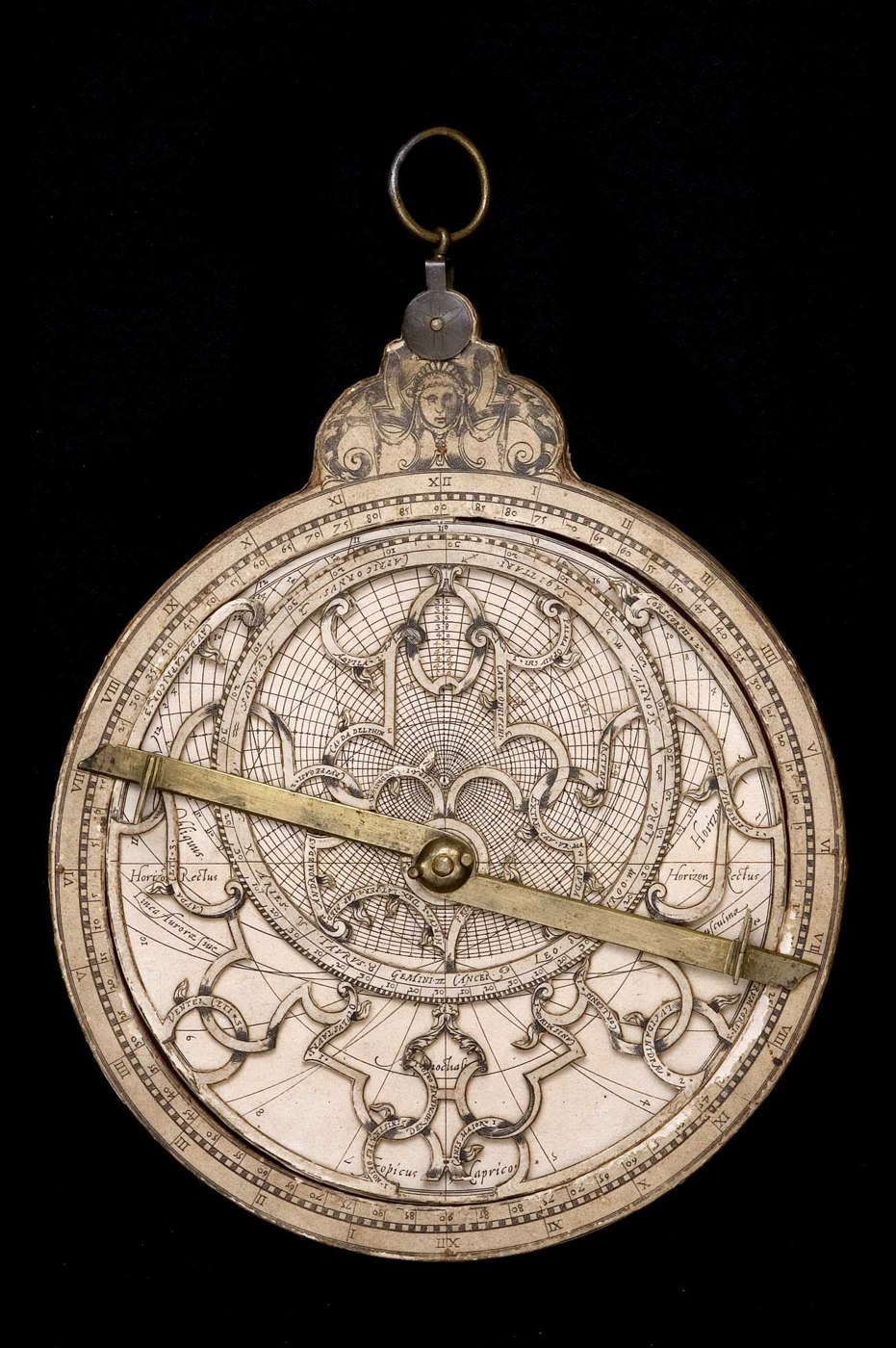
This astrolabe, dated 1584 and signed by the Parisian maker Philippe Danfrie, is constructed primarily of wood finished with applied printed paper. The instrument features a three-lobed throne and an integrated base, both decorated with printed imagery. The limb and mater are of single-piece wood construction, featuring scales for degree measurements and equal hours. The reverse side includes six distinct scales: degree, zodiacal signs, calendar, shadow square, dominical letter, and epact. The rete is crafted from pasteboard with applied paper and displays 29 star pointers. The instrument is held together by a central brass bolt with a wing-nut, supporting a double-ended rule and alidade. The astrolabe was presented to the History of Science Museum by Lewis Evans in 1924, having been acquired from the dealer Guggenheim in Venice.

Front view of the paper-covered wood astrolabe, showing the rete and rule.
Front view of the paper-covered wood astrolabe, showing the rete and rule. — History of Science Museum, University of Oxford. Rights pending — permission not yet requested. Original source

Catalogue identity

Source
www.mhs.ox.ac.uk
Category
Tool · Latin-inscribed astrolabe
Maker / attribution
Philippe Danfrie
Reference
Not recorded
Catalogue / lot identifier
34268
Source-reported date
1584
Source-reported place
France

Source-reported attribution and specifications are not independent authentication. A listing does not establish present ownership, current display, availability or permission to reproduce.

Object description

Construction and Materials

The instrument is primarily manufactured from wood, which serves as the base for applied printed paper. This material choice allowed for faster production methods using copper-plates compared to traditional metal-engraved instruments. The mater and limb are designed as a single-piece construction.

The throne utilizes a three-lobed form, also made of wood. It is adorned with printed illustrations; the front side displays a female face, while the reverse side depicts an impish face. The suspension components, including the shackle and the ring, are fashioned from brass.

Evidence for this section
  • “Wood with applied printed paper.”
  • “The throne is of the three-lobed type made of wood attached with integrated base made of wood”
  • “The front is covered in paper and decorated with printed decoration including a female face, while the rear of the throne, also covered in paper, is decorated with similar printed decoration including an impish face.”

Scales and Back Plate

The reverse of the astrolabe is covered in printed paper and hosts six circular scales. These include a degree scale (0-90 degrees), zodiacal divisions, and a calendar representing the days of the year. The central portion includes a shadow square marked in fingers.

Additionally, the back displays tables for the dominical letter and the epact for the year 1583. The maker's signature is prominently engraved on the back, providing the name Philipvs Danfrieus and his title as Siderographus Regius Generalis (Royal Astrolabist General) in Paris.

Evidence for this section
  • “The back contains 6 scales of the following types: Degree; Zodiacal signs; Calendar; Shadow square; Dominical letter; Epact.”
  • “The back is inscribed: with a maker's signature marked as Philipvs Danfrieus, Siderographus Regius Generalis Lutetiae exarabat, Anno Salutis 1584.”

Rete and Components

The rete is constructed of pasteboard covered with printed paper and features 29 stars identified with flamant pointers. The zodiacal signs are labelled around the ecliptic circle. The rete is held in place by a brass threaded bolt and wing-nut assembly.

The instrument includes an alidade and a rule, both of which are double-ended and counter-changed. These components are original to the instrument. The plates provide a range of latitudes spanning from 39 to 57 degrees.

Evidence for this section
  • “Pasteboard rete with applied printed paper.”
  • “There are 29 stars on the rete marked with flamant pointers.”
  • “The rete is attached using a nut & bolt. Brass threaded bolt with wing-nut.”
  • “Alidade Double-ended, counter-changed.”
  • “There are 3 plates with latitudes ranging from 39°0' to 57°0' .”

Open research questions

  • Are there identifiable variations in the printed paper patterns between this and other extant Danfrie astrolabes?
  • How do the specific latitude plates for this model correlate to the intended geographical markets of 1584?

Source evidence

Recorded claims and source quotations for Philippe Danfrie paper-covered wood astrolabe
FieldSource-reported valueSource quotation
MakerPhilippe Danfrie“Maker Philippe Danfrie”
Date1584“Anno Salutis 1584”
MaterialWood with applied printed paper“Wood with applied printed paper.”
Inventory Number34268“Inventory no. 34268”
Maker SignaturePhilipvs Danfrieus, Siderographus Regius Generalis Lutetiae exarabat, Anno Salutis 1584“Philipvs Danfrieus, Siderographus Regius Generalis Lutetiae exarabat, Anno Salutis 1584.”
Star Count29“The rete contains 29 stars.”
ProvenancePresented by Lewis Evans in 1924“Presented by Lewis Evans in 1924”

Visible details

  • The throne features an impish face on the reverse and a female face on the front.
  • The rete contains 29 stars marked with flamant-style pointers.
  • The brass bolt assembly includes a threaded bolt and a wing-nut.

Research qualifications

  • The source notes this type of astrolabe was probably more common than surviving numbers indicate.
  • The specific modern identity of some stars on the rete remains subject to technical identification.

Photograph identity and source facts were screened before import; rights clearance remains pending.

Consulted source

Astrolabe, inventory 34268 (Paris, 1584)

Reviewed 2026-10-26 · Record 3bbeb07a25

Terms in this record

Glossary explanations for terms named in this object’s record.