
Skip to content
The Encyclopedia of Horology

Clock · Bracket clock

Perigal and Browne Balloon-Shaped Bracket Clock

Partially verified

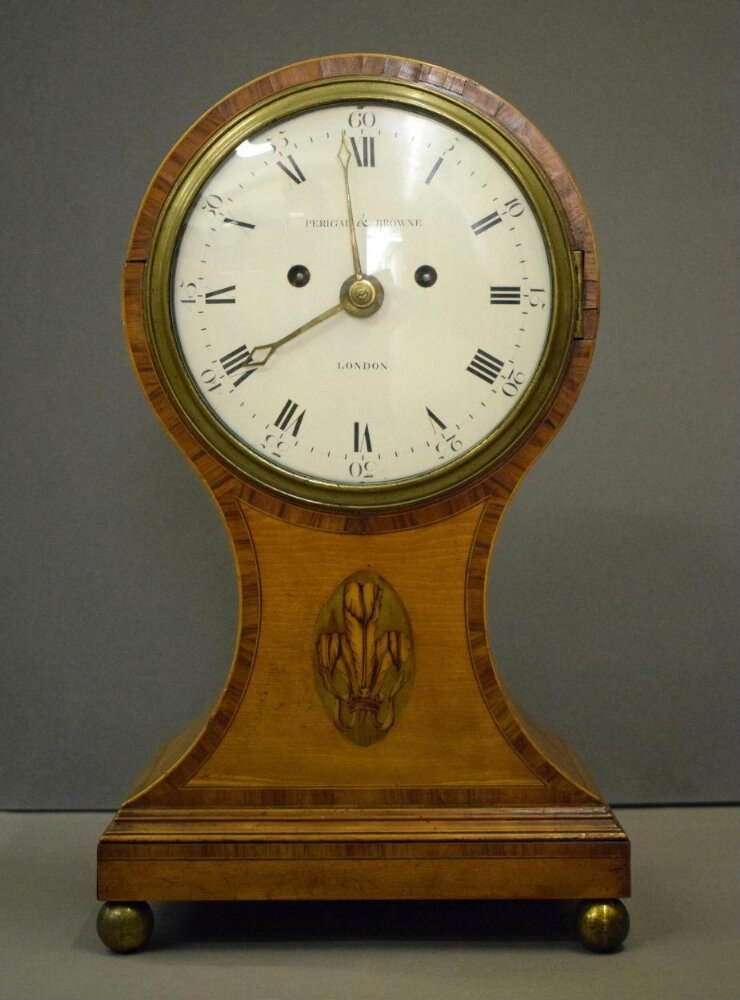
This bracket clock was produced in London between 1790 and 1800 by the firm Perigal and Browne. The object features a distinctive balloon-shaped case, a design choice inspired by the development of hot-air ballooning in the late 18th century. The case is constructed using satinwood veneer enhanced with cross-banding of tulipwood. A central decorative element on the front of the case consists of a vesica-shaped inlay depicting the Prince of Wales' feathers. The clock assembly is supported by four globular brass feet. The timekeeping mechanism is paired with a white enamel dial, which displays Roman numerals for the hours and Arabic numerals at five-minute intervals. The maker's name and location, 'Perigal and Browne, London', are painted directly onto the enamel dial in black. The clock stands at a height of 41.9 cm and was acquired by the museum as a bequest from Arthur Penrose Milstead.

Front view of the balloon-shaped bracket clock with its white enamel dial and Prince of Wales' feathers inlay.
Front view of the balloon-shaped bracket clock with its white enamel dial and Prince of Wales' feathers inlay. — Victoria and Albert Museum, London. Rights pending — permission not yet requested. Original source

Catalogue identity

Source
collections.vam.ac.uk
Category
Clock · Bracket clock
Maker / attribution
Perigal and Browne
Reference
W.18:1 to :2-1951
Catalogue / lot identifier
W.18:1 to :2-1951
Source-reported date
1790-1800
Source-reported place
London

Source-reported attribution and specifications are not independent authentication. A listing does not establish present ownership, current display, availability or permission to reproduce.

Object description

Case Construction and Design

The clock is housed in a balloon-shaped case, a form that emerged in the late 18th century. This specific silhouette was inspired by the contemporary public interest in hot-air balloon flight, which gained popularity following early experiments in Britain during the 1780s. The structure is finished with a veneer of satinwood, valued for its light, golden hue.

The decorative scheme includes cross-banding executed in tulipwood. A focal point of the case front is a vesica-shaped inlay panel portraying the three feathers of the Prince of Wales. The clock is raised on four spherical, globular brass feet, which elevate the main body of the case from the surface upon which it sits.

Evidence for this section
  • “Bracket clock in a balloon-shaped case veneered in satinwood with cross-banding of tulipwood, inlaid with a vesica-shaped panel with the Prince of Wales' feathers.”
  • “The shape refers to the exciting new phenomenon of hot-air balloons.”
  • “The clock is raised on four globular brass feet.”

Dial and Inscriptions

The clock face consists of a white enamel dial. The chapter ring features black Roman numerals to denote the hours. Smaller Arabic numerals are positioned at five-minute intervals around the perimeter, providing a secondary reference for reading the minutes.

The maker's mark is integrated into the dial design. The inscription 'Perigal and Browne, London' is applied in black enamel across the surface of the dial, centered below the hand mounting point.

Evidence for this section
  • “The white enamel dial, with Roman hour numerals and arabic numerals for the five-minute intervals, is painted with the name of the makers, 'Perigal and Browne, London'.”
  • “On dial, in black enamel”

Provenance and Production

The clock was manufactured in London during the final decade of the 18th century, between 1790 and 1800. The makers, Perigal and Browne, were responsible for both the design and the construction of the object.

The clock entered the museum collection as part of a bequest made by Arthur Penrose Milstead. Its accession number, W.18:1 to :2-1951, suggests the inclusion of related components or parts within the singular registration of the object.

Evidence for this section
  • “1790-1800, Perigal and Browne, London”
  • “Bequeathed by Arthur Penrose Milstead”
  • “Accession number: W.18:1 to :2-1951”

Open research questions

  • What is the specific type of movement housed within the balloon case?
  • Are there secondary marks on the movement plates to verify the Perigal and Browne attribution?

Source evidence

Recorded claims and source quotations for Perigal and Browne Balloon-Shaped Bracket Clock
FieldSource-reported valueSource quotation
MakerPerigal and Browne“Perigal and Browne”
Date1790-1800“1790-1800”
LocationLondon“London”
MaterialsSatinwood, tulipwood, enamel“veneered in satinwood with cross-banding of tulipwood, inlaid with a vesica-shaped panel with the Prince of Wales' feathers. The”
Accession numberW.18:1 to :2-1951“W.18:1 to :2-1951”

Visible details

  • Case shape mimics a hot-air balloon
  • Vesica-shaped inlay of Prince of Wales' feathers
  • Dial features black Roman hour numerals and Arabic five-minute numerals
  • Four globular brass feet support the clock

Research qualifications

  • The exact provenance of the movement mechanism beyond the case is not detailed
  • Specific mechanical function or escapement type is not documented

Photograph identity and source facts were screened before import; rights clearance remains pending.

Consulted source

Bracket clock, Perigal and Browne, London, 1790-1800

Reviewed 2026-11-02 · Record e3a298262d

Terms in this record

Glossary explanations for terms named in this object’s record.