
Skip to content
The Encyclopedia of Horology

Pocket watch · Pendant watch

Pendant Watch with Inner and Outer Case

Partially verified

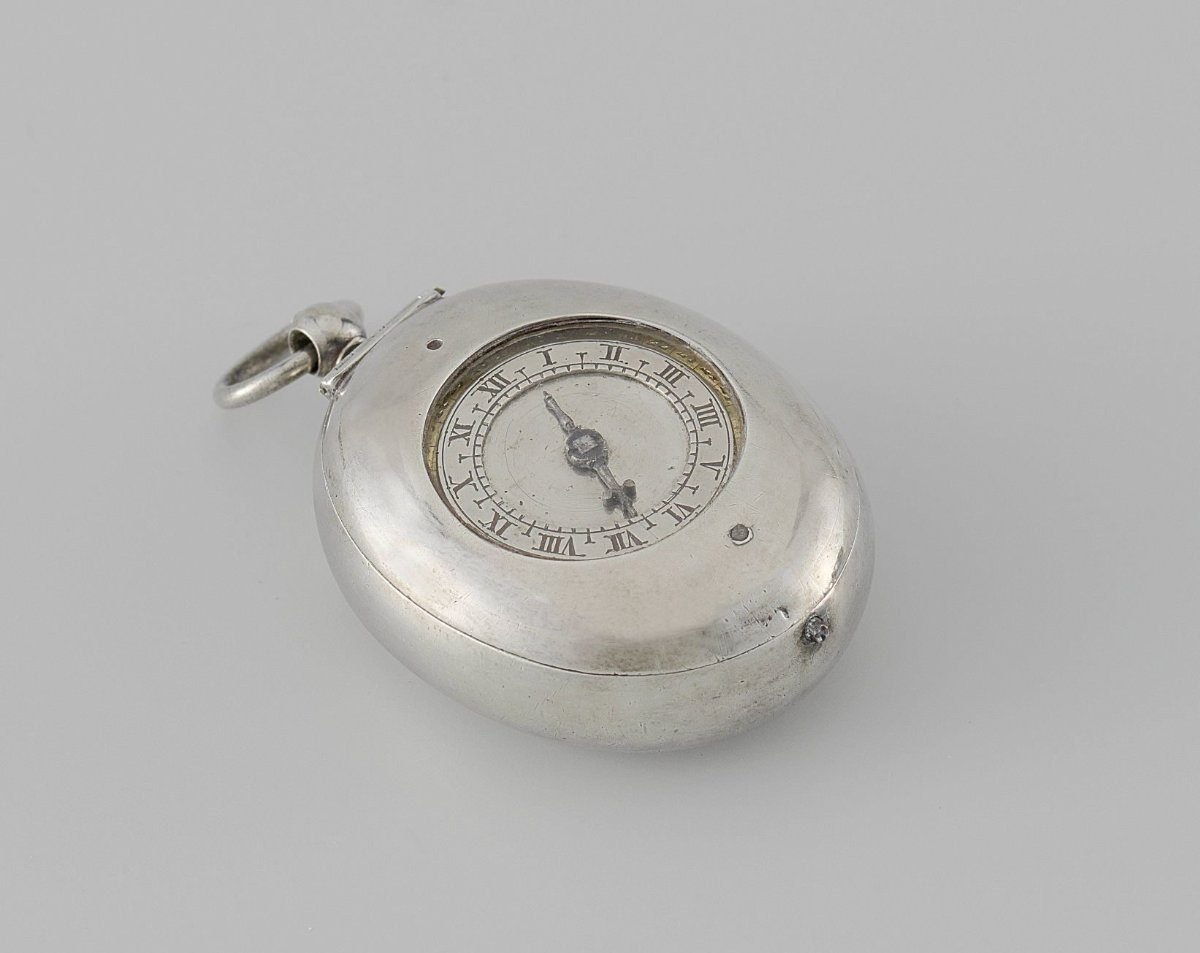
This pendant watch, catalogued as BK-NM-3080 by the Rijksmuseum, is an oval timepiece featuring both an inner and an outer silver case. Attributed to the maker Mathys Bockels of Haarlem, the watch dates to circa 1610. The design incorporates a silver dial that includes a fire-gilt date ring and functions with a single hand. The internal mechanism utilizes a gut cord drive and features pierced pillars, as well as an elongated balance cock. Notably, the balance is constructed without a balance spring. The object measures 4 cm in length and 3.5 cm in width.

The oval pendant watch featuring a silver case and single-hand dial, as documented in the Rijksmuseum collection.
The oval pendant watch featuring a silver case and single-hand dial, as documented in the Rijksmuseum collection. — Rijksmuseum, Amsterdam. Rights pending — permission not yet requested. Original source

Catalogue identity

Source
orbiscollectibles.com
Category
Pocket watch · Pendant watch
Maker / attribution
Mathys Bockels
Reference
Not recorded
Catalogue / lot identifier
BK-NM-3080
Source-reported date
c. 1610
Source-reported place
Netherlands

Source-reported attribution and specifications are not independent authentication. A listing does not establish present ownership, current display, availability or permission to reproduce.

Object description

Casing and External Features

The object is an oval-shaped pendant watch constructed with both an inner and an outer silver case. Its physical form is defined by these dimensions, measuring 4 cm in length and 3.5 cm in width. The exterior is characterized by a plain finish, consistent with a utilitarian yet refined construction suitable for wear. A pendant loop is present at the apex of the case, allowing for suspension.

The dial is also constructed of silver and is notable for the inclusion of a fire-gilt date ring. The time is indicated by a single hand, a feature consistent with the period's horological technology.

Evidence for this section
  • “Pendant watch, oval with plain silver outer and inner case”
  • “silver dial with fire-gilt date ring, one hand”
  • “length 4 cm x width 3.5 cm”

Movement and Technical Construction

The movement is mounted with pierced pillars, a structural choice that allows for both stability and aesthetic detail within the confined space of the oval case.

The escapement assembly includes an elongated balance cock. A distinct technical feature of this specific movement is the absence of a balance spring, as the balance operates without this component. This configuration is consistent with the movement's dated origin of circa 1610, highlighting a specific stage in the development of the portable watch movement before the widespread implementation of spring-regulated balance wheels.

Evidence for this section
  • “movement with gut cord drive, pierced pillars, elongated balance cock”
  • “balance without balance spring”

Provenance and Identification

The watch is attributed to the maker Mathys Bockels of Haarlem, as evidenced by the markings present on the piece. This information has been preserved through its entry into the permanent collection of the Rijksmuseum, Amsterdam, where it is identified by the accession number BK-NM-3080. The record for this object is supported by documentation provided by the museum.

The identification remains subject to the accuracy of the museum's own internal archives, which provide the primary record for its classification, including its categorization as a halshorloge or calendar watch within their broader jewellery and instrument collection.

Evidence for this section
  • “marked: Mathys Bockels, Haerlem”
  • “The Rijksmuseum, Amsterdam, holds this object as BK-NM-3080”
  • “halshorloge · calendar watch · jewellery”

Open research questions

  • What specific archival evidence links the maker Mathys Bockels to the Haarlem region during the early 17th century?
  • How does the lack of a balance spring on this specific movement compare to other surviving watches in the Rijksmuseum collection from the same period?

Source evidence

Recorded claims and source quotations for Pendant Watch with Inner and Outer Case
FieldSource-reported valueSource quotation
MakerMathys Bockels“marked: Mathys Bockels, Haerlem”
Datec. 1610“c. 1610”
Dimensions4 cm x 3.5 cm“length 4 cm x width 3.5 cm”
MaterialSilver“silver (metal)”
Dial FeaturesSilver dial with fire-gilt date ring“silver dial with fire-gilt date ring”
Drive mechanismGut cord drive“movement with gut cord drive”
BalanceBalance without balance spring“balance without balance spring”

Visible details

  • Oval-shaped silver casing with a pendant loop at the top
  • Single-hand dial configuration with visible Roman numerals
  • Silver finish throughout the exterior case
  • Visible pin-like release or closure at the bottom edge of the case

Research qualifications

  • The maker attribution and wider type classification require further verification against external horological references.
  • The description is derived from a translation of museum records, which may not capture all nuance of the physical mechanism.

Photograph identity and source facts were screened before import; rights clearance remains pending.

Consulted source

Pendant Watch with Inner and Outer Case

Reviewed 2026-11-02 · Record e5628eeb17

Terms in this record

Glossary explanations for terms named in this object’s record.