
Skip to content
The Encyclopedia of Horology

Clock · Precision pendulum clock

Paul Stübner Precision Pendulum Clock

Partially verified

This astronomical precision seconds pendulum clock was manufactured by Paul Stübner, a Glashütte-based clockmaker who established his business in 1905. The timepiece features a rectangular-shaped brass movement driven by a weight and incorporates a Graham escapement with adjustable steel pallets featuring inlaid sapphires. It is equipped with a lateral impulse pendulum spring suspension and an invar steel pendulum, identified as "type K" with number 2217 and DRP number 100870. The clock stands 1490 mm tall and is housed in a mahogany case with a silvered dial. According to the provided archive details, the mechanism was delivered to Stübner on January 5th, 1919, as documented in the Riefler catalogue of works under number 265. Stübner, formerly an employee of Strasser & Rohde, primarily utilized Riefler pendulums for his precision clocks throughout his career, which spanned from 1905 until his retirement in the 1930s.

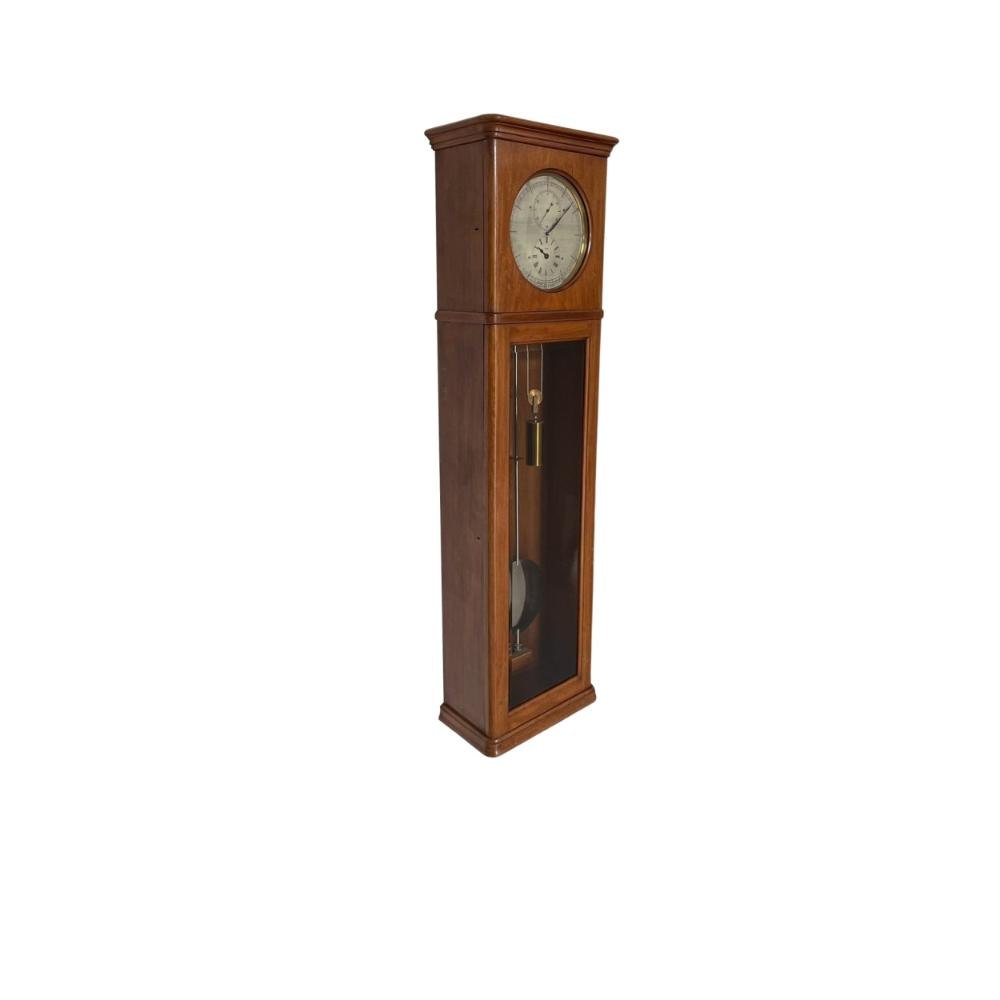
Full view of the Paul Stübner precision pendulum clock.
Full view of the Paul Stübner precision pendulum clock. — Invaluable. Rights pending — permission not yet requested. Original source

Catalogue identity

Source
www.invaluable.com
Category
Clock · Precision pendulum clock
Maker / attribution
Paul Stübner
Reference
Not recorded
Catalogue / lot identifier
178
Source-reported date
circa 1920
Source-reported place
Germany
Source-reported serial
265

Source-reported attribution and specifications are not independent authentication. A listing does not establish present ownership, current display, availability or permission to reproduce.

Object description

Case and Dial

The clock is housed in a tall, floor-standing mahogany case measuring 1490 mm. The design features a large glass panel in the lower section, which allows for the observation of the pendulum's motion, while the upper section contains the dial and the movement. The case is described by the auction description as being in very good condition with some surface scratching.

The silvered dial is situated at the top of the clock, consistent with standard astronomical regulator layouts. According to the condition report, the dial remains in very good condition, although it shows signs of slight oxidation.

Evidence for this section
  • “Case: Mahogany.”
  • “Dial: Silvered.”
  • “Case: very good, scratched.”
  • “Dial: very good, slightly oxydized.”

Movement and Pendulum

The clock is powered by a weight-driven, rectangular-shaped brass movement. The escapement is a Graham type, featuring adjustable steel pallets with inlaid sapphires. This configuration was designed to reduce friction and improve timekeeping accuracy. The movement is mounted to allow for the attachment of a precision pendulum, which is an invar steel "type K" model, bearing the number 2217 and DRP number 100870. The pendulum utilizes a lateral impulse pendulum spring suspension system.

The auction house reports the movement is in very good condition but notes that it is to be restored.

Evidence for this section
  • “Movm.: Rectangular-shaped brass movement, weight driven, Graham escapement with adjustable steel pallets with inlaid sapphires”
  • “invar steel pendulum "type K", no. 2217, DRP no. 100870”
  • “Movm.: very good, to be restored.”

Provenance and Documentation

The clock is accompanied by specific archival data relating to its components. The source notes that the movement, identified as number 265, was delivered to Paul Stübner on January 5th, 1919, according to the Riefler catalogue of works. Paul Stübner operated his own workshop in Glashütte starting in 1905, having previously worked for the firm Strasser & Rohde for 25 years.

Throughout his production history, Stübner utilized Riefler pendulums for the majority of his clocks, with a transition to Strasser & Rohde pendulums observed in items produced around 1920. The object is officially classified as an astronomical Glashütte precision seconds pendulum clock. Stübner specialized in the production of precision pendulum clocks, a pursuit linked by the source to the Imperial Navy's requirements for independent marine chronometer supplies.

Evidence for this section
  • “An astronomical Glashütte precision seconds pendulum clock with Riefler K-pendulum, delivered to Stübner on January 5th, 1919, according to the Riefler catalogue of works Movm. No. 265”
  • “Paul Stübner, later known as "Mädchen-Stübner”
  • “Most of his clocks were supplied with Riefler pendulums”

Open research questions

  • What specific restoration work is required for the movement?
  • Are there any identifiable maker's marks or stamps on the mahogany case beyond those documented?

Source evidence

Recorded claims and source quotations for Paul Stübner Precision Pendulum Clock
FieldSource-reported valueSource quotation
MakerPaul Stübner“Paul Stübner”
OriginDeutschland“Origin Deutschland”
Datecirca 1920“circa 1920”
Dimensions1490 mm“1490 mm”
Movement serial265“Movm. No. 265”
Pendulum typeInvar steel pendulum type K, no. 2217“invar steel pendulum "type K", no. 2217”
EscapementGraham escapement“Graham escapement”
Case materialMahogany“Case: Mahogany.”

Visible details

  • Mahogany wood case with full-length glass door
  • Silvered circular clock dial with indices
  • Weight-driven movement with cord suspension
  • Brass plates connected by cylindrical pillars

Research qualifications

  • The condition report indicates the movement requires restoration
  • The exact production date is approximate per the source

Photograph identity and source facts were screened before import; rights clearance remains pending.

Consulted source

Paul Stübner - Precision Pendulum Clock

Reviewed 2026-10-26 · Record f082408f2a

Terms in this record

Glossary explanations for terms named in this object’s record.