
Skip to content
The Encyclopedia of Horology

Tool · Nuremberg diptych dial

Paul Reinmann Oval Diptych Dial

Partially verified

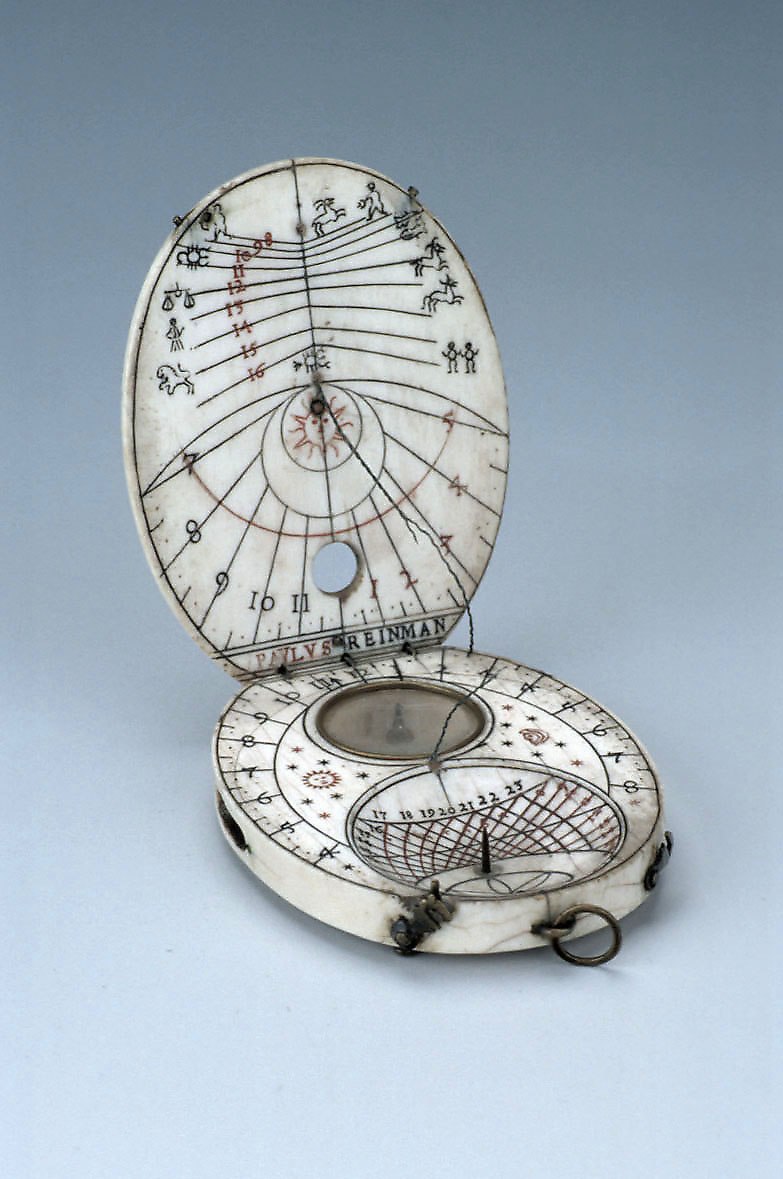
This oval diptych dial is an ivory and brass instrument measuring 55 x 74 x 11 mm, attributed to the maker Paul Reinmann and dated circa 1600. It is constructed in two leaves, with the interior surfaces featuring multiple timekeeping methods. The upper leaf includes a vertical pin gnomon dial showing length of day and solar declination, alongside a string gnomon dial for common hours. The inner lower leaf contains a central compass, a string gnomon dial for common hours, and a scaphe dial indicating Italian and Babylonian hours. Decoration utilizes red and black pigments and includes celestial imagery such as sun and moon effigies. The outer surface of the lower leaf includes a lunar volvelle and a table of Julian epacts beginning in 1602. The instrument features a maker's mark consisting of a coronet and stands on four bun feet in the spandrel spaces.

The open diptych dial displaying the inner ivory leaves, string gnomon, and compass.
The open diptych dial displaying the inner ivory leaves, string gnomon, and compass. — Museum of the History of Science, Oxford. Rights pending — permission not yet requested. Original source

Catalogue identity

Source
www.mhs.ox.ac.uk
Category
Tool · Nuremberg diptych dial
Maker / attribution
Paul Reinmann
Reference
Not recorded
Catalogue / lot identifier
40780
Source-reported date
circa 1600
Source-reported place
Nuremberg

Source-reported attribution and specifications are not independent authentication. A listing does not establish present ownership, current display, availability or permission to reproduce.

Object description

Construction and Dial Layout

The diptych dial is crafted from ivory and brass, configured as two hinged oval leaves. The interior upper leaf contains a vertical pin gnomon dial representing solar declination and day length, alongside a string gnomon dial for common hours ranging from 7 to 12 to 5. Decoration on this section includes celestial symbols and a sun effigy at the dial center.

The interior lower leaf centers on a compass, flanked by a string gnomon dial for common hours. Below the compass is a scaphe dial that tracks Italian hours in black and Babylonian hours in red, with additional lunar and stellar iconography incorporated into the design.

Evidence for this section
  • “The inner part of the upper leaf has a vertical pin gnomon dial marking the length of the day from 8 to 16 in red and the declination of the sun by means of the symbols of the zodiac signs.”
  • “The compass is blank, and below it, is a scaphe dial with Italian hours numbered in black from 9 to 23 and Babylonian hours numbered in red from 1 to 16, with a six-leaf flower at the centre.”

Exterior Features and Epact Table

The exterior of the upper leaf serves as a navigation aid, containing a wind rose with 32 directions, 16 of which are explicitly labeled. This side also incorporates a brass index arm and a compass viewing hole for use when the instrument is closed.

The exterior of the lower leaf provides calendrical information, featuring a lunar volvelle and a specific table of Julian epacts. The epact table is explicitly marked to correspond with the year 1602, which provides the primary evidence for the instrument's date of manufacture.

Evidence for this section
  • “The outer side of the upper leaf of this oval dial has a wind rose with 32 directions, 16 of which are named”
  • “The outer side of the lower leaf has a lunar volvelle (incomplete) and a table of Julian epacts starting for the year 1602 explained by the inscription 'EPACTA IVLIA ANNO 1602'.”

Condition and Markings

The object exhibits specific losses, notably the absence of the wind vane from the compartment located on the left edge. Additionally, the lunar volvelle located on the exterior of the lower leaf is described as incomplete in the museum record.

The instrument bears a signature for Paul Reinmann on the upper leaf interior and a maker's mark in the form of a coronet at the bottom of the lower leaf exterior. The base is finished with four bun feet placed in the spandrel areas.

Evidence for this section
  • “On the left edge is a compartment for the wind vane (missing).”
  • “At the bottom is the maker's mark (a coronet) and four bun feet in the spandrel spaces.”

Open research questions

  • What specific functions were intended for the missing wind vane component?
  • To what extent is the current blank state of the compass consistent with the original intended function of this dial?

Source evidence

Recorded claims and source quotations for Paul Reinmann Oval Diptych Dial
FieldSource-reported valueSource quotation
MakerPaul Reinmann“Signed by Paul Reinmann”
Inventory number40780“Inventory number: 40780”
Dimensions55 x 74 x 11 mm“55 x 74 x 11 mm”
Maker's markCoronet“maker's mark (a coronet)”
MaterialsIvory and brass“Ivory and brass”
Date reference1602“starts with the year 1602”
Decoration colorsRed and black“use of two colours (red and black)”

Visible details

  • Features a wind rose with 32 directions on the exterior upper leaf.
  • The internal scaphe dial depicts a six-leaf flower at the center.
  • The dial is signed 'PAVLVS REINMAN' in red and black ink.
  • The compass is presently blank.

Research qualifications

  • The lunar volvelle on the outer lower leaf is reported as incomplete.
  • A wind vane originally located on the left edge is missing.
  • The date of circa 1600 is suggested by the epact table, which begins in 1602.

Photograph identity and source facts were screened before import; rights clearance remains pending.

Consulted source

Diptych Dial

Reviewed 2026-10-26 · Record 4d3e719748

Terms in this record

Glossary explanations for terms named in this object’s record.