
Skip to content
The Encyclopedia of Horology

Tool · Nuremberg diptych dial

Hans Tucher Diptych Dial

Partially verified

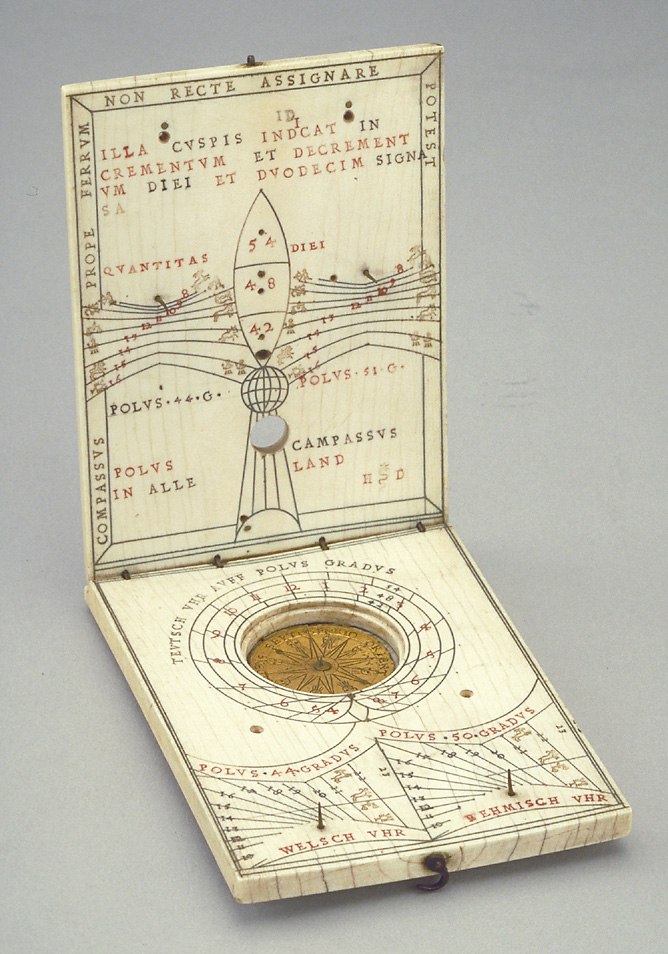
This diptych sundial, attributed to either Hans Tucher II or Hans Tucher III, is constructed from ivory and brass with dimensions of 130 x 94 x 12 mm. It comprises multiple integrated time-measuring features, including a string gnomon dial, various pin gnomon dials calibrated for different latitudes, and a lunar volvelle for nocturnal timekeeping. The instrument features intricate stamped inscriptions, colored with brown, black, and red fills, alongside a windrose and a compass bowl. Signed by Hans Tucher with his crowned serpent maker's mark, the dial displays complex layouts for Italian, German, Babylonian, and Bohemian hours. Several components are noted as missing or damaged, including the index arm, wind vane, compass needle, glass, and string gnomons. The object was gifted to the British Museum in 1871 by A.W. Franks.

Inner surfaces of the open diptych dial showing the pin gnomon dials on the upper leaf and the string gnomon dial and compass housing on the lower leaf.
Inner surfaces of the open diptych dial showing the pin gnomon dials on the upper leaf and the string gnomon dial and compass housing on the lower leaf. — British Museum, London. Rights pending — permission not yet requested. Original source

Catalogue identity

Source
www.mhs.ox.ac.uk
Category
Tool · Nuremberg diptych dial
Maker / attribution
Hans Tucher
Reference
MLA 1871,11-15.17
Catalogue / lot identifier
MLA 1871,11-15.17
Source-reported date
circa 1600
Source-reported place
Nuremberg

Source-reported attribution and specifications are not independent authentication. A listing does not establish present ownership, current display, availability or permission to reproduce.

Object description

Construction and Design

The diptych dial is crafted from ivory and brass, measuring 130 by 94 by 12 mm. Its design utilizes stamped inscriptions enhanced with brown, black, and red pigments. The upper leaf displays a windrose on its outer surface, while the interior is equipped with pin gnomon dials for various latitudes, specifically 44 and 51 degrees, for measuring day length and Italian hours.

The lower leaf includes a string gnomon dial for German hours with scales for latitudes 42, 48, and 54 degrees. Additionally, it contains a compass bowl, though it is currently missing the needle and glass cover. On the lower section are pin gnomon dials for Babylonian and Bohemian hours, calibrated for latitudes 44 and 50 degrees respectively.

Evidence for this section
  • “Ivory and brass; 130 x 94 x 12 mm”
  • “The inscriptions are stamped and filled with brown, black and red colouring”
  • “The inner surface of the upper leaf consists of two pin gnomon dials for day length”

Nocturnal and Lunar Functions

The inner surface of the lower leaf serves as a lunar volvelle designated as a 'COMPASSVS NOCTVRNVS'. This component features a stamped scale numbered 1 to 29 and a fixed silver dial marked 1 to 12 twice. A rotating brass dial with an index arm and crescent-shaped cutout allows for the indication of moon phases and nighttime hours.

The mechanism is decorated with stars and a crescent moon. It includes symbols for phases such as the new moon and full moon. The instrument also features the maker's identification, 'H D' for Hans Tucher, accompanied by his trade mark, a crowned serpent, providing a distinct signature for this specialized nocturnal timekeeping device.

Evidence for this section
  • “The inner surface of the lower leaf has a lunar volvelle called 'COMPASSVS NOCTVRNVS'”
  • “a rotating brass dial with an index arm with a small crescent and a circular cut out showing the phases of the moon”
  • “Above the dial are the letters 'H D' for Hans Tucher seperated by his trade mark, the crowned serpent”

Condition and Attribution

Attribution of this instrument is based on comparisons with other dated dials, pointing toward either Hans Tucher II or Hans Tucher III around the year 1600. The auction house reports noted that several elements are missing, including an index arm, a wind vane, and the compass needle and its protective glass.

The dial contains minor textual errors where letters in inscriptions remain unfilled with color or are otherwise marked as mistakes. The instrument was presented to the museum collection in 1871 by A.W. Franks and remains documented in the catalogue of European scientific instruments held by the Department of Medieval and Later Antiquities.

Evidence for this section
  • “Comparison with other dated dials allows this instrument by either Hans Tucher II or Hans Tucher III to be dated to around 1600”
  • “An index arm and a wind vane are missing”
  • “The instrument was presented by A.W. Franks in 1871”

Open research questions

  • Could metallurgical analysis of the brass distinguish between the potential production periods of Tucher II and Tucher III?
  • Are there extant examples of similar Tucher dials that retain the now-missing wind vane and index arm configuration?

Source evidence

Recorded claims and source quotations for Hans Tucher Diptych Dial
FieldSource-reported valueSource quotation
MakerHans Tucher“Signed by Hans Tucher”
Datecirca 1600“circa 1600”
Place of originNuremberg“Nuremberg”
Dimensions130 x 94 x 12 mm“130 x 94 x 12 mm”
MaterialsIvory and brass“Ivory and brass”
Museum numberMLA 1871,11-15.17“MLA 1871,11-15.17”
Maker's markCrowned serpent“his maker's mark, a crowned serpent”

Visible details

  • Ivory construction with stamped, colored inscriptions
  • Missing compass needle and glass cover
  • Crowned serpent maker's mark visible on the dial faces
  • Multiple pin gnomon scales for distinct geographic latitudes

Research qualifications

  • The exact identity between Hans Tucher II and III remains unconfirmed
  • Various missing parts including an index arm and a wind vane limit the original functional capacity

Photograph identity and source facts were screened before import; rights clearance remains pending.

Consulted source

Diptych Dial

Reviewed 2026-10-26 · Record 909c922081

Terms in this record

Glossary explanations for terms named in this object’s record.