
Skip to content
The Encyclopedia of Horology

Pocket watch · Minute repeating pocket watch

Patek Philippe Minute Repeating Pocket Watch

Partially verified

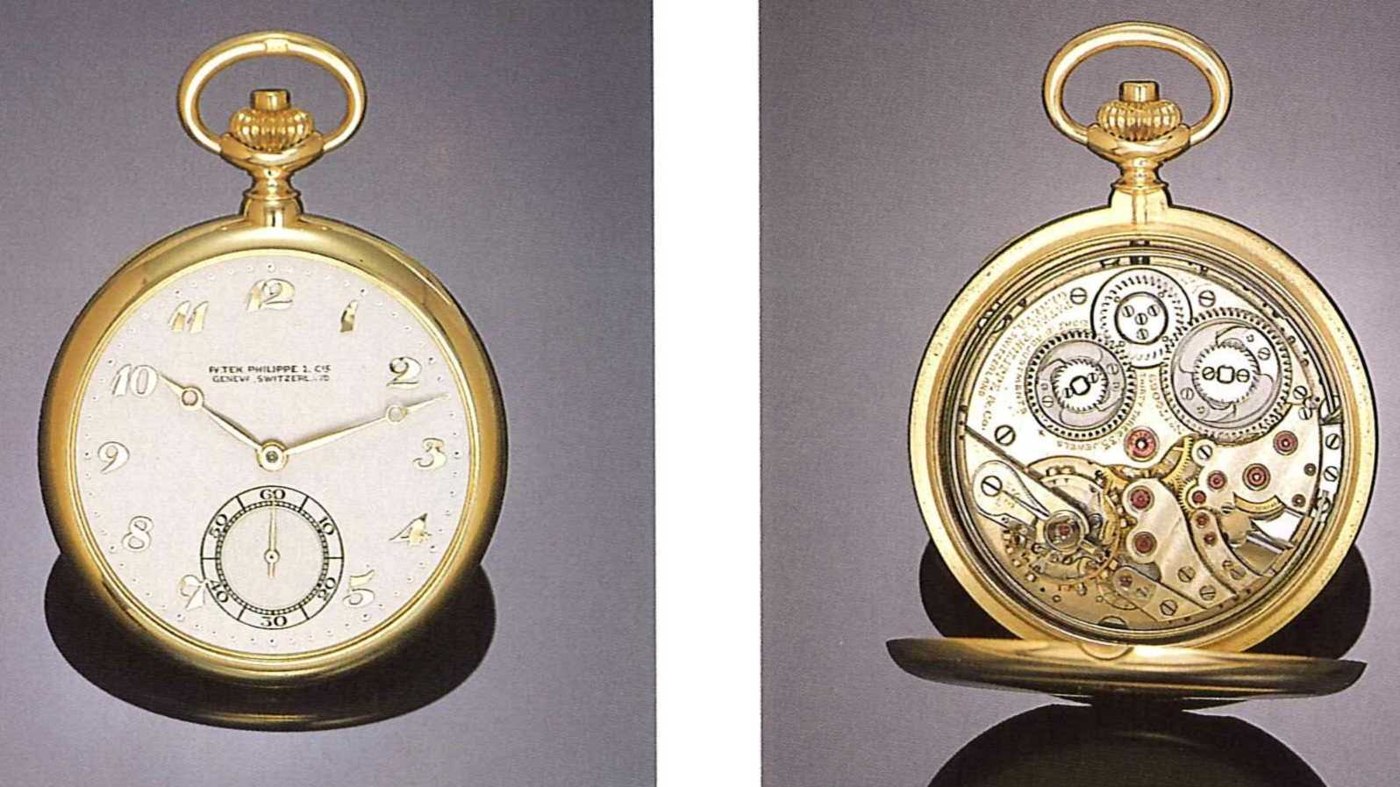
This minute-repeating pocket watch, manufactured by Patek Philippe & Cie. circa 1915, features an independent striking train. The timepiece is housed in a 48 mm 18k gold "demi-bassine" polished case characterized by invisible hinges. The dial is finished in matte silver with applied gold Breguet numerals, paired with gold Breguet-style hands and a subsidiary seconds register at the six o'clock position. Internally, the watch is powered by a rhodium-plated 17-ligne double train movement featuring fausses côtes decoration and 33 jewels. The movement incorporates an equilibrated straight-line lever escapement, a cut bimetallic balance, and a Breguet balance spring equipped with a swan-neck micrometric index. The repeating function, which chimes on gongs, is activated by a push piece integrated into the pendant. The piece is signed by the maker on the dial, the case, and the movement.

Front and back views of the Patek Philippe 18k gold minute repeating pocket watch.
Front and back views of the Patek Philippe 18k gold minute repeating pocket watch. — Antiquorum. Rights pending — permission not yet requested. Original source

Catalogue identity

Source
catalog.antiquorum.swiss
Category
Pocket watch · Minute repeating pocket watch
Maker / attribution
Patek Philippe & Cie.
Reference
Not recorded
Catalogue / lot identifier
228
Source-reported date
circa 1915
Source-reported place
Switzerland
Source-reported serial
174069 (movement), 412310 (case)

Source-reported attribution and specifications are not independent authentication. A listing does not establish present ownership, current display, availability or permission to reproduce.

Object description

Case and Dial Design

The watch is enclosed in an 18k gold case constructed in the "demi-bassine" style, characterized by a polished finish and the inclusion of invisible hinges. The case measures 48 mm in diameter. The pendant houses the release mechanism for the repeating train, which is operated via a push piece.

The dial surface consists of a matte silver finish. It is adorned with applied gold Breguet-style numerals. The time is indicated by matching gold Breguet-style hands. Positioned at the six o'clock location is a subsidiary seconds dial, which includes a surrounding track for interval measurement. The dial bears the signature of Patek Philippe & Cie., Genève.

Evidence for this section
  • “Three body massive "demi-bassine" polished case with invisible hinges”
  • “Mat silver dial with applied gold Breguet numerals and subsidiary seconds”
  • “Gold Breguet hands”
  • “Signed on the dial.”

Movement and Mechanism

This timepiece utilizes a 17-ligne rhodium-plated movement designed with a double train architecture. The movement incorporates a differential winding system and is jeweled with 33 stones. It features fausses côtes decoration, a common aesthetic treatment for bridge components of this period.

The regulating and escapement components include an equilibrated straight-line lever escapement and a cut bimetallic balance. The oscillation is controlled by a Breguet balance spring fitted with a swan-neck micrometric index for regulation. The complication is a minute repeater, which strikes on gongs when activated by the pendant-mounted push piece.

Evidence for this section
  • “Fine rhodium plated 17"' double train movement”
  • “differential winding, 33 jewels”
  • “equilibrated straight line lever escapement, cut bimetallic balance, Breguet balance spring with a swan neck micrometric index”
  • “Repeating on gongs. the repeating train released by means of a push piece on the pendant.”

Identification and Documentation

The object is identified by movement number 174069 and case number 412310, dating it to approximately 1915. The manufacturer's signature appears on the dial, the internal movement, and the case. The auction description reports that the object is in very good condition.

A comparison is noted in the source documentation regarding this watch and a similar model found in the Patek Philippe company book for pocket watches, specifically on page 235, figures 217 a and b. This cross-reference serves as an indicator of the model's design lineage within the maker's historical production.

Evidence for this section
  • “Patek Philippe & Cie., Genève, No 174069, case No 412310, circa 1915.”
  • “Signed on the dial. the case and the movement.”
  • “In very good condition.”
  • “A very similar watch is illustrated in the Patek Philippe book for pocket watches, page 235 fig. 217 a and b.”

Open research questions

  • What is the specific movement caliber designation for this 17-ligne double train movement?
  • What production records exist for this serial number in the Patek Philippe archives?

Source evidence

Recorded claims and source quotations for Patek Philippe Minute Repeating Pocket Watch
FieldSource-reported valueSource quotation
MakerPatek Philippe & Cie., Genève“Patek Philippe & Cie., Genève”
Movement Serial174069“No 174069”
Case Serial412310“case No 412310”
Datecirca 1915“circa 1915”
Case Material18k gold“18k gold”
Case Typedemi-bassine“demi-bassine" polished case with invisible hinges”
Movement Details17 ligne double train“17"' double train movement”
Jewel Count33 jewels“33 jewels”
ConditionVery good“In very good condition”
Dimensions48 mm“Diam.: 48 mm.”

Visible details

  • Polished 18k gold demi-bassine case
  • Applied gold Breguet numerals on a matte silver dial
  • Visible swan-neck micrometric index on the movement
  • Subsidiary seconds dial with an outer track

Research qualifications

  • The specific historical record of this individual movement's ownership remains undocumented beyond the auction description
  • The reference to a 'very similar' watch in company literature is based on comparison rather than direct provenance

Photograph identity and source facts were screened before import; rights clearance remains pending.

Terms in this record

Glossary explanations for terms named in this object’s record.