
Skip to content
The Encyclopedia of Horology

Pocket watch · Deck-watch

Parkinson & Frodsham Silver Spring Detent Escapement Deck-Watch No. 948

Partially verified

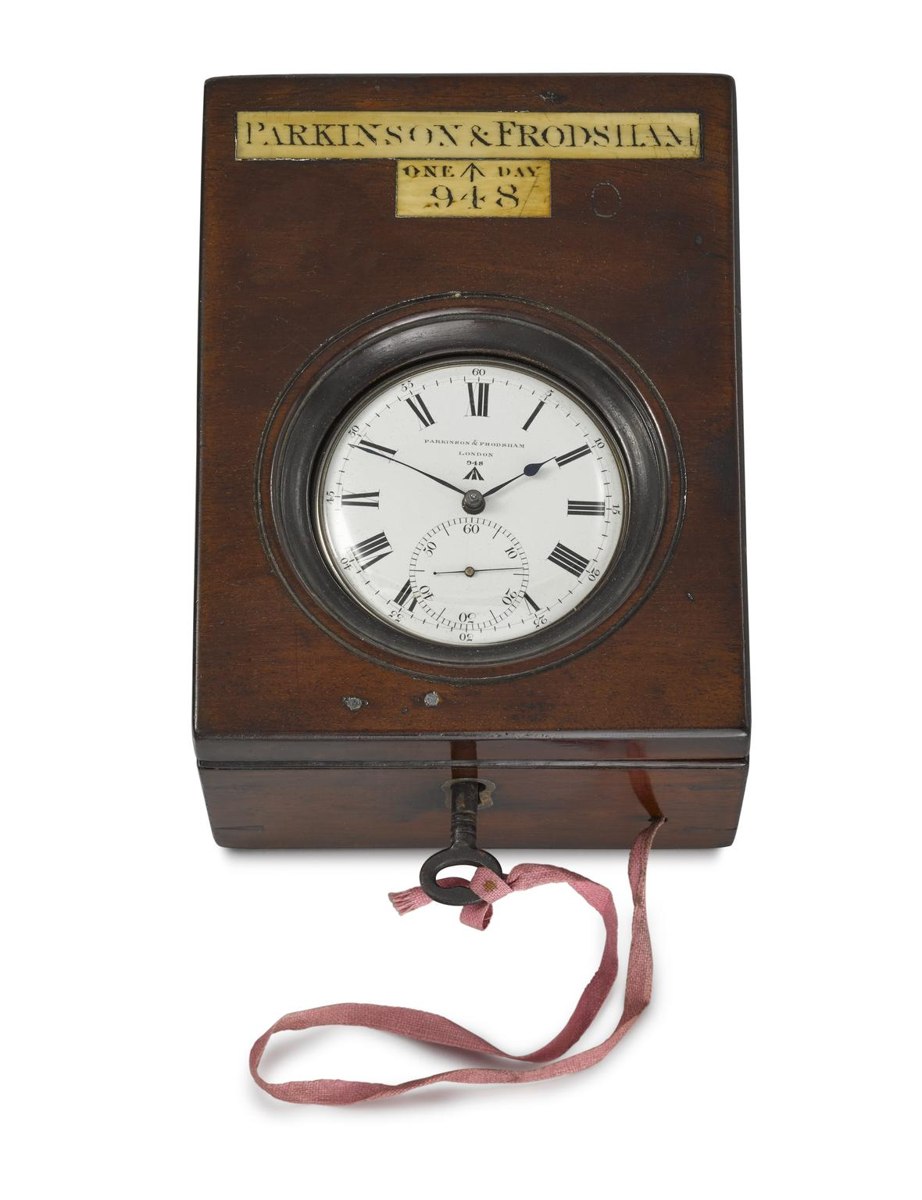
According to the Science Museum Group, this silver spring detent escapement deck-watch was made in London by Parkinson & Frodsham and is hallmarked for 1823–4. Housed in a mahogany box measuring 57 mm by 89 mm by 120 mm, the timepiece features a white enamel dial with Roman numerals, a subsidiary seconds dial, and blued steel hands. The dial and an exterior plaque bear the broad arrow mark and serial number 948. Source records state that the movement features a flat spiral balance-spring with a stud on a flexible arm. The source also reports that this watch accompanied Captain William Parry aboard HMS Hecla during his June 1827 North Pole attempt.

Top view of Parkinson & Frodsham deck-watch No. 948 mounted in its mahogany case with key
Top view of Parkinson & Frodsham deck-watch No. 948 mounted in its mahogany case with key — The Clockmakers' Museum/Clarissa Bruce © The Clockmakers’ Charity. Rights pending — permission not yet requested. Original source

Catalogue identity

Source
collection.sciencemuseumgroup.org.uk
Category
Pocket watch · Deck-watch
Maker / attribution
Parkinson & Frodsham
Reference
Not recorded
Catalogue / lot identifier
L2015-3359
Source-reported date
1823 – 4
Country
United Kingdom
Source-reported serial
948

Source-reported attribution and specifications are not independent authentication. A listing does not establish present ownership, current display, availability or permission to reproduce.

Object description

Physical Description and Housing

The timepiece is housed in a mahogany box measuring 57 mm by 89 mm by 120 mm. The box features inset plaques inscribed 'PARKINSON & FRODSHAM' and 'ONE ^ DAY 948'. A winding or case key is stored with the object, secured by a pink ribbon.

The watch features a white enamel dial with black Roman hour numerals, an outer minute track with Arabic 5-minute markings, and a subsidiary seconds dial at 6 o'clock. Blued steel hands are present for hours, minutes, and seconds.

Evidence for this section
  • “Mahogany deck box fitted with rectangular inset plaques inscribed 'PARKINSON & FRODSHAM' and 'ONE ^ DAY 948'.”
  • “White enamel dial with a subsiduary seconds dial and blued steel hands”
  • “White enamel dial featuring black Roman hour numerals, outer minute track with Arabic 5-minute markings, and a subsidiary seconds dial at 6 o'clock.”

Maker Marks and Identification

The dial is signed 'Parkinson & Frodsham London 948' and bears the broad arrow mark. The object is recorded in the Clockmakers' Museum collection under number 447, with the official object number L2015-3359. The watch is hallmarked for 1823–4.

Institutional records state the watch accompanied Captain William Parry aboard the 'Hecla' during his June 1827 attempt to reach the North Pole.

Evidence for this section
  • “signed 'Parkinson & Frodsham London 948' and the broad arrow mark.”
  • “Hallmarked for 1823 – 4.”
  • “Clockmakers' Museum No. 447”
  • “This deck watch accompanied Capt. William Parry aboard ‘Hecla’ in his attempt to reach the North Pole in June 1827.”

Mechanism and Technical Specifications

The timepiece is identified as a silver spring detent escapement deck-watch. Source records specify that the movement features a flat spiral balance-spring with a stud on a flexible arm, described as aiding the even coiling and uncoiling of the spring.

The internal movement components are concealed within the mahogany box in the current display configuration.

Evidence for this section
  • “Silver spring detent escapement deck-watch in a mahogany case by Parkinson and Frodsham.”
  • “Flat spiral balance-spring with its stud on a flexible arm to aid the even coiling and uncoiling of the spring.”

Open research questions

  • What specific archival documents verify the service history of this watch on the 1827 Hecla expedition?
  • Does the 'ONE DAY' inscription on the plaque denote the expected power reserve or winding frequency?

Source evidence

Recorded claims and source quotations for Parkinson & Frodsham Silver Spring Detent Escapement Deck-Watch No. 948
FieldSource-reported valueSource quotation
EscapementSilver spring detent escapement“Silver spring detent escapement deck-watch in a mahogany case by Parkinson and Frodsham.”
Dial signaturesigned 'Parkinson & Frodsham London 948' and the broad arrow mark“signed 'Parkinson & Frodsham London 948' and the broad arrow mark.”
Hallmark date1823 – 4“Hallmarked for 1823 – 4.”
Expedition historyCapt. William Parry aboard ‘Hecla’ in June 1827“This deck watch accompanied Capt. William Parry aboard ‘Hecla’ in his attempt to reach the North Pole in June 1827.”
Museum collection numberClockmakers' Museum No. 447“Clockmakers' Museum No. 447”
Materialssilver, brass, steel, enamel, glass, mahogany, ivory, velvet“Materials: silver (alloy) , brass (copper, zinc alloy) , steel (metal) , enamel , glass , mahogany (wood) , ivory , velvet and diamond”
Watch Dimensions69 mm x 57 mm x 22 mm“watch: 69 mm x 57 mm x 22 mm”

Visible details

  • Mahogany deck box fitted with rectangular inset plaques inscribed 'PARKINSON & FRODSHAM' and 'ONE ^ DAY 948'.
  • White enamel dial featuring black Roman hour numerals, outer minute track with Arabic 5-minute markings, and a subsidiary seconds dial at 6 o'clock.
  • Dial is inscribed 'PARKINSON & FRODSHAM LONDON 948' above a broad arrow ordnance mark.
  • Blued steel hands for hours, minutes, and seconds.
  • A winding or case key is inserted into the front keyhole and secured with a pink woven fabric ribbon.

Research qualifications

  • The interior watch case and movement details are concealed inside the wooden box in this view.
  • Expedition provenance and internal technical specifications rely on institutional catalogue documentation.

Photograph identity and source facts were screened before import; rights clearance remains pending.

Terms in this record

Glossary explanations for terms named in this object’s record.