
Skip to content
The Encyclopedia of Horology

Pocket watch · Pair-case automaton watch

Pair-case automaton watch by James Cox

Partially verified

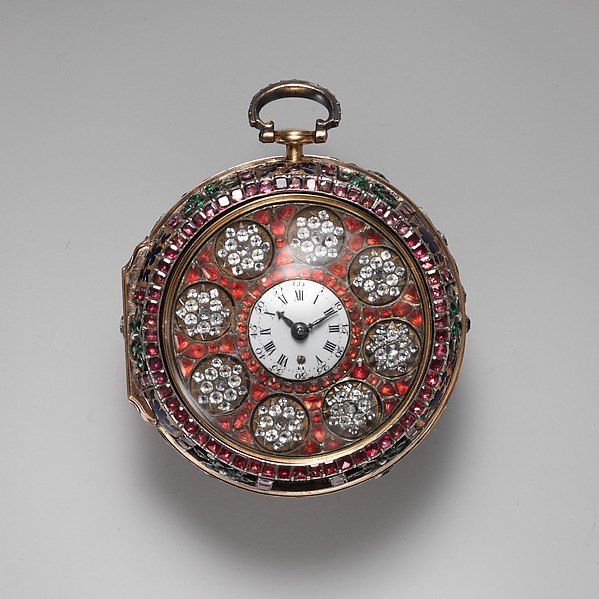
This pair-case automaton watch, dated circa 1770 and attributed to James Cox, is a horological piece currently held in the collection of The Metropolitan Museum of Art. The object features an outer gold case decorated with enamel and set with gemstones and paste jewels. The white enamel dial is surrounded by a frame embedded with paste jewels, which houses eight spinning star-shaped rosettes that move when the mechanism is activated. The inner watch movement, which bears the serial number 1393, is constructed with a verge escapement and includes a diamond end-stone. While such automaton mechanisms were integrated into pieces designed for potential export to China and India, historical records suggest that similar items may also have been produced for English patrons and sold through lottery or auction during the late 18th century.

Pair-case automaton watch by James Cox and Peter Mounier, ca. 1770.
Pair-case automaton watch by James Cox and Peter Mounier, ca. 1770. — The Metropolitan Museum of Art — Gift of Audrey Love, in memory of C. Ruxton Love Jr., 1977. Rights pending — permission not yet requested. Original source

Catalogue identity

Source
orbiscollectibles.com
Category
Pocket watch · Pair-case automaton watch
Maker / attribution
James Cox
Reference
1977.436.4a, b
Catalogue / lot identifier
1977.436.4a, b
Source-reported date
ca. 1770
Source-reported place
Britain
Source-reported serial
1393

Source-reported attribution and specifications are not independent authentication. A listing does not establish present ownership, current display, availability or permission to reproduce.

Object description

Design and Automaton Features

The object is constructed as a pair-case watch with complex decorative elements. The dial is composed of white enamel and is enclosed within a frame adorned with paste jewels. A primary feature of this watch is the automaton mechanism consisting of eight rosettes, or stars, which are designed to spin within a rotating frame upon activation.

The exterior of the outer case is highly embellished, incorporating gold, enamel, and a variety of gemstones and paste jewels. The central panel of the case reverse displays an enameled illustration of a bird amidst foliage, surrounded by a border of set stones. The physical dimensions of the combined case are approximately 6.4 by 4.4 by 2.3 centimeters.

Evidence for this section
  • “This watch features a dial closely set with paste jewels, housing eight rosettes, or stars, that spin inside a rotating frame when set in motion.”
  • “Outer case: gold, partly enameled and set with gemstones and paste jewels”

Movement and Identification

The internal movement of the watch is equipped with a verge escapement, a traditional mechanism for the period. A diamond end-stone is fitted within the movement to reduce friction. The movement is identified by the serial number 1393, which is engraved or marked internally.

The watch is attributed to James Cox, with the museum records noting his association with Peter Mounier. The horological classification of the piece is defined by the inclusion of this automaton mechanism, which differentiates it from standard timepieces of the late 18th century.

Evidence for this section
  • “Internally, the mechanism is fitted with a verge escapement and a diamond end-stone, and the movement bears the number 1393.”
  • “The museum records the maker as James Cox|Peter Mounier”

Provenance and Historical Context

This watch entered the collection of The Metropolitan Museum of Art as a gift from Audrey Love in 1977. The museum assigns the accession number 1977.436.4a, b to the object.

Historical documentation indicates that automata of this type were frequently integrated into items intended for export to China and India, although production for English clients is also considered possible.

Evidence for this section
  • “Such automata were integrated into pieces likely designed for export to China and India, though they may alternatively have been produced for English patrons.”
  • “Credit line: Gift of Audrey Love, in memory of C. Ruxton Love Jr., 1977.”

Open research questions

  • What is the nature of the collaborative relationship between James Cox and Peter Mounier regarding this specific movement design?
  • Can the provenance be traced further back than the 1977 accession, specifically identifying the original purchaser or lottery winner?

Source evidence

Recorded claims and source quotations for Pair-case automaton watch by James Cox
FieldSource-reported valueSource quotation
MakerJames Cox“museum culture/maker: James Cox”
Serial Number1393“the movement bears the number 1393”
EscapementVerge“fitted with a verge escapement”
Dateca. 1770“dated ca. 1770”
Outer Case MaterialsGold, enamel, gemstones, paste“Outer case: gold, partly enameled and set with gemstones and paste jewels”
Movement componentDiamond end-stone“fitted with a verge escapement and a diamond end-stone”
Dimensions6.4 x 4.4 x 2.3 cm“Overall (with bail, confirmed): 2 1/2 × 1 3/4 × 15/16 in. (6.4 × 4.4 × 2.3 cm)”

Visible details

  • White enamel dial features Roman numeral hour markers
  • Outer case exterior displays a blue and gold enamel bird motif
  • Eight star-shaped rosettes appear on the dial frame
  • Suspension bail features set stones

Research qualifications

  • The exact original intended market for this specific object remains subject to historical conjecture
  • Attribution to Cox involves a collaborative context with Peter Mounier that requires further specialist research

Photograph identity and source facts were screened before import; rights clearance remains pending.

Consulted source

Pair-case automaton watch, James Cox, ca. 1770

Reviewed 2026-11-02 · Record 3f3f112b3c

Terms in this record

Glossary explanations for terms named in this object’s record.