
Skip to content
The Encyclopedia of Horology

Tool · Nuremberg diptych dial

Nuremberg Diptych Dial

Partially verified

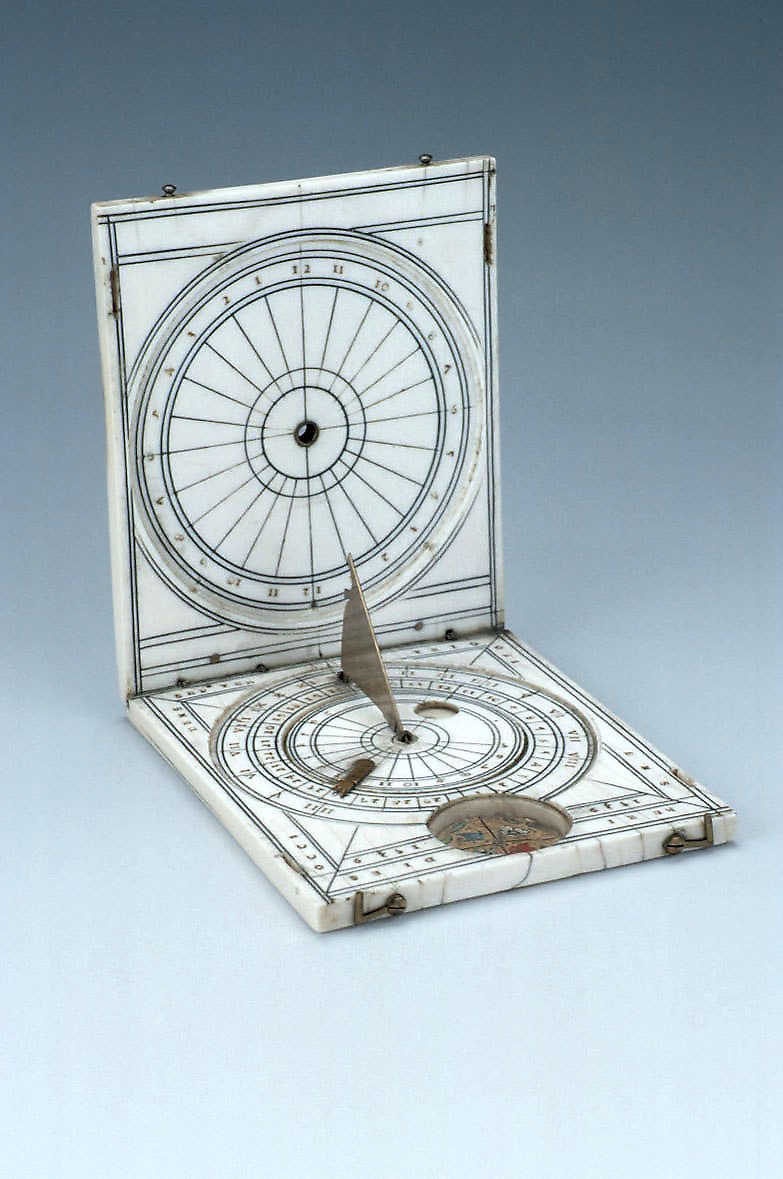
This Nuremberg diptych dial, held by the Museum of the History of Science, Oxford, is constructed from ivory and gilt brass. Measuring 93 x 111 x 12 mm, the object features an upper and lower leaf configuration. The upper leaf includes a nocturnal on the outer face and a pin gnomon dial on the inner side. The lower leaf houses a compass, now missing its needle and ring, with a decorative card painted in red, blue, and gold. The inner side of the lower leaf contains a dial with a folding brass gnomon and a pierced lunar volvelle. The dial displays cardinal points in the spandrels and includes a date at the bottom, originally inscribed as 1529 and later corrected to 1539.

Nuremberg diptych dial with folding gnomon and compass space.
Nuremberg diptych dial with folding gnomon and compass space. — Museum of the History of Science, Oxford. Rights pending — permission not yet requested. Original source

Catalogue identity

Source
www.mhs.ox.ac.uk
Category
Tool · Nuremberg diptych dial
Maker / attribution
Not established
Reference
Not recorded
Catalogue / lot identifier
70129
Source-reported date
1539
Source-reported place
Germany

Source-reported attribution and specifications are not independent authentication. A listing does not establish present ownership, current display, availability or permission to reproduce.

Object description

Construction and Layout

The diptych dial is constructed primarily of ivory with gilt brass accents, presenting as a folding case measuring approximately 93 by 111 by 12 mm. The device is organized into two leaves, the upper and lower, which serve as the housing for several distinct time-telling features. The exterior of the lower leaf is described as blank, while the outer side of the upper leaf serves as a gilt brass nocturnal, a device used to determine time based on the position of stars at night.

The inner faces are more complex, featuring multiple dials and indicators. The inner side of the upper leaf contains a pin gnomon dial, though the pin itself is missing. The lower leaf interior is equipped with a folding brass gnomon for measuring common hours, accompanied by a pierced lunar volvelle to track lunar phases. Cardinal points are marked in the spandrels as 'SEPTEMTRIO', 'ORIENS', 'MERIDIES', and 'OCCIDENS'.

Evidence for this section
  • “Ivory and gilt brass; 93 x 111 x 12 mm”
  • “The outer side of the upper leaf has a gilt brass nocturnal.”
  • “The inner side of the lower leaf has a pierced lunar volvelle and a dial with folding brass gnomon for common hours marked from IIII to XII to VIII.”

Inscriptions and Dating

The dial contains clear markings that assist in its temporal classification. A significant feature is the date inscription found at the bottom of the lower leaf. The source notes that the device appears to have been originally dated 1529, which was subsequently corrected to 1539.

The absence of a maker's mark leaves the specific origin within the Nuremberg craft tradition unattributed to a particular individual.

Evidence for this section
  • “At the bottom is the date '1529', corrected to '1539'.”
  • “Unsigned”
  • “In the spandrel spaces are the cardinal points named 'SEPTEMTRIO', 'ORIENS', 'MERIDIES', OCCIDENS'.”

Compass and Condition

Integrated into the lower leaf is a compass, which is currently missing its needle and ring. Despite the absence of these core mechanical components, the compass card remains present. It is described as being finely painted in red, blue, and gold, demonstrating the decorative attention applied to the instrument's functional elements.

The condition of the object is noted by the loss of specific components, namely the pin for the upper gnomon and the needle assembly of the compass. The instrument is documented in academic literature concerning European scientific history.

Evidence for this section
  • “At the bottom centre is a compass (needle and ring missing) with card painted in red, blue and gold.”
  • “The inner side of the upper leaf has a pin gnomon dial (pin missing)”
  • “See P. Gouk, The Ivory Sundials of Nuremberg 1500-1700 (Cambridge, 1988).”

Open research questions

  • What is the reason for the 1529 to 1539 date correction?
  • Which Nuremberg workshops are associated with this type of ivory diptych construction?

Source evidence

Recorded claims and source quotations for Nuremberg Diptych Dial
FieldSource-reported valueSource quotation
MaterialIvory and gilt brass“Ivory and gilt brass”
Dimensions93 x 111 x 12 mm“93 x 111 x 12 mm”
Date1539“Dated 1539”
LocationNuremberg“Nuremberg”
CompassNeedle and ring missing“compass (needle and ring missing)”
Upper leaf featuresGilt brass nocturnal on outer, pin gnomon dial on inner“The outer side of the upper leaf has a gilt brass nocturnal. The inner side of the upper leaf has a pin gnomon dial”
Lower leaf featuresPierced lunar volvelle and folding gnomon dial“The inner side of the lower leaf has a pierced lunar volvelle and a dial with folding brass gnomon”

Visible details

  • Folding brass gnomon on the lower leaf interior
  • Compass card featuring red, blue, and gold pigment
  • Engraved cardinal point labels in the spandrel corners
  • Diptych design with two ivory leaves connected by hinges

Research qualifications

  • Missing pin gnomon on the upper leaf
  • Missing compass needle and ring

Photograph identity and source facts were screened before import; rights clearance remains pending.

Consulted source

Diptych Dial

Reviewed 2026-10-26 · Record 8dcc7990de

Terms in this record

Glossary explanations for terms named in this object’s record.