
Skip to content
The Encyclopedia of Horology

Pocket watch · Pocket watch

Nicolas Gribelin watch

Partially verified

This pocket watch, held by the Metropolitan Museum of Art, is attributed to the maker Nicolas Gribelin (the Younger?), active in France during the 17th century. The object is described as a French, Paris movement, paired with a case of uncertain origin, possibly from Blois. The construction utilizes enameled gold for the case, while the movement is fabricated from gilded brass, steel, which is partly blued, and silver. The overall dimensions of the watch are 2 3/4 by 2 3/8 inches (approximately 7 by 6 cm). The museum documentation categorizes the item under European Sculpture and Decorative Arts, noting its identity as a singular watch within their collection.

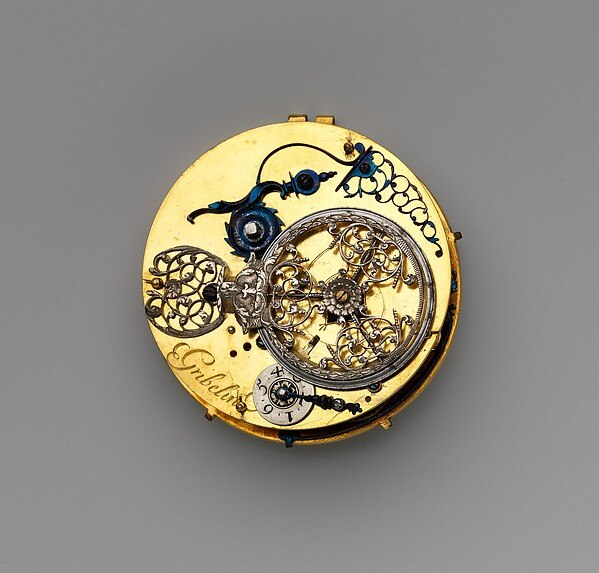
Detailed view of the internal movement of the watch, showing the balance cock, the regulator scale, and the signature of Nicolas Gribelin.
Detailed view of the internal movement of the watch, showing the balance cock, the regulator scale, and the signature of Nicolas Gribelin. — The Metropolitan Museum of Art, Gift of J. Pierpont Morgan, 1917. Rights pending — permission not yet requested. Original source

Catalogue identity

Source
orbiscollectibles.com
Category
Pocket watch · Pocket watch
Maker / attribution
Nicolas Gribelin (the Younger?)
Reference
Not recorded
Catalogue / lot identifier
17.190.1559
Source-reported date
case probably ca. 1650–60, movement ca. 1680
Source-reported place
France

Source-reported attribution and specifications are not independent authentication. A listing does not establish present ownership, current display, availability or permission to reproduce.

Object description

Case and External Features

The watch is housed in an enameled gold case, measuring 2 3/4 by 2 3/8 inches. The exterior and interior surfaces are decorated with detailed enameled figurative scenes and floral patterns. The lid and case body show a pastoral landscape on the interior and a classical figurative composition on the exterior, with floral decoration integrated along the perimeter of the watch case.

The case is attributed to a production date of approximately 1650 to 1660. The museum source notes that while the movement is of Parisian origin, the case may have been produced in Blois, indicating a potential assembly of components from different geographic sources.

Evidence for this section
  • “Case: enameled gold”
  • “case probably ca. 1650–60”
  • “French, Paris movement with possibly Blois case”

Movement and Construction

The movement is constructed primarily of gilded brass, with additional components made from silver and steel, some of which exhibit a blued finish. It features a floral-pierced balance cock and bridge. The movement contains a small regulator dial with a pointer, allowing for adjustments to the timekeeping.

The movement is dated to approximately 1680. It is formally identified as a French, Paris movement, and is attributed to the horologist Nicolas Gribelin, possibly the younger individual of that name, who was active between 1637 and 1719.

Evidence for this section
  • “Movement: gilded brass, steel, partly blued, and silver”
  • “movement ca. 1680”
  • “Watchmaker: Nicolas Gribelin (the Younger?) (French, 1637–1719)”

Provenance and Identification

The object is held by the Metropolitan Museum of Art as part of its European Sculpture and Decorative Arts collection under the accession number 17.190.1559. It was gifted to the museum by J. Pierpont Morgan in 1917. The documentation provided serves as the primary record for the object's materials, dimensions, and attributed dating.

The combination of a Paris-made movement with a potentially Blois-made case suggests a specific historical pairing that the museum has documented as part of its collection management.

Evidence for this section
  • “The Metropolitan Museum of Art holds this object as 17.190.1559”
  • “Gift of J. Pierpont Morgan, 1917”
  • “French, Paris movement with possibly Blois case”

Open research questions

  • Is there evidence to confirm the Blois origin of the case?
  • Can the association between this specific movement and case be dated to a particular historical collection context?

Source evidence

Recorded claims and source quotations for Nicolas Gribelin watch
FieldSource-reported valueSource quotation
MakerNicolas Gribelin (the Younger?) (French, 1637–1719)“Watchmaker: Nicolas Gribelin (the Younger?) (French, 1637–1719)”
Case materialenameled gold“Case: enameled gold”
Movement materialsgilded brass, steel, partly blued, and silver“Movement: gilded brass, steel, partly blued, and silver”
Dimensions2 3/4 × 2 3/8 in. (7 × 6 cm)“Overall: 2 3/4 × 2 3/8 in. (7 × 6 cm).”
Date estimatecase probably ca. 1650–60, movement ca. 1680“case probably ca. 1650–60, movement ca. 1680”
Museum number17.190.1559“17.190.1559”

Visible details

  • Movement features an engraved floral cock and balance bridge
  • Enamelwork on the case interior and exterior shows figurative scenes
  • Movement includes a small circular regulator scale with a pointer
  • Case exterior is decorated with floral motifs in enamel

Research qualifications

  • Maker attribution is qualified by the source as possibly being the younger Nicolas Gribelin
  • Case origin is not definitively identified and is only suggested as possibly being from Blois
  • The assembly of the movement and case at different dates is an estimated assessment by the institution

Photograph identity and source facts were screened before import; rights clearance remains pending.

Terms in this record

Glossary explanations for terms named in this object’s record.