
Skip to content
The Encyclopedia of Horology

Marine chronometer · Marine chronometer

Molyneux & Sons Marine Chronometer No. 1438

Partially verified

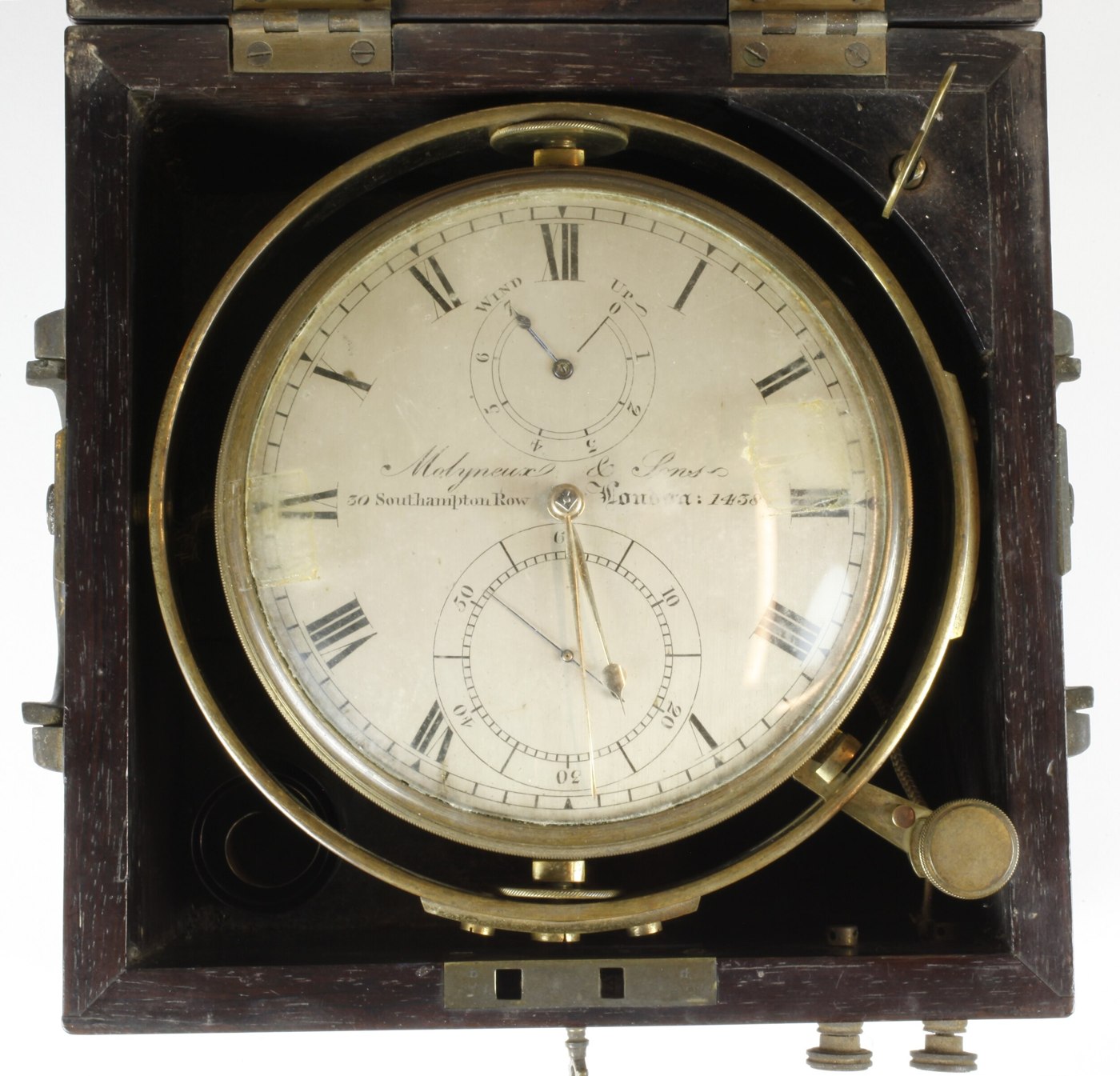
This marine chronometer, numbered 1438, was manufactured by Molyneux & Sons in London during the 1830s. The instrument features a silvered dial with Roman numerals, a winding indicator at the 12 o'clock position, and a subsidiary seconds dial at 6 o'clock. It is housed in a wooden box equipped with brass gimbals. In approximately 1860, the chronometer was modified by a watchmaker in Williamstown, Australia, to incorporate an electrical circuit connected to the seconds arbor. This adaptation enabled the generation of an electrical signal for use with a chronograph, facilitating its application in field observatories. The object was later utilized by the Melbourne Observatory for various astronomical activities, including the 1871 solar eclipse expedition and the Transits of Venus in 1874 and 1882. The item was transferred to the Museum Victoria from the Office of Trade Measurement in 1994.

Marine chronometer No. 1438, displaying the silvered dial, Roman numerals, and the winding and seconds sub-dials.
Marine chronometer No. 1438, displaying the silvered dial, Roman numerals, and the winding and seconds sub-dials. — Museums Victoria. Rights pending — permission not yet requested. Original source

Catalogue identity

Source
collections.museumsvictoria.com.au
Category
Marine chronometer · Marine chronometer
Maker / attribution
Molyneux & Sons
Reference
Not recorded
Catalogue / lot identifier
ST 42498
Source-reported date
circa 1830s
Source-reported place
England
Source-reported serial
1438

Source-reported attribution and specifications are not independent authentication. A listing does not establish present ownership, current display, availability or permission to reproduce.

Object description

Construction and Dial

The chronometer is housed in a wooden case and is mounted on brass gimbals to maintain level in marine environments. The dial is silvered and displays Roman numerals for the hours. Two subsidiary dials are integrated into the primary face: a winding indicator positioned at the 12 o'clock mark and a seconds dial located at the 6 o'clock position.

The dial bears an inscription that identifies the maker, their London address, and the specific serial number of the unit. The overall dimensions of the object are approximately 18 cm in length, 18 cm in width, and 20 cm in height.

Evidence for this section
  • “Brass chronometer on brass gimbals in wooden case.”
  • “Silvered dial with roman numerals and seconds dial at 6 o'clock and winding dial at 12 o'clock.”
  • “Dial marked "MOLYNEUX & SONS, 30 SOUTHAMPTON ROW, LONDON: 1438".”

Operational History and Modification

In approximately 1860, Government Astronomer Robert Ellery commissioned a modification to the device to enhance its utility for astronomical research. A watchmaker in Williamstown attached an electrical circuit to the seconds arbor, which produced a signal every second to mark a chronograph. This adaptation permitted the instrument to be used for the chronographic registration of astronomical observations during field expeditions.

The chronometer saw service during various scientific projects, notably the Melbourne Observatory's expedition to north Queensland for the 1871 total solar eclipse and the Transits of Venus in 1874 and 1882. Documentation from 1887 suggests the chronometer maintained an accurate rate at that time.

Evidence for this section
  • “In about 1860 Ellery had the chronometer adapted by a Williamstown watchmaker so that an electrical circuit was attached to the seconds arbor”
  • “used in several astronomical expeditions undertaken by the Melbourne Observatory, including the total solar eclipse expedition to north Queensland in 1871 and the Transits of Venus in 1874 and 1882.”
  • “In 1887 Ellery could report that the chronometer was still going at an excellent rate.”

Documentation and Maintenance

The object includes an internal label within the case that specifies its historical role as a sidereal chronometer at the Melbourne Observatory. This label also contains handwritten notations regarding various repair dates spanning from 1882 until 1892.

The provenance of the chronometer is documented through its transfer to the museum collection in 1994 from the Office of Trade Measurement, which was formerly known as the Weights and Measures Branch under the Victorian Local Government Department.

Evidence for this section
  • “Label inside case indicating chronometer used as a sidereal chronometer at Melbourne Observatory, and notes of repair dates from 1882 to 1892.”
  • “Transfer from Office of Trade Measurement (formerly Weights & Measures Branch), Victoria: Local Government Department, 28 Sep 1994”

Open research questions

  • What specific type of electrical contact mechanism was installed on the seconds arbor?
  • Are the internal components, aside from the electrical modification, consistent with Molyneux & Sons 1830s production standards?

Source evidence

Recorded claims and source quotations for Molyneux & Sons Marine Chronometer No. 1438
FieldSource-reported valueSource quotation
MakerMolyneux & Sons“Molyneux & Sons”
Datecirca 1830s“circa 1830s”
OriginLondon, England“London, England”
Registration NumberST 42498“Registration number: ST 42498”
Dimensions18 cm (L) x 18 cm (W) x 20 cm (H)“18 cm (Length), 18 cm (Width), 20 cm (Height)”
Electrical modificationCirca 1860“In about 1860 Ellery had the chronometer adapted by a Williamstown watchmaker”
ProvenanceTransfer from Office of Trade Measurement“Transfer from Office of Trade Measurement (formerly Weights & Measures Branch), Victoria: Local Government Department, 28 Sep 1994”

Visible details

  • Silvered dial with Roman numerals
  • Winding dial located at 12 o'clock
  • Secondary seconds dial at 6 o'clock
  • Wooden exterior case with brass corner reinforcements

Research qualifications

  • Modification date by Williamstown watchmaker is approximate
  • Exact functional status of the electrical circuit mechanism is not described

Photograph identity and source facts were screened before import; rights clearance remains pending.

Consulted source

Marine Chronometer - No.1438, Molyneux & Sons, London, England, circa 1830s

Reviewed 2026-10-26 · Record 7d6dba8c23

Terms in this record

Glossary explanations for terms named in this object’s record.