
Skip to content
The Encyclopedia of Horology

Marine chronometer · Two-day marine chronometer

Marine chronometer by Robert Roskell

Partially verified

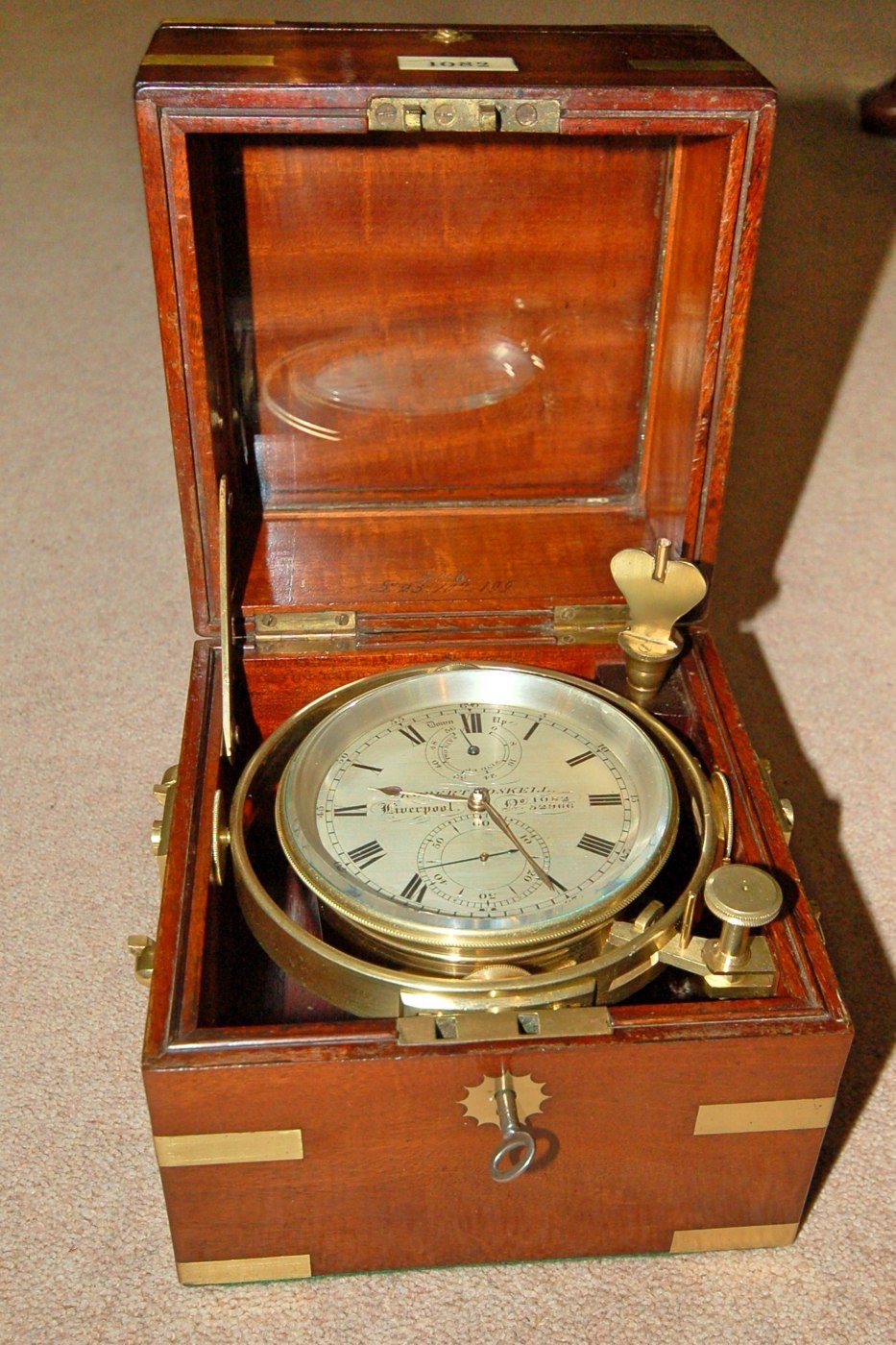
This early Victorian 56-hour marine chronometer was manufactured by the Liverpool maker Robert Roskell (1773-1847). The timepiece is housed in a three-tier, brass-bound mahogany box featuring carrying handles and a bone plaque inscribed with the number 1082. The chronometer movement is spring-driven with fusee and stop-work. The round, silvered dial is signed "Robert Roskell Liverpool" and carries the identification numbers 1082 and 52966. It displays Roman numerals, brass hands, a subsidiary seconds dial, and a state-of-wind indicator positioned at the 12 o'clock mark. The chronometer is mounted on brass gimbals within its wooden housing, measuring 16.5 cm in width, 17.7 cm in height, and 16.5 cm in depth. The piece is attributed to circa 1840 based on the maker's working period.

View of the open mahogany box showing the marine chronometer on brass gimbals, the silvered dial with subsidiary indicators, and the winding key.
View of the open mahogany box showing the marine chronometer on brass gimbals, the silvered dial with subsidiary indicators, and the winding key. — Pendulum of Mayfair. Rights pending — permission not yet requested. Original source

Catalogue identity

Source
www.pendulumofmayfair.co.uk
Category
Marine chronometer · Two-day marine chronometer
Maker / attribution
Robert Roskell
Reference
Not recorded
Catalogue / lot identifier
1062
Source-reported date
circa 1840
Source-reported place
United Kingdom
Source-reported serial
1082/52966

Source-reported attribution and specifications are not independent authentication. A listing does not establish present ownership, current display, availability or permission to reproduce.

Object description

Case and Presentation

The chronometer is housed in a three-tier mahogany box secured with brass fittings. The exterior features brass corner protectors and brass carrying handles to facilitate transport in maritime environments. A distinctive feature of the housing is the inset bone plaque on the front, which bears the number 1082, corresponding with the internal identification marks.

Internally, the chronometer is suspended on a set of brass gimbals, which allow the instrument to remain level despite the motion of a vessel. The box dimensions are recorded as 16.5 cm in width, 17.7 cm in height, and 16.5 cm in depth.

Evidence for this section
  • “The three tier brass bound mahogany box with bone plaque numbered 1082 and having brass carrying handles.”
  • “Case 16.5cm wide, 17.7cm high, 16.5cm deep.”
  • “An early Victorian 56 hour marine chronometer on brass gimbals”

Dial and Indication

The chronometer features a round, silvered dial marked with Roman numerals and equipped with brass hands. The dial is signed "Robert Roskell Liverpool" and includes two subsidiary displays. A state-of-wind indicator is positioned at the 12 o'clock position to show the remaining power reserve, while a subsidiary seconds dial is located towards the bottom.

The dial surface bears the identification numbers 1082 and 52966. These markings provide a specific reference for the instrument alongside the maker's signature.

Evidence for this section
  • “The silvered dial signed Robert Roskell Liverpool, numbered 1082/52966 with subsidiary seconds dial and state-of-wind at 12.”
  • “Subsidiary seconds and state of wind indicator to the round silvered dial with Roman Numerals and brass hands.”

Movement and Attribution

The mechanism is a 2-day, spring-driven fusee movement equipped with stop-work. It is attributed to the Liverpool-based maker Robert Roskell, who was active between 1773 and 1847. The source dates this specific chronometer to approximately 1840.

His work is connected to the later firm of Hunt & Roskell through his son's partnership.

Evidence for this section
  • “Robert Roskell (1773-1847), 2-day spring driven marine chronometer from around C1840.”
  • “High quality fusee movement with stop-work.”
  • “Robert’s son later became a partner in the firm of Hunt & Roskell.”

Open research questions

  • What is the purpose of the secondary serial number '52966' in addition to '1082'?
  • Are there any identifiable stamps on the movement plate that further clarify the date or production batch?

Source evidence

Recorded claims and source quotations for Marine chronometer by Robert Roskell
FieldSource-reported valueSource quotation
MakerRobert Roskell (1773-1847)“Robert Roskell (1773-1847), 2-day spring driven marine chronometer from around C1840.”
Movement typeFusee“High quality fusee movement with stop-work.”
Dial signatureRobert Roskell Liverpool“The silvered dial signed Robert Roskell Liverpool”
Box materialMahogany“The three tier brass bound mahogany box”
Dimensions16.5cm wide, 17.7cm high, 16.5cm deep“Case 16.5cm wide, 17.7cm high, 16.5cm deep.”
Chronometer duration56 hours“An early Victorian 56 hour marine chronometer”
Serial numbers1082/52966“Numbered 1082/52966.”

Visible details

  • Brass gimbal mount inside the wooden box
  • Bone identification plaque on the exterior case
  • State-of-wind indicator at the 12 o'clock position
  • Subsidiary seconds dial located at the bottom of the main dial

Research qualifications

  • The exact date of manufacture is approximate, provided as 'around C1840'.
  • The significance of the dual numbering sequence (1082/52966) is not explained in the source

Photograph identity and source facts were screened before import; rights clearance remains pending.

Terms in this record

Glossary explanations for terms named in this object’s record.