
Skip to content
The Encyclopedia of Horology

Clock · Spring mantel clock

Mantel clock by Pierre Leurtier

Partially verified

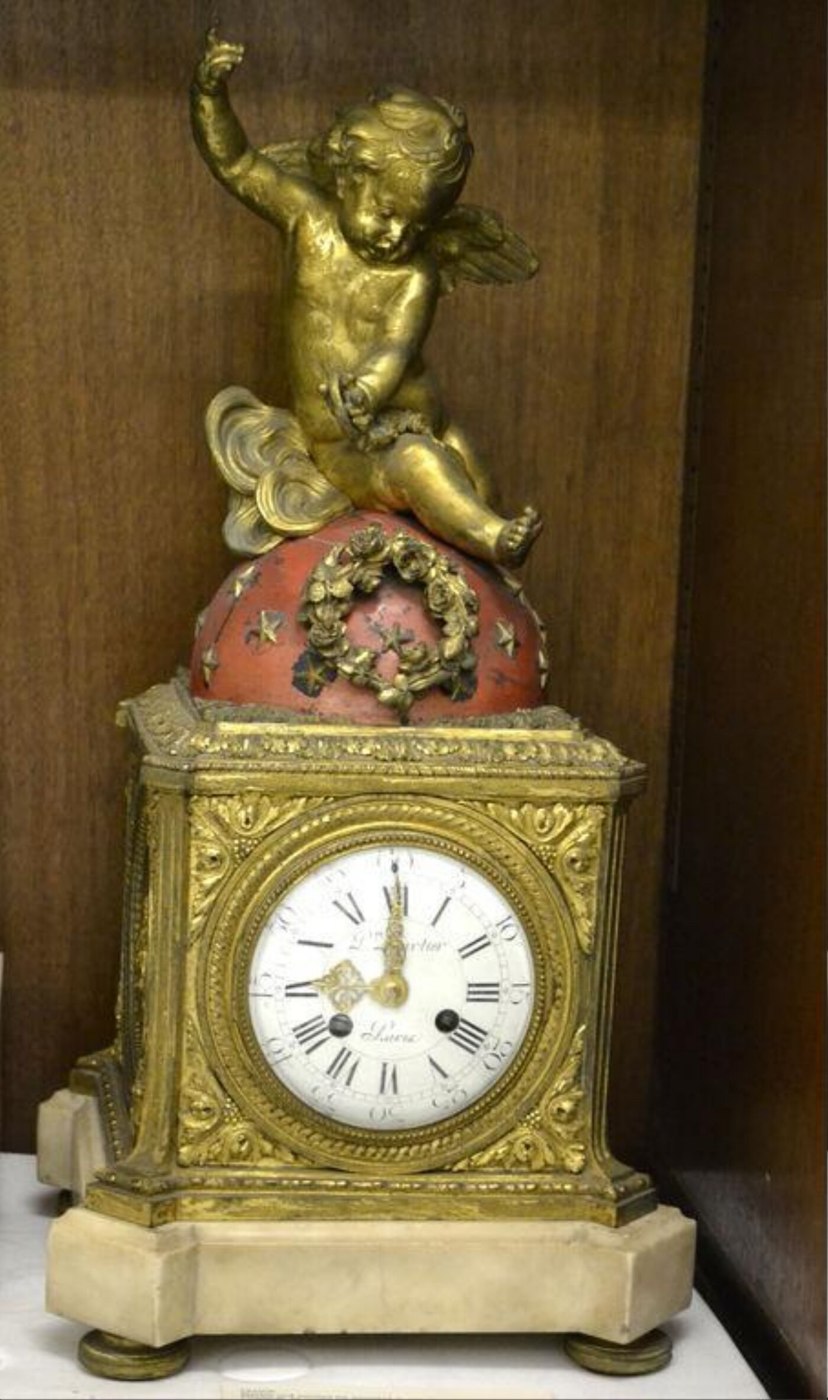
This spring-driven mantel clock was produced by the clockmaker Pierre Leurtier in Paris, approximately 1870. The timepiece features a cubical ormolu case set atop a white marble base with angled corners, supported by flat circular brass feet. The dial is white enamel, featuring Roman numerals for the hours and Arabic numerals for the minutes, with additional markings for five-minute intervals. A gilt-bronze figure of a cupid sits atop a red enamelled globe, which is decorated with star motifs and a wreath. The clock is signed "Pre Leurtier AParis" on the dial. The interior mechanism utilizes a circular movement plate with a Brocot-type regulator and an anchor escapement. It was acquired by the museum as part of a bequest from W.T. Johnson.

A spring-driven mantel clock featuring a cupid figurine, ormolu casing, and marble base.
A spring-driven mantel clock featuring a cupid figurine, ormolu casing, and marble base. — Victoria and Albert Museum, London. Rights pending — permission not yet requested. Original source

Catalogue identity

Source
collections.vam.ac.uk
Category
Clock · Spring mantel clock
Maker / attribution
Pierre Leurtier
Reference
Not recorded
Catalogue / lot identifier
M.1780-1944
Source-reported date
1860
Source-reported place
France
Source-reported serial
2298

Source-reported attribution and specifications are not independent authentication. A listing does not establish present ownership, current display, availability or permission to reproduce.

Object description

Case and Dial Design

The clock is housed in a cubical ormolu case, distinguished by decorative enamel side plaques depicting cupids. The dial is executed in white enamel, measuring 11.4 cm in diameter, and includes standard hour and minute graduations in Roman and Arabic numerals, respectively. A small regulation aperture is positioned above the twelve o'clock marker.

The top of the assembly features an allegorical cupid figure seated upon a red-enamelled globe. The globe is ornamented with star-shaped decorations and a central wreath. The case rests upon a white marble base with angled corners, supported by simple, flat circular brass feet, which elevate the structure from the surface on which it rests.

Evidence for this section
  • “A spring clock with a white enamelled dial on a white marble base with angled corners”
  • “the sides set with oval enamel plaques decorated with cupids. On top is a cupid sitting on a red enamelled globe studded with stars and mounted with a wreath.”

Movement and Mechanism

The movement is constructed on circular plates 9 cm in diameter. It employs a Brocot-type regulator and an anchor escapement with an escape wheel containing 43 teeth. The anchor pallets are designed to embrace twelve teeth of the escape wheel. Both the going and striking trains are powered by going barrels, and the striking train utilizes a rack mechanism.

The backplate is marked with the initials 'AC' within a circular stamp, accompanied by the serial number 2298. Additional numeric stamps read '4 6' at the bottom of the plate. At the current time, the pendulum and the bell for the striking train are not present within the movement casing.

Evidence for this section
  • “the backplate stamped with the initials AC within a circle and 2298 also stamped 4 6 at bottom”
  • “anchor escapement, with escape wheel of 43T, the pallets embracing 12 teeth. The pendulum missing, but regulator of Brocot type.”

Provenance and Documentation

The clock was bequeathed to the museum by W.T. Johnson. The object is officially catalogued under accession number M.1780-1944.

The clockmaker, Pierre Leurtier, is listed as the author of the piece, with the signature appearing on the dial. The place of manufacture is recorded as Paris, and the dating of the object is established as approximately 1870.

Evidence for this section
  • “Bequeathed by W.T. Johnson with a collection of over 150 pieces of English, French and Irish domestic 18th and 19th century silver”
  • “Date: 1870”

Open research questions

  • What is the significance of the stamp 'AC' on the backplate?
  • Were the original pendulum and bell lost prior to the bequest by W.T. Johnson?

Source evidence

Recorded claims and source quotations for Mantel clock by Pierre Leurtier
FieldSource-reported valueSource quotation
MakerLeurtier, Pierre (clockmaker)“Leurtier, Pierre (clockmaker)”
Place of originParis“Paris (made)”
Accession numberM.1780-1944“M.1780-1944”
Case materialMarble, brass, ormolu“Marble, brass, ormolu”
Dial signaturePre Leurtier AParis“Pre Leurtier AParis”
Dimensions21 in height“Height: 21 in”

Visible details

  • White enamel dial with Roman hour numerals
  • Cupid figure perched on a red star-studded globe
  • Flat circular brass feet supporting a white marble plinth
  • Ornate gilt brass hands on a white dial

Research qualifications

  • The pendulum is missing from the movement
  • The bell component is missing from the striking train

Photograph identity and source facts were screened before import; rights clearance remains pending.

Consulted source

Clock

Reviewed 2026-10-26 · Record 74cc9f9723

Terms in this record

Glossary explanations for terms named in this object’s record.