
Skip to content
The Encyclopedia of Horology

Clock · Lyre clock

Lyre Clock with Second and Date

Partially verified

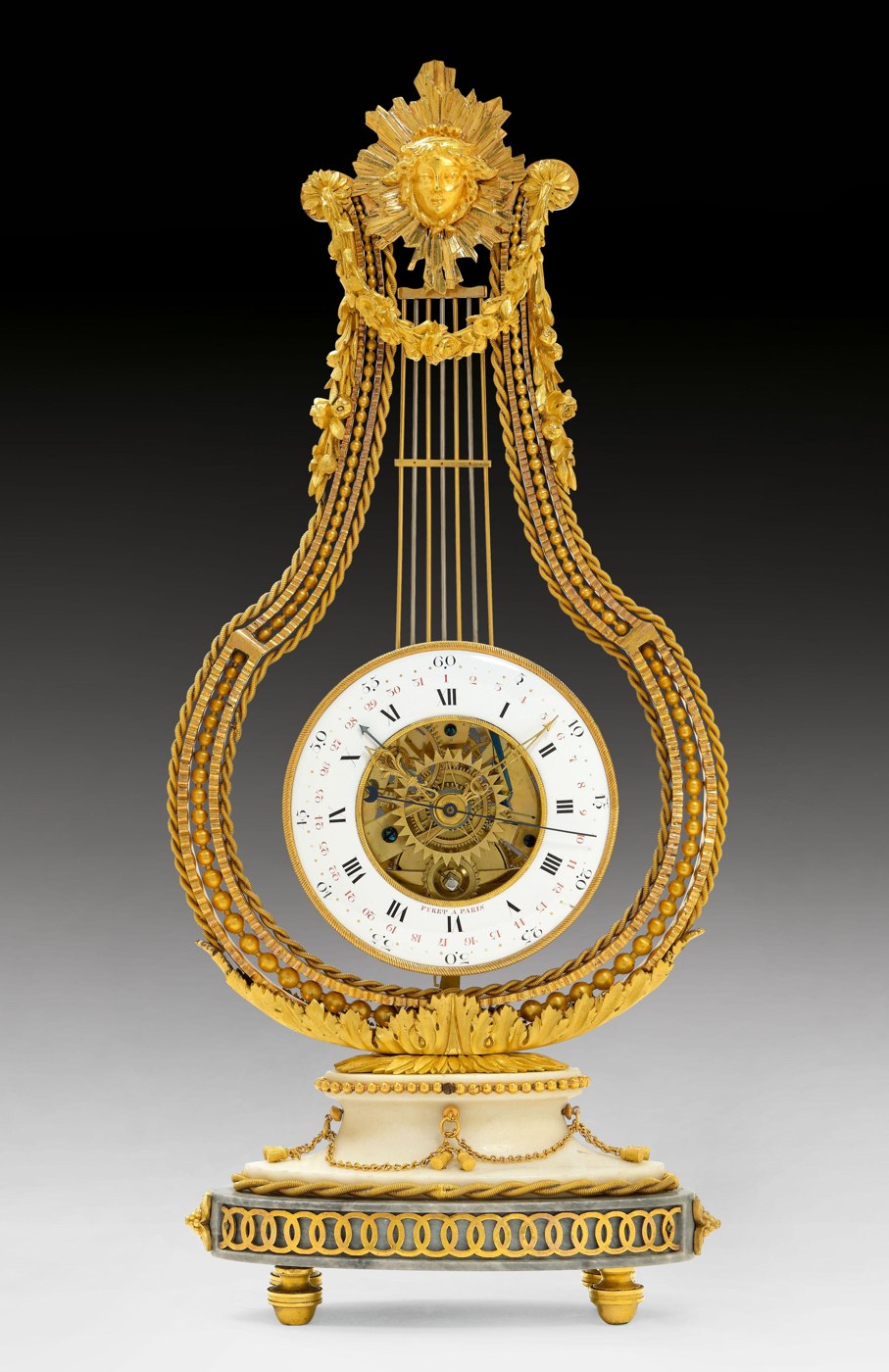
This French lyre-form clock, dating to approximately 1780, is attributed to the Parisian clockmaker Furet. The timepiece features an openwork frame constructed of gilt bronze, which is designed to emulate the silhouette of a lyre. The upper portion of the frame is ornamented with a woman's face within a sunburst halo, accompanied by flower garlands. The movement, which incorporates a scissor escapement and a compensation pendulum, is integrated into the central swinging assembly. The white enamel chapter ring displays Roman numerals for the hours, with Arabic numerals for both the minutes and the date, marked in black and red. The clock rests upon a stepped marble base composed of white and grey stone, embellished with meander frieze, beadwork, and chain details, and supported by round feet.

Front view of the lyre clock featuring the gilt bronze frame and central dial assembly.
Front view of the lyre clock featuring the gilt bronze frame and central dial assembly. — Invaluable / Koller Auctions (via Invaluable). Rights pending — permission not yet requested. Original source

Catalogue identity

Source
www.invaluable.com
Category
Clock · Lyre clock
Maker / attribution
Furet
Reference
Not recorded
Catalogue / lot identifier
1122
Source-reported date
circa 1780
Source-reported place
France

Source-reported attribution and specifications are not independent authentication. A listing does not establish present ownership, current display, availability or permission to reproduce.

Object description

Design and Construction

The clock is designed in the form of a lyre, a specific decorative shape associated with the Louis XVI period that draws thematic inspiration from music. The openwork gilt bronze frame supports the central components, with the pendulum rods oriented to represent the strings of the instrument. The structure is finished at the top with a sun-figure featuring a facial motif, often identified as a Medusa head, surrounded by a halo and adorned with floral garlands.

The entire assembly is mounted upon a stepped marble base consisting of white and grey stone. This base is further embellished with refined metalwork, including a meander frieze, beadwork, and decorative chains. The object is supported by round feet and is displayed with a glass cloche on a later base.

Evidence for this section
  • “Openwork frame in the shape of a lyre, the top decorated with a woman's face and flower garlands”
  • “The lyre pendulum is a very specific form from the Louis XVI period and is dedicated to the theme of music”
  • “On a stepped marble base with a recessed top and round feet. The base decorated with a meander frieze, beadwork and chains.”

Movement and Dial

The timepiece utilizes a partially skeletonized movement, which is integrated directly into the swinging pendulum assembly. The escapement is of the scissor type, and the clock is equipped with a compensation pendulum.

The chapter ring is crafted from white enamel and provides three distinct sets of markings: Roman numerals for the hours, and Arabic numerals for the minutes and date. These indicators are rendered in a combination of black and red paint. The dial is signed Furet à Paris.

Evidence for this section
  • “The clock with partially skeletonized movement mounted on a compensation pendulum”
  • “Movement with scissor escapement”
  • “White enamel chapter ring with Roman hours, Arabic minutes and Arabic date numerals in black and red.”

Condition and Attribution

The auction description attributes the clock to the Parisian maker Furet, dating it to approximately 1780.

The item is sold as part of a lot that includes a glass cloche and a later base assembly, which provides structural support for the original clock mechanism.

Evidence for this section
  • “Louis XVI, Paris ca. 1780, the chapter ring signed Furet à Paris”
  • “Chips to the marble base, minimal losses to the chapter ring.”
  • “On a later base with a glass cloche.”

Open research questions

  • What is the specific historical relationship between Furet and the production of lyre-form clocks during the late 18th century?
  • Are there archival records linking this specific movement configuration to Furet's workshop versus contemporary Parisian clockmakers?

Source evidence

Recorded claims and source quotations for Lyre Clock with Second and Date
FieldSource-reported valueSource quotation
MakerFuret“the chapter ring signed Furet à Paris”
Datecirca 1780“ca. 1780”
MaterialsGilt bronze and marble“Gilt bronze and white and grey marble”
Height52 cm“H 52 cm”
EscapementScissor“Movement with scissor escapement”
ConditionMarble chips and dial losses“Chips to the marble base, minimal losses to the chapter ring”
Design typeFree-swinging pendulum“features this second, ingenious system of the free-swinging pendulum”

Visible details

  • The dial features both Roman hour and Arabic date numerals
  • A sun-figure with a human face surmounts the lyre frame

Research qualifications

  • The source mentions a 'later base' which may not be original to the 18th-century clock
  • The exact identity of the woman's face, described as a possible Medusa, remains source-attributed

Photograph identity and source facts were screened before import; rights clearance remains pending.

Terms in this record

Glossary explanations for terms named in this object’s record.