
Skip to content
The Encyclopedia of Horology

Clock · Table clock

Louis XVI portico table clock by Nicolas-Alexandre Folin

Partially verified

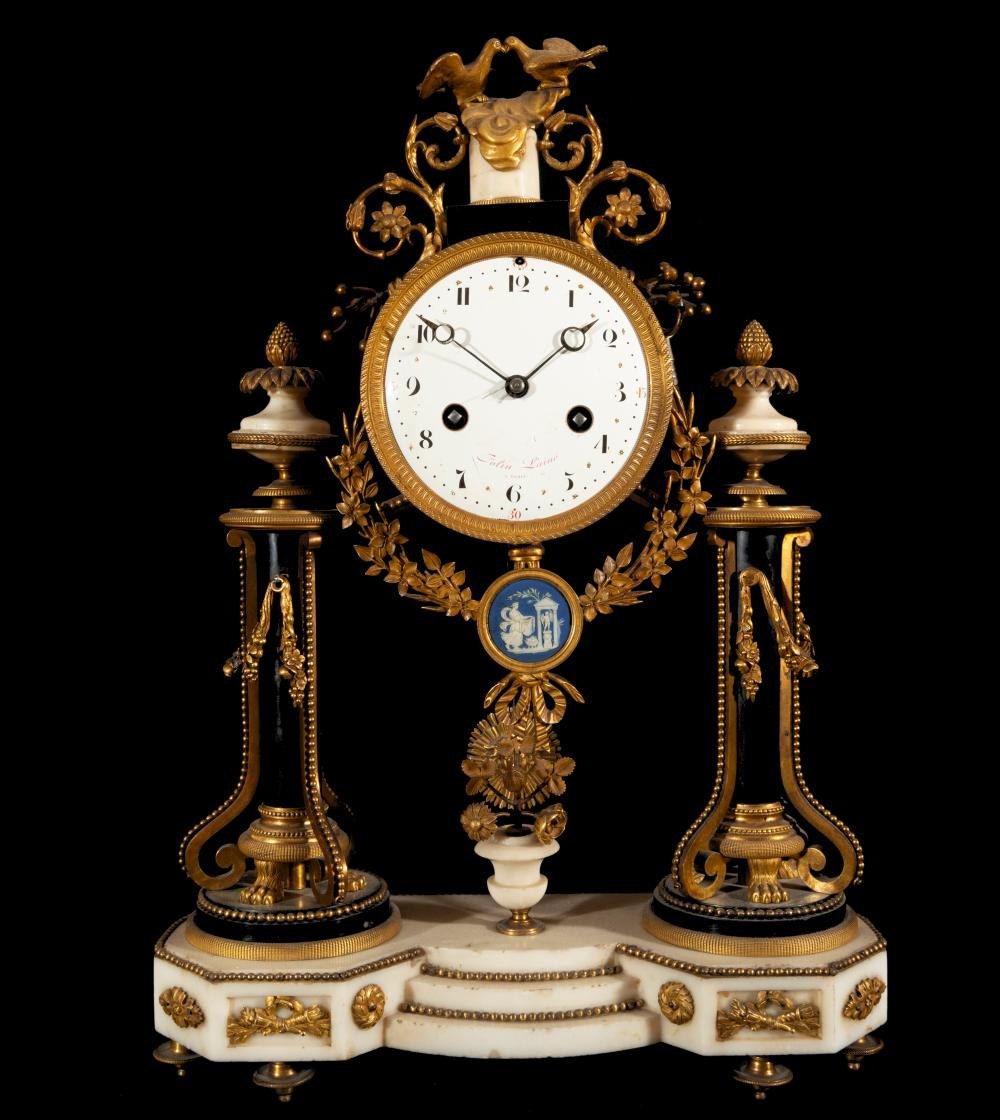
This Louis XVI table clock is of the 'pendule portique' type, constructed from black and white marble. The clock is signed 'Folin l'Ainé à Paris' on the enamel dial, which features Arabic numerals. The movement is fitted with an anchor escapement and a pendulum. Its sounding mechanism uses a counting wheel to strike on a silver amalgamated bell, ringing once on both the half hour and the full hour. The case design incorporates gilt metal ornamentation, including floral swags, a central blue and white ceramic medallion, and a bird-topped summit. The overall dimensions of the clock are 53x37x15 cm. Provenance for this piece is attributed to The Antoon Gaemers Collection, identified as belonging to the estate of a fourth-generation watchmaker. The clock dates to the late 18th century, a period during which the maker, Nicolas-Alexandre Folin, was active in Paris.

Front view of the Louis XVI portico table clock showing the enamel dial, marble base, and gilt metal ornamentation.
Front view of the Louis XVI portico table clock showing the enamel dial, marble base, and gilt metal ornamentation. — Templum Fine Art Auctions (via Invaluable). Rights pending — permission not yet requested. Original source

Catalogue identity

Source
www.invaluable.com
Category
Clock · Table clock
Maker / attribution
Nicolas-Alexandre Folin
Reference
Not recorded
Catalogue / lot identifier
483
Source-reported date
18th century
Source-reported place
France

Source-reported attribution and specifications are not independent authentication. A listing does not establish present ownership, current display, availability or permission to reproduce.

Object description

Case and Aesthetic Design

The table clock follows the 'pendule portique' form, utilizing a structural arrangement of black marble pillars set upon a white marble base. The base is decorated with gilt metal appliqués featuring floral wreaths and military trophies.

The central portion of the clock hosts the dial, which is framed by a wreath of gilt metal foliage. Below the dial, a circular blue and white ceramic medallion depicting a classical scene is suspended, flanked by a sunburst motif and floral arrangements. The summit of the clock is capped with a gilt metal figure of two birds.

Evidence indicates the use of varied materials in the construction, combining black and white marble with cast gilt metal elements to achieve the Louis XVI stylistic presentation.

Evidence for this section
  • “Black and white marble table clock 'pendule portique'”
  • “enamel dial with Arabic numerals, signed 'Folin l'Ainé à Paris'”
  • “the sound mechanism with counting wheel, ringing once on the half hour and the whole hour on a silver amalgamated bell.”

Mechanism and Function

The clock is powered by a manual winding movement. Timekeeping is regulated by an anchor escapement and a pendulum.

The striking mechanism is governed by a counting wheel. This system enables the clock to sound once on both the half hour and the full hour. The sound is produced by a silver amalgamated bell located within the case.

Evidence for this section
  • “the mechanism with an anchor escapement and a pendulum suspended from rope”
  • “the sound mechanism with counting wheel, ringing once on the half hour and the whole hour on a silver amalgamated bell.”

Maker and Provenance

The clock is signed by Nicolas-Alexandre Folin, noted as 'Folin l'Ainé' ('Folin the Elder'). While the maker was active as a watchmaker for a significant duration, he was officially accepted into the master guild in 1789.

The clock was part of The Antoon Gaemers Collection, which represented four generations of chronometry expertise held by the Gaemers family, who were collectors and watchmakers.

Documentation provided by the auction house associates this specific object with the Antoon Gaemers collection, noting its appearance in historical photography.

Evidence for this section
  • “signed 'Folin l'Ainé à Paris'”
  • “Although he was only accepted into the guild as a master in 1789”
  • “Provenance: The Antoon Gaemers Collection: Four Generations of Chronometry”
  • “Demonstrable in the last two photographs, the same watch that occupies our place appears.”

Open research questions

  • Are there specific hallmarking or records that further narrow the manufacture date within the late 18th century?
  • What is the specific material composition and origin of the blue and white medallion?

Source evidence

Recorded claims and source quotations for Louis XVI portico table clock by Nicolas-Alexandre Folin
FieldSource-reported valueSource quotation
MakerNicolas-Alexandre Folin“Nicolas-Alexandre Folin”
SignedFolin l'Ainé à Paris“signed 'Folin l'Ainé à Paris'”
Dimensions53 x 37 x 15 cm“53x37x15 cm”
StrikeHalf hour and full hour“ringing once on the half hour and the whole hour”
MaterialBlack and white marble“Black and white marble table clock 'pendule portique'”
EscapementAnchor“mechanism with an anchor escapement”
ProvenanceThe Antoon Gaemers Collection“Provenance: The Antoon Gaemers Collection: Four Generations of Chronometry”

Visible details

  • Enamel dial with Arabic numerals
  • Central blue and white medallion
  • Gilt metal bird finial
  • Black marble pillars

Research qualifications

  • Maker active before 1789 but master status only confirmed in 1789
  • Exact year of manufacture not definitively confirmed by records

Photograph identity and source facts were screened before import; rights clearance remains pending.

Consulted source

French 18th century Louis XVI table clock H.1780 Nicolas-Alexandre Folin

Reviewed 2026-10-26 · Record 77d4d5ac5a

Terms in this record

Glossary explanations for terms named in this object’s record.