
Skip to content
The Encyclopedia of Horology

Clock · Longcase clock

Longcase clock by Joseph Davis

Partially verified

This longcase clock, attributed to circa 1740, is attributed to the London-based maker Joseph Davis. Standing 211.5 cm tall, the clock features a case finished in green and gold japanning, a European technique imitating Asian lacquer that employs varnish and gold leaf. The wooden case is adorned with Chinoiserie-style motifs, including floral sprays, figures, and architectural elements, and contains an internal lining of paper stamped with Chinese scenes. The arched hood houses a brass dial with a silvered chapter ring, signed 'Joseph Davis, London' on a circular plate. The brass dial plate is further decorated with mounts featuring masks, dolphins, and scrollwork. The case includes a hinged door with a central circular glass panel. Given to the Victoria and Albert Museum by Lionel Harris, the clock was reported by the donor to have been originally purchased in Spain.

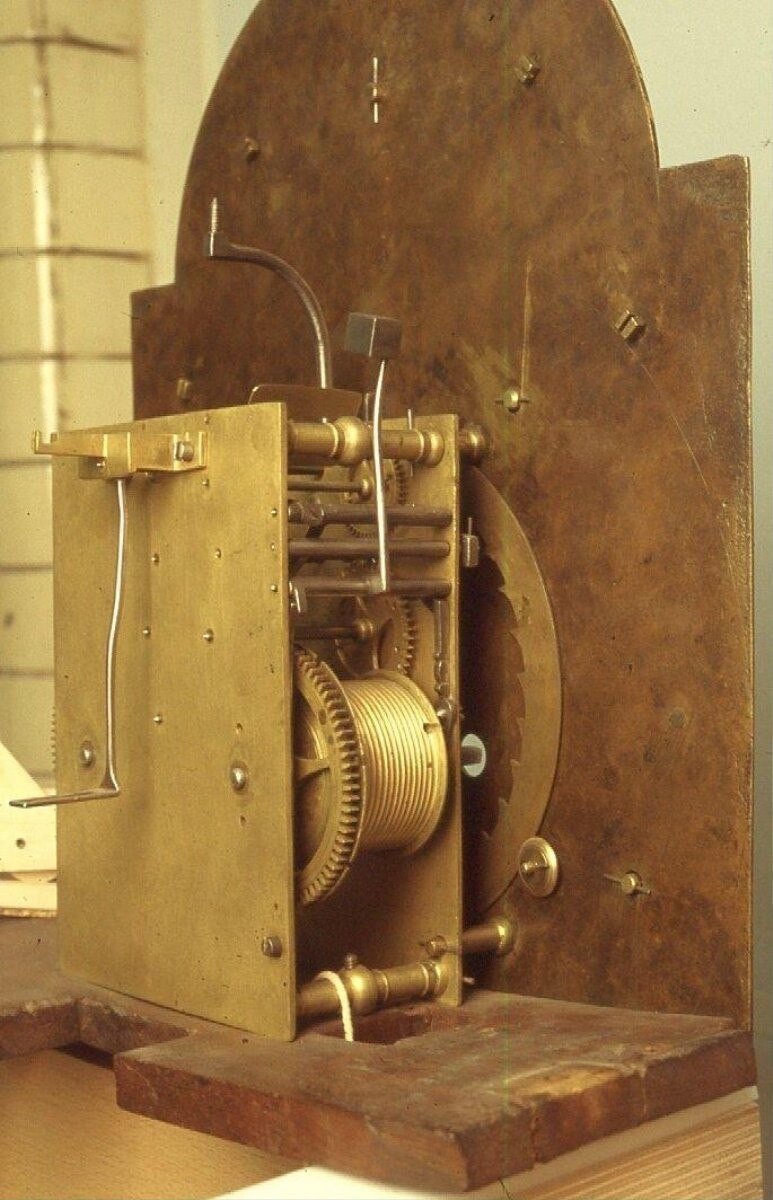
Side view of the clock mechanism showing the brass plates and barrel
Side view of the clock mechanism showing the brass plates and barrel — Victoria and Albert Museum. Rights pending — permission not yet requested. Original source

Catalogue identity

Source
collections.vam.ac.uk
Category
Clock · Longcase clock
Maker / attribution
Joseph Davis
Reference
Not recorded
Catalogue / lot identifier
W.29:1to3-1911
Source-reported date
c.1740
Source-reported place
London

Source-reported attribution and specifications are not independent authentication. A listing does not establish present ownership, current display, availability or permission to reproduce.

Object description

Case Construction and Decoration

The clock features a long-case construction finished in green and gold japanning. The case is decorated with Chinoiserie motifs, including floral designs, figures, and architectural scenes, applied over a surface of varnish and gold leaf. The interior of the case is lined with paper stamped with Chinese scenes on a gilt ground.

Structural elements include a hinged door with a central circular glass panel. The current condition shows that the hood has been restored and the base exhibits significant surface damage, with the lining paper noted as worn and the back of the case pierced with holes.

Evidence for this section
  • “The case is simply made with mouldings and is decorated in lacquer on the hinged door and base with sprays of flowers, figures (one on horseback) and a building; in the middle of the door is a circular panel of glass.”
  • “The case is lined inside with paper stamped with Chinese secenes on a gilt ground.”
  • “Hood restored: surface considerably damaged especially on the base.”

Dial and Signature

The clock features an arched hood which encloses a brass dial. The dial is equipped with a silvered chapter ring and a circular dial plate where the signature 'Joseph Davis, London' is engraved.

The brass dial plate is enriched with decorative metal mounts. These mounts incorporate designs of masks, dolphins, and scrollwork. This dial assembly sits within the hood structure, which serves as the primary mounting for the timekeeping face.

Evidence for this section
  • “the arched hood surrounding a brass dial with silvered chapter ring, the dial signed in a circular dial plate, 'Joseph Davis, London'.”
  • “The brass dial plate is enriched with mounts of masks, dolphins and scrollwork.”

History and Provenance

The clock was donated to the collection by Lionel Harris of The Spanish Art Gallery. Records indicate the donor stated the clock was purchased in Spain, a provenance considered credible given the export of London-made clocks to Spain during the mid-18th century.

The object was on loan to Hogarth's House, Chiswick, beginning in 1952. The clock is associated with other japanned timepieces produced by Davis, and it is proposed that the maker specialized in supplying such decorated clocks throughout his career.

Evidence for this section
  • “Gift from Lionel Harris (The Spanish Art Gallery, 50 Conduit St. W1).”
  • “Said to have been purchased in Spain. This is entirely credible and japanned clocks were a major export from London in the middle of the 18th century”
  • “From 1952 this clock was on loan to Hogarth's House, Chiswick, for some years.”

Open research questions

  • What is the specific mechanical configuration of the striking train visible in the movement?
  • Are there visible signs of internal clockwork alterations or replacements consistent with 18th-century usage?

Source evidence

Recorded claims and source quotations for Longcase clock by Joseph Davis
FieldSource-reported valueSource quotation
MakerJoseph Davis“'Joseph Davis, London'”
Datec.1740“c.1740”
ProvenanceLionel Harris“Gift from Lionel Harris”
TechniqueJapanning“varnished ('japanned') outer case that was a European imitation of Asian lacquer”
ConditionHood restored“Hood restored: surface considerably damaged especially on the base.”

Visible details

  • Brass dial plate with mask, dolphin and scrollwork mounts
  • Mechanism showing going train barrel and circular plates
  • Interior of case lined with paper featuring Chinese scenes
  • Hinged door with central circular glass panel

Research qualifications

  • Originality of the hood cresting is uncertain
  • Exact history of purchase in Spain is unverified

Photograph identity and source facts were screened before import; rights clearance remains pending.

Consulted source

A long-case clock with green and gold japanned case

Reviewed 2026-11-02 · Record 81079c0d80

Terms in this record

Glossary explanations for terms named in this object’s record.