
Skip to content
The Encyclopedia of Horology

Clock · Table clock

Late 18th-century mahogany table clock by Alexander Cumming

Partially verified

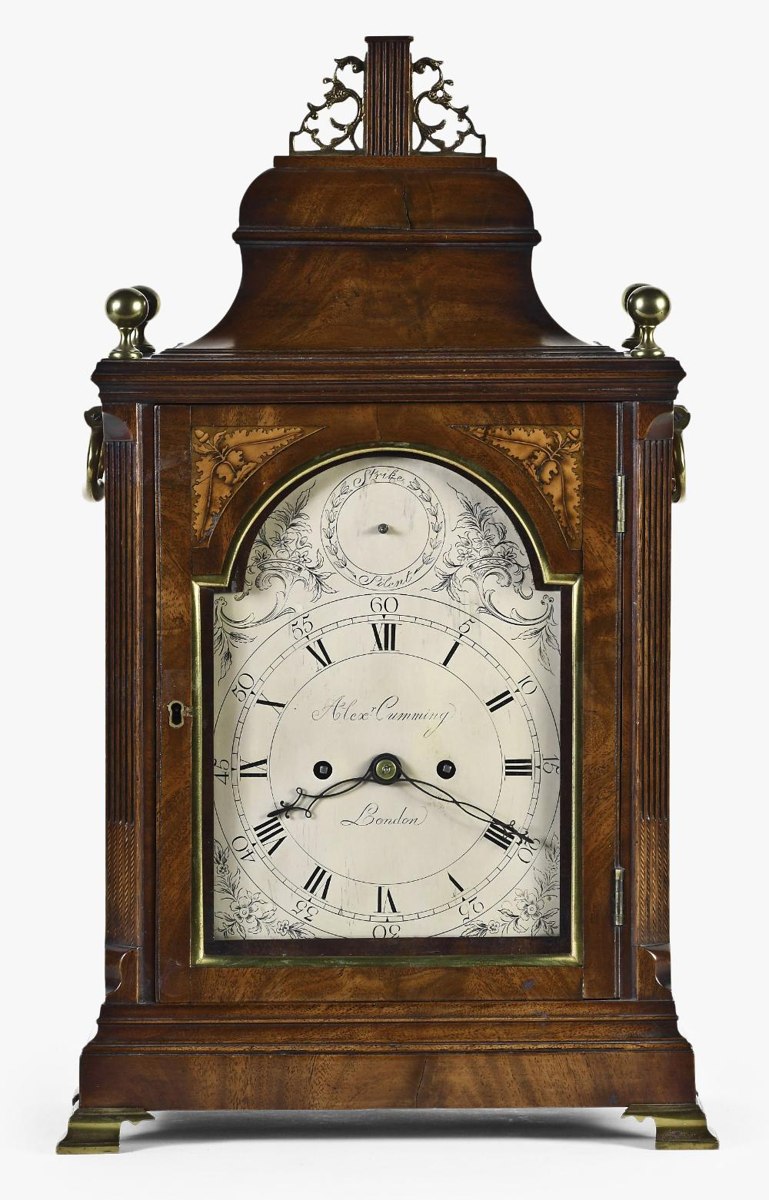
This late 18th-century English table clock by Alexander Cumming of London is housed in a mahogany-veneered bell-top case resting on brass bracket feet. The case displays stop-fluted canted corners with line inlays, oak leaf and acorn marquetry in the upper door spandrels, brass carrying handles, and brass finials. The top is surmounted by a fluted plinth flanked by brass ornaments. Its arched silvered brass dial is inscribed 'Alexr Cumming London' with Roman hour markers, Arabic five-minute numerals, engraved foliate spandrels, and a subsidiary Strike/Silent ring in the arch. The source reports an eight-day, two-train fusee movement striking on a bell.

Front view of late 18th-century mahogany table clock signed by Alexander Cumming
Front view of late 18th-century mahogany table clock signed by Alexander Cumming — Schmitt Horan & Co.. Rights pending — permission not yet requested. Original source

Catalogue identity

Source
www.invaluable.com
Category
Clock · Table clock
Maker / attribution
Alexander Cumming
Reference
Not recorded
Catalogue / lot identifier
465
Source-reported date
circa 1790
Country
United Kingdom

Source-reported attribution and specifications are not independent authentication. A listing does not establish present ownership, current display, availability or permission to reproduce.

Object description

Case Construction and Decorative Elements

The clock is housed in a mahogany-veneered, bell-top case, which rests upon brass bracket feet. The design includes a molded base and top, with the front corners featuring stop-fluted canting and contrasting line inlays. The door is flanked by this marquetry and features oak leaf and acorn motifs.

The sides of the case are fitted with brass carrying handles and frets. The upper section is surmounted by a fluted plinth flanked by decorative brass ornaments. The top section is described as lacking a top finial.

Evidence for this section
  • “the mahogany veneered, bell top case on brass bracket feet and with molded base and top”
  • “canted, stop fluted corners with contrasting line inlays flanking the door with oak leaf and acorn marquetry”
  • “the sides with brass frets and handles”
  • “surmounted by a fluted plinth with flanking brass ornaments”
  • “lacking top finial”

Dial and Timing Mechanism

The time is displayed via a sheet-brass silvered dial, which features Roman hour numerals and Arabic five-minute markers. The surface is decorated with engraved floral and foliate spandrels and equipped with blued steel hands.

The movement is an eight-day, two-train fusee mechanism that strikes the hour on a bell. The backplate features an engraved border, and the pendulum includes a similarly engraved bob. A subsidiary dial located in the arch is designated for 'Strike/Silent' functions, though the source notes the indicator is missing.

Evidence for this section
  • “roman numeral sheet brass silvered dial with arabic five minute markers, engraved floral and foliate spandrels and blued steel hands”
  • “8 day two train fusee movement, the back plate with engraved border and striking the hour on a bell, and pendulum with similarly engraved bob”
  • “lacking strike/ silent indicator”

Condition and Historical Notes

The clock is attributed to Alexander Cumming of London and is noted as dating to approximately 1790. A clock repairer’s label dated 1863 is present on the seat board.

Reported condition issues include minor splits and losses to the veneers, with some lifting on the convex portion of the front top. The dial has been resilvered, and the dial mask shows replaced veneers, splits in the joints, and warping at the upper right.

Evidence for this section
  • “Alexander Cumming, London, a good late 18th century table clock”
  • “circa 1790”
  • “the seat board with clock repairers label dated 1863”
  • “veneers with minor splits and a few minor losses, veneer lifting on convex portion of front of top”
  • “dial mask veneers replaced, top portion of dial mask with warp at upper right, mask joints with splits, dial resilvered”

Open research questions

  • What is the specific nature of the warping on the upper right of the dial mask and how does it affect the alignment of the strike/silent ring?
  • Does the 1863 repairer's label identify a specific workshop or geographic location?
  • Is there evidence of original mounting hardware for the missing finial that could guide a historically appropriate restoration?

Source evidence

Recorded claims and source quotations for Late 18th-century mahogany table clock by Alexander Cumming
FieldSource-reported valueSource quotation
Maker and originAlexander Cumming, London“Alexander Cumming, London, a good late 18th century table clock”
Movement type8 day two train fusee movement“8 day two train fusee movement, the back plate with engraved border and striking the hour on a bell”
Case designMahogany veneered bell top case on brass bracket feet“the mahogany veneered, bell top case on brass bracket feet and with molded base and top”
Dimensions21.5in x 12.75in x 8in“Dimensions 21.5in x 12.75in x 8in”
Reported datecirca 1790“circa 1790”
ProvenanceFormerly from the collection of Victor Kochaver“From the collection of Victor Kochaver”
AccessoriesIncludes door key“ACCESSORIES: door key”

Visible details

  • Silvered dial is signed 'Alexr Cumming London' across the center.
  • Arched upper subsidiary dial ring is engraved 'Strike' and 'Silent', lacking an indicator hand.
  • Mahogany bell-top case features stop-fluted canted corners and oak leaf and acorn marquetry spandrels above the glazed door.
  • Fluted rectangular plinth at the top center has flanking pierced brass scrollwork ornaments, but lacks a central top finial.
  • Case is supported on four shaped brass bracket feet and fitted with brass side carrying handles.

Research qualifications

  • Source notes the dial has been resilvered, dial mask veneers were replaced, the top finial is missing, and the strike/silent indicator is lacking.
  • Internal two-train fusee movement and engraved backplate are not visible in the front photograph.

Photograph identity and source facts were screened before import; rights clearance remains pending.

Consulted source

At Auction: A good late 18th century mahogany table clock by Alexander Cumming

Reviewed 2026-10-25 · Record 9cd255235a

Terms in this record

Glossary explanations for terms named in this object’s record.