
Skip to content
The Encyclopedia of Horology

Clock · Lantern clock

Lantern clock by William Goodwin

Partially verified

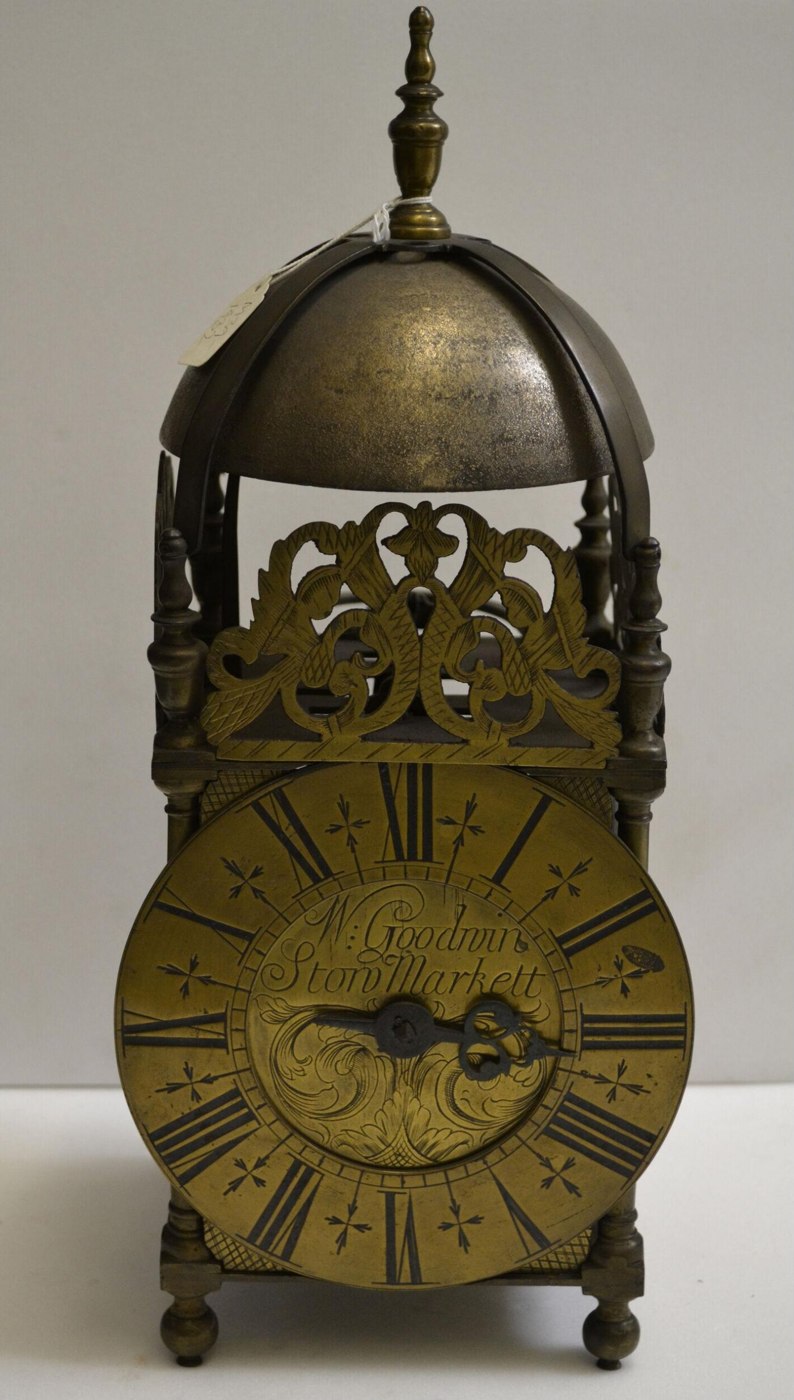
It utilizes a posted frame construction with plates measuring 5 3/4 inches square, featuring four ball feet and baluster finials. The dial displays elongated Roman hour numerals and is engraved with leafy scrolls. The movement comprises a going train with an anchor escapement and a striking train located at the rear, which includes a renewed count-wheel and a locking-plate mechanism. The clock is powered by weights that hang beneath the frame. The clock was acquired by the Victoria and Albert Museum following a donation from Mr. Charles Lamb of Brixton in memory of his parents.

Front view of the brass lantern clock, showing the chapter ring, pierced cresting, and finials.
Front view of the brass lantern clock, showing the chapter ring, pierced cresting, and finials. — Victoria and Albert Museum. Rights pending — permission not yet requested. Original source

Catalogue identity

Source
collections.vam.ac.uk
Category
Clock · Lantern clock
Maker / attribution
Goodwin, William
Reference
Not recorded
Catalogue / lot identifier
M.39-1932
Source-reported date
Late 17th century
Source-reported place
England

Source-reported attribution and specifications are not independent authentication. A listing does not establish present ownership, current display, availability or permission to reproduce.

Object description

Case and Dial Construction

The lantern clock is constructed from a posted brass frame with top and bottom plates measuring 5 3/4 inches square. The case is decorated with pierced frets located above the front and side sections, with the front fret specifically featuring engraving. The assembly stands on four ball feet and features baluster finials at the corners, which serve to surmount the bell straps. This lantern clock, crafted from cast and engraved brass, is attributed to the clockmaker William Goodwin of Stowmarket, Suffolk, and dates to the late 17th century.

The dial is engraved and measures 6 1/2 inches in diameter. The chapter ring is 1 1/2 inches broad and includes elongated Roman hour numerals with half and quarter-hour markers. The center of the dial is decorated with engraved leafy scrolls and bears the maker's signature. A single pierced iron hand is used for time indication, incorporating a tail design.

Evidence for this section
  • “Lantern form bracket clock in brass with a posted frame, with top and bottom plates 5 3/4” square.”
  • “The centre of the dial is engraved with leafy scrolls and signed 'W.Goodwin Stow Markett'.”

Movement and Escapement

The clock movement is divided into two primary functional trains. A going train is situated at the front of the frame, which operates using an anchor escapement. This escapement features an escape wheel of 42 teeth, with pallets spanning 9 teeth. Power is provided to the movement via weights, which are intended to hang freely below the base of the clock frame.

The striking train is located at the rear of the movement and functions via a locking-plate mechanism. This specific train features a renewed count-wheel to regulate the striking intervals. Spiked pulleys are included within the drive system, with a ratchet mechanism implemented specifically on the striking train for control.

Evidence for this section
  • “The movement has a going train at the front with anchor escapement, an escape wheel of 42T, and pallets spanning 9T.”
  • “Locking-plate striking train at rear, with renewed count-wheel.”

Provenance and History

This clock was donated to the collection by Mr. Charles Lamb of Brixton. The gift was made in memory of his parents. The object is listed under the accession number M.39-1932 within the museum's holdings.

Lantern clocks of this type were a popular domestic form in England from the 1620s until the end of the 18th century.

Evidence for this section
  • “Given by Mr Charles Lamb of Brixton “in memory of his parents”.”
  • “The origin of the term Lantern probably stems from its resemblance to this domestic form of portable lighting, but may also derive from a corruption of the word latten meaning brass.”

Open research questions

  • What is the approximate manufacturing date of the count-wheel renewal?
  • Were there any modifications made to the original spiked pulleys or drive trains beyond the count-wheel?

Source evidence

Recorded claims and source quotations for Lantern clock by William Goodwin
FieldSource-reported valueSource quotation
MakerGoodwin, William“Maker: Goodwin, William (Clock-maker)”
DateLate 17th century“Date: Late 17th century”
Place of originStowmarket“Place of origin: Stowmarket (Made)”
MaterialsCast and engraved brass“Materials and techniques: Cast and engraved brass”
Dial signatureW: Goodwin Stow Markett“Marks and inscriptions: W: Goodwin Stow Markett”
EscapementAnchor escapement“The movement has a going train at the front with anchor escapement”
Striking mechanismLocking-plate“Locking-plate striking train at rear, with renewed count-wheel.”

Visible details

  • Pierced and engraved crestings at the top of the case
  • Dial featuring leaf scroll engraving and signature
  • Single pierced iron hand with tail
  • Posted frame construction with ball feet

Research qualifications

  • The count-wheel is recorded as a renewal.
  • Specific dating to the late 17th century is approximate.

Photograph identity and source facts were screened before import; rights clearance remains pending.

Consulted source

Clock

Reviewed 2026-10-26 · Record 62143ff773

Terms in this record

Glossary explanations for terms named in this object’s record.