
Skip to content
The Encyclopedia of Horology

Clock · Lantern clock

Lantern clock by Richard Ames

Partially verified

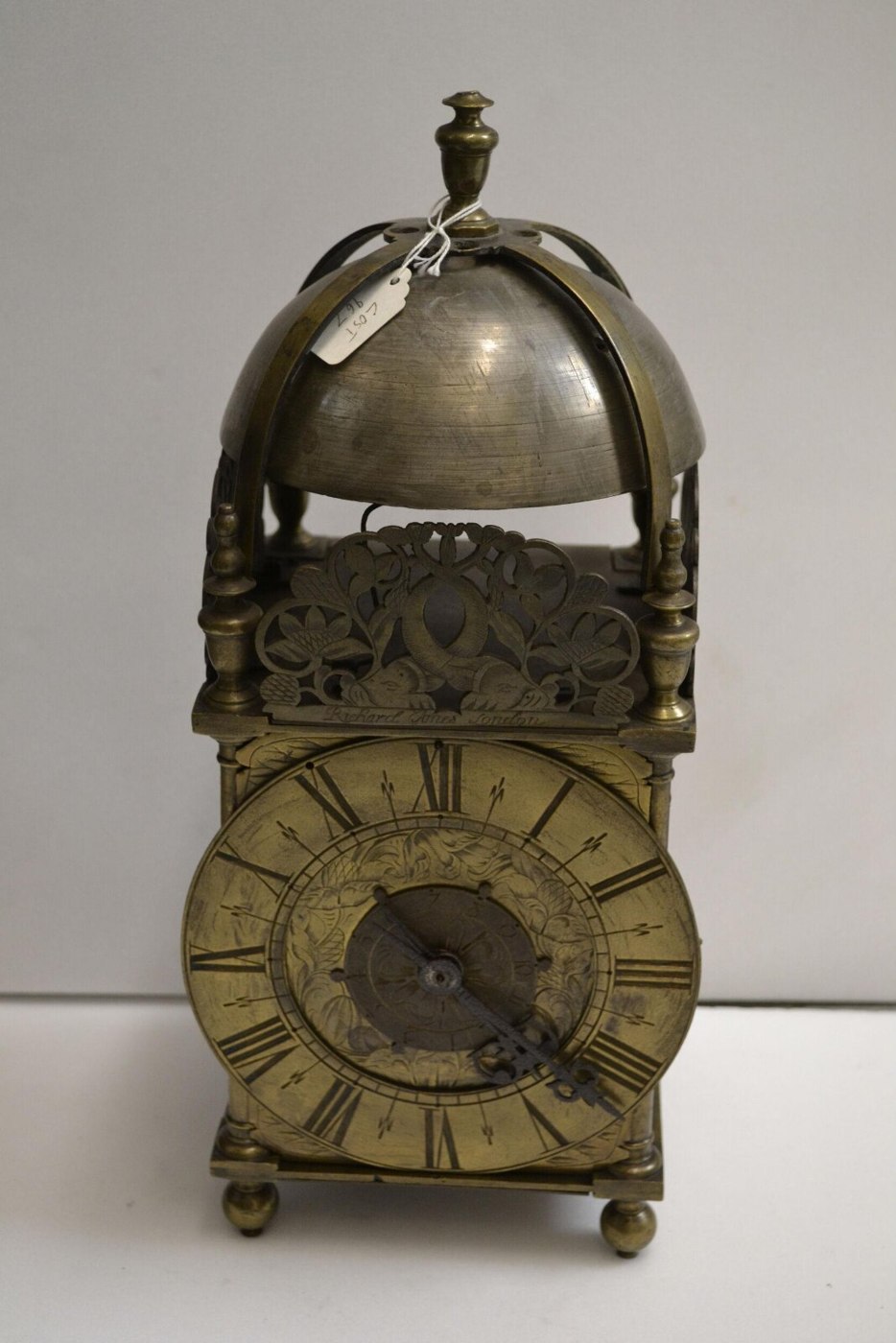
This brass lantern clock is attributed to the London clockmaker Richard Ames and dates to approximately 1650. Constructed with a posted brass frame, the clock features a square bottom, ball feet, and five turned baluster finials; the finial surmounting the bell is recorded as missing its upper section. The timepiece is characterized by dolphin-form crestings at the front and sides, complemented by top plates featuring pierced foliate strapwork of tulip flowers and leaves. The brass dial plate is engraved with a central tulip motif and foliage, surrounded by a chapter ring with Roman hour numerals. A smaller, centrally-positioned iron alarm dial includes Arabic numerals. The clock is operated by iron hour and minute hands with fleur-de-lis terminations. The front fret is inscribed beneath the dolphin motifs with the maker's signature, "Richard Ames London."

Front view of the lantern clock, displaying the dial with iron hands, dolphin cresting, and the bell finial.
Front view of the lantern clock, displaying the dial with iron hands, dolphin cresting, and the bell finial. — Victoria and Albert Museum. Rights pending — permission not yet requested. Original source

Catalogue identity

Source
collections.vam.ac.uk
Category
Clock · Lantern clock
Maker / attribution
Richard Ames
Reference
Not recorded
Catalogue / lot identifier
M.49-1995
Source-reported date
1650-1660
Source-reported place
London

Source-reported attribution and specifications are not independent authentication. A listing does not establish present ownership, current display, availability or permission to reproduce.

Object description

Case and Exterior Decoration

The lantern clock is constructed on a posted brass frame. The base is supported by four ball feet. The top of the clock is defined by pierced foliate strapwork featuring tulip flowers and leaves, which serves as a decorative enclosure for the upper mechanism.

Dolphin-form crestings are positioned at the front and sides of the clock. Five turned baluster finials are integrated into the design; one sits atop the bell, though it is noted as lacking its upper section. The frame is designed to be suspended from a hook or placed on a wall bracket.

Evidence for this section
  • “Posted brass frame, dolphin frets above, supported on ball feet with five turned baluster finials”
  • “top plates in the form of pierced foliate strapwork featuring tulip flowers and leaves”
  • “that above the bell has lost its upper section”

Dial and Timekeeping

The dial consists of a brass plate featuring engraved tulip and foliage patterns. A prominent chapter ring displays Roman numerals for the hours. The primary timekeeping is performed by a single hand, while a secondary hand registers the minutes.

An alarm function is managed by a small iron dial positioned in the center of the main dial plate. This iron dial uses Arabic numerals and includes iron hands finished with fleur-de-lis ends.

Evidence for this section
  • “Brass dial-plate, crudely engraved with tulip and foliage with brass chapter ring with Roman hour numerals”
  • “alarm dial of iron, with Arabic numerals with iron hour and minute hands with fleur de lis ends”

Maker and Provenance

The clock is signed on the front fret beneath the dolphin decorations. Richard Ames is documented as a clockmaker active in London during the mid-to-late 17th century, specifically associated with the parish of St Andrew's Holborn.

The clock entered the collection as part of a bequest from Estella Canziani, an artist associated with Dr Hildburgh, a benefactor of the V&A. The bequest included thirteen objects, including jewellery and silver.

Evidence for this section
  • “The front fret signed beneath the dolphins Richard Ames London”
  • “Richard Ames was apprenticed to Peter Closon in 1649 and was subsequently is listed as a clockmaker”
  • “The clock was one of two clocks bequeathed by Estella Canziani”

Open research questions

  • Does the 1650 dating correlate with the maker's apprenticeship status under Peter Closon?
  • What is the mechanical construction of the alarm mechanism attached to the iron dial?

Source evidence

Recorded claims and source quotations for Lantern clock by Richard Ames
FieldSource-reported valueSource quotation
MakerRichard Ames“Richard Ames London”
Accession numberM.49-1995“M.49-1995”
Datecirca 1650“Richard Ames London about 1650”
Dial featuresBrass chapter ring, iron alarm dial“brass chapter ring with Roman hour numerals, the alarm dial of iron, with Arabic numerals”

Visible details

  • Dolphin-shaped cresting above the dial.
  • Engraved tulip design on the brass dial-plate.
  • Large bell mounted on the top of the frame.
  • Iron alarm dial with Arabic numerals.

Research qualifications

  • Date range provided by source as 1650-1660 vs 1650.
  • Maker's active working years recorded as starting in 1657, complicating the 1650 date.

Photograph identity and source facts were screened before import; rights clearance remains pending.

Consulted source

Lantern clock

Reviewed 2026-11-02 · Record 4d5237e915

Terms in this record

Glossary explanations for terms named in this object’s record.