
Skip to content
The Encyclopedia of Horology

Clock · Lantern clock

Lantern clock by John Smorthwait

Partially verified

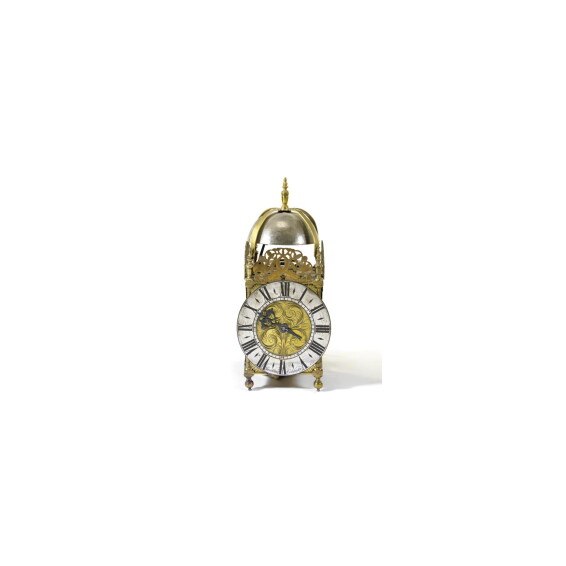
This lantern clock, documented by Sotheby's as by John Smorthwait of Colchester circa 1730, measures 37 cm (14½ inches) in height. The brass construction features slender turned corner columns, turned feet, urn finials, and pierced dolphin frets below an arched bell strap holding a top-mounted bell. The 6½-inch dial has a silvered chapter ring with Roman numerals and lozenge half-hour marks around an engraved foliate centre, fitted with a single replaced hand. Sotheby's reports a reverse signature on the dial plate and describes a posted rope- and weight-driven movement equipped with an anchor escapement, an outside countwheel, and rear iron hanging loop with wall spikes.

Front view of lantern clock attributed to John Smorthwait, showing dial, dolphin fret, and top bell
Front view of lantern clock attributed to John Smorthwait, showing dial, dolphin fret, and top bell — Sotheby's. Rights pending — permission not yet requested. Original source

Catalogue identity

Source
www.sothebys.com
Category
Clock · Lantern clock
Maker / attribution
John Smorthwait
Reference
Not recorded
Catalogue / lot identifier
60
Source-reported date
circa 1730
Country
United Kingdom

Source-reported attribution and specifications are not independent authentication. A listing does not establish present ownership, current display, availability or permission to reproduce.

Object description

Identity and Attribution

Sotheby's catalogues this lantern clock as the work of John Smorthwait, Colchester, dating it to circa 1730. The piece is recorded with an overall height of 37 cm (14½ inches).

The cataloguing notes that the reverse of the dial bears a repeat signature, described as 'probably for practise'.

Evidence for this section
  • “A lantern clock, John Smorthwait, Colchester, circa 1730”
  • “37cm. 14½in. high”
  • “the reverse with repeat signature, probably for practise”

Frame and Visible Case Architecture

The frame is described in the source as having slender turned corner columns, turned feet, urn finials, and dolphin frets. Frontal observation confirms the turned brass columns on turned feet, finials, and pierced fretwork beneath a top-mounted bell supported by arched straps.

The rear of the clock is recorded as having an iron hanging loop and wall spikes, though these mounting elements are not visible in the front photograph.

Evidence for this section
  • “the frame with slender turned corner columns, turned feet, urn finials and dolphin frets”
  • “the rear with iron hanging loop and wall spikes”
  • “Turned brass corner columns mounted on turned ball or peg feet and surmounted by finials”
  • “Pierced fretwork below a domed bell supported by arched straps and topped with a finial”

Dial Configuration and Mechanism Reports

The cataloguing specifies a 6½-inch dial featuring lozenge half-hour marks, an engraved foliate centre, and a single hand noted as replaced. Visual inspection shows a circular silvered chapter ring with Roman numerals and lozenge divisions extending beyond the pillar frame, surrounding the engraved gilt-brass centre with a pierced black hand.

Internally, Sotheby's records a posted rope- and weight-driven movement equipped with an anchor escapement, an outside countwheel, and a top-mounted bell. These internal mechanical components cannot be verified directly from the exterior frontal photograph.

Evidence for this section
  • “6½-inch dial with lozenge half-hour marks, single hand (replaced) and foliate engraved centre”
  • “the posted rope and weight driven movement with anchor escapement and outside countwheel with top mounted bell”
  • “Circular silvered chapter ring with Roman numerals and lozenge half-hour divisions extending past the pillar frame”
  • “Engraved gilt-brass dial centre with a single pierced black hand”

Open research questions

  • What is the exact text and execution of the signature on the front dial and the practice signature on the reverse?
  • Does the posted movement retain its original wheelwork, and has the anchor escapement undergone alteration or conversion?
  • What are the physical details and condition of the rear iron hanging loop and wall spikes?

Source evidence

Recorded claims and source quotations for Lantern clock by John Smorthwait
FieldSource-reported valueSource quotation
Maker and originJohn Smorthwait, Colchester, circa 1730“John Smorthwait, Colchester, circa 1730”
Dimensions37 cm (14½ in.) high“37cm. 14½in. high”
Dial features6½-inch dial with lozenge half-hour marks, replaced single hand, and foliate engraved centre“6½-inch dial with lozenge half-hour marks, single hand (replaced) and foliate engraved centre”
Movement descriptionPosted rope- and weight-driven movement with anchor escapement and outside countwheel“the posted rope and weight driven movement with anchor escapement and outside countwheel with top mounted bell”
Frame and mountingTurned corner columns, turned feet, urn finials, dolphin frets, iron hanging loop and wall spikes“the frame with slender turned corner columns, turned feet, urn finials and dolphin frets, the rear with iron hanging loop and wall spikes”
Dial reverse signatureRepeat signature, probably for practice, noted on the reverse“the reverse with repeat signature, probably for practise”

Visible details

  • Circular silvered chapter ring with Roman numerals and lozenge half-hour divisions extending past the pillar frame
  • Engraved gilt-brass dial centre with a single pierced black hand
  • Turned brass corner columns mounted on turned ball or peg feet and surmounted by finials
  • Pierced fretwork below a domed bell supported by arched straps and topped with a finial

Research qualifications

  • Movement details, rope-and-weight drive, escapement, and outside countwheel are not visible in the front photo
  • The source notes that the single hand is replaced
  • Rear iron hanging loop, wall spikes, and reverse practice signature cannot be confirmed from the front image

Photograph identity and source facts were screened before import; rights clearance remains pending.

Consulted source

(#60) A lantern clock, John Smorthwait, Colchester, circa 1730

Reviewed 2026-10-21 · Record 198bdac55c

Terms in this record

Glossary explanations for terms named in this object’s record.