
Skip to content
The Encyclopedia of Horology

Movement · Ébauche

Joseph Preston lever watch movement ébauche

Partially verified

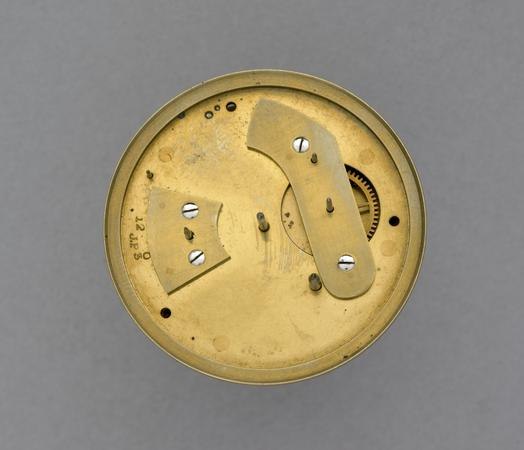
This English full-plate watch movement ébauche was made in Prescot by Joseph Preston, dated circa 1860 (or late 19th to early 20th century in museum notes). Designed for a lever escapement that was never fitted, the unfinished mechanism incorporates an uncut fusee equipped with Harrison's maintaining power, four turned pillars, and an unpivoted four-wheel brass train. The front plate features a raised flange, a recessed face, and a stepped rim intended to seat a dial. Two separate curved brass bridges secure the fusee and the third wheel and fourth pinion, accompanied by stamped sizing numerals and maker's marks.

Front plate view of the unfinished brass watch movement ébauche showing bridges and stamped marks
Front plate view of the unfinished brass watch movement ébauche showing bridges and stamped marks — British Museum. Rights pending — permission not yet requested. Original source

Catalogue identity

Source
www.britishmuseum.org
Category
Movement · Ébauche
Maker / attribution
Joseph Preston
Reference
Not recorded
Catalogue / lot identifier
1958,1201.1459
Source-reported date
circa 1860
Country
England

Source-reported attribution and specifications are not independent authentication. A listing does not establish present ownership, current display, availability or permission to reproduce.

Object description

Object Identity and Manufacture

This object is an incomplete English full-plate lever watch movement ébauche manufactured in Prescot, Lancashire. The movement is attributed to Joseph Preston, with source notes identifying the mark as associated with the firm Joseph Preston & Son.

Dating for the item is recorded as circa 1860 in the main museum description, though supplemental catalogue notes for this piece also reference a broader 'late 19th or early 20th century' timeframe.

Evidence for this section
  • “Producer name Ebauche maker: Joseph Preston”
  • “Production date 1860 (circa)”
  • “The mark of Joseph Preston & Son, Prescot, Lancashire.”
  • “Prescot, late 19th or early 20th century.”

Mechanical Construction and State of Completion

The ébauche features a full-plate layout supported by four turned pillars, with a separate barrel-bridge and individual bridges for the train wheels and fusee on the front plate. It is currently unfinished and lacks a dial, hands, case, motion work, and escapement components.

The fusee is equipped with Harrison's maintaining power but lacks an uncut groove for the chain. The brass train wheels include a solid centre wheel, with third and fourth wheels featuring five crossings. The arbors are unpivoted, extending beyond the plates and ending in male centres.

Evidence for this section
  • “Full-plate ebauche with a separate barrel-bridge; separate bridges on the front-plate for the train wheel's and fusee.”
  • “Fusee with Harrison's maintaining power; groove uncut.”
  • “The train arbors are unpivoted, the arbors extending beyond the plates and ending in male centres.”

Observations of Assembly

The potence remains in a rough state and is oversized, which impinges on the fusee and fourth wheel, preventing the back plate from fitting against the pillar shoulders. While balance holes are drilled in the balance cock and back plate, they are absent in the potence.

The front plate bears the stamped marks '12 0 3' and 'J.P'. The back plate was intended to be secured by pins, but the corresponding holes remain undrilled.

Evidence for this section
  • “The potence is still largely in the rough and oversize, impinging on the fusee and fourth wheel and preventing the back plate from fitting against the pillar shoulders.”
  • “The front plate of this ébauche is punched for Joseph Preston, and '12 0 3', the size of the movement.”
  • “It was intended that the back plate should be secured by pins but the pin holes are not yet drilled.”

Open research questions

  • What is the significance of the sizing marks '12 0 3' in the context of Joseph Preston's production?
  • Why does the source provide two disparate production date ranges (circa 1860 vs. late 19th/early 20th century) for the same object registration number?

Source evidence

Recorded claims and source quotations for Joseph Preston lever watch movement ébauche
FieldSource-reported valueSource quotation
MakerJoseph Preston“Producer name Ebauche maker: Joseph Preston”
Place of manufactureEngland (Prescot)“Production place Ebauche made in: England”
ConstructionFull-plate ébauche with separate bridges“Full-plate ebauche with a separate barrel-bridge; separate bridges on the front-plate for the train wheel's and fusee.”
Maintaining powerHarrison's maintaining power with uncut fusee“Fusee with Harrison's maintaining power; groove uncut.”
Escapement designLever escapement (not yet fitted)“Designed for lever escapement (not yet fitted).”
Movement diameter43 mm“Dimensions Diameter: 43 millimetres (movement)”
Dimensions43.0 mm diameter, 9.0 mm height“Dimensions: diameter 43.0 mm, height 9.0 mm”
ProvenanceIlbert collection“Provenance: Ilbert collection. Ilbert acquired this from Otto in 1933.”

Visible details

  • Front plate view displaying two curved brass bridges secured by polished steel screws
  • Visible stamped marks reading '12', '0', '3', and 'J.P' on the brass front plate
  • Unfinished unpivoted train arbors protruding through plate apertures
  • Raised outer flanged edge and stepped dial seating rim around movement perimeter

Research qualifications

  • Dating varies between circa 1860 in published catalogue text and late 19th or early 20th century in manuscript notes
  • Maker attribution varies between Joseph Preston and Joseph Preston & Sons
  • Incomplete ébauche lacking dial, hands, case, motion work, escapement parts, and mainspring hooking

Photograph identity and source facts were screened before import; rights clearance remains pending.

Consulted source

ebauche | British Museum

Reviewed 2026-10-25 · Record e8d2d20214

Terms in this record

Glossary explanations for terms named in this object’s record.