
Skip to content
The Encyclopedia of Horology

Clock · Longcase clock

John Wilding gravity escapement longcase clock

Partially verified

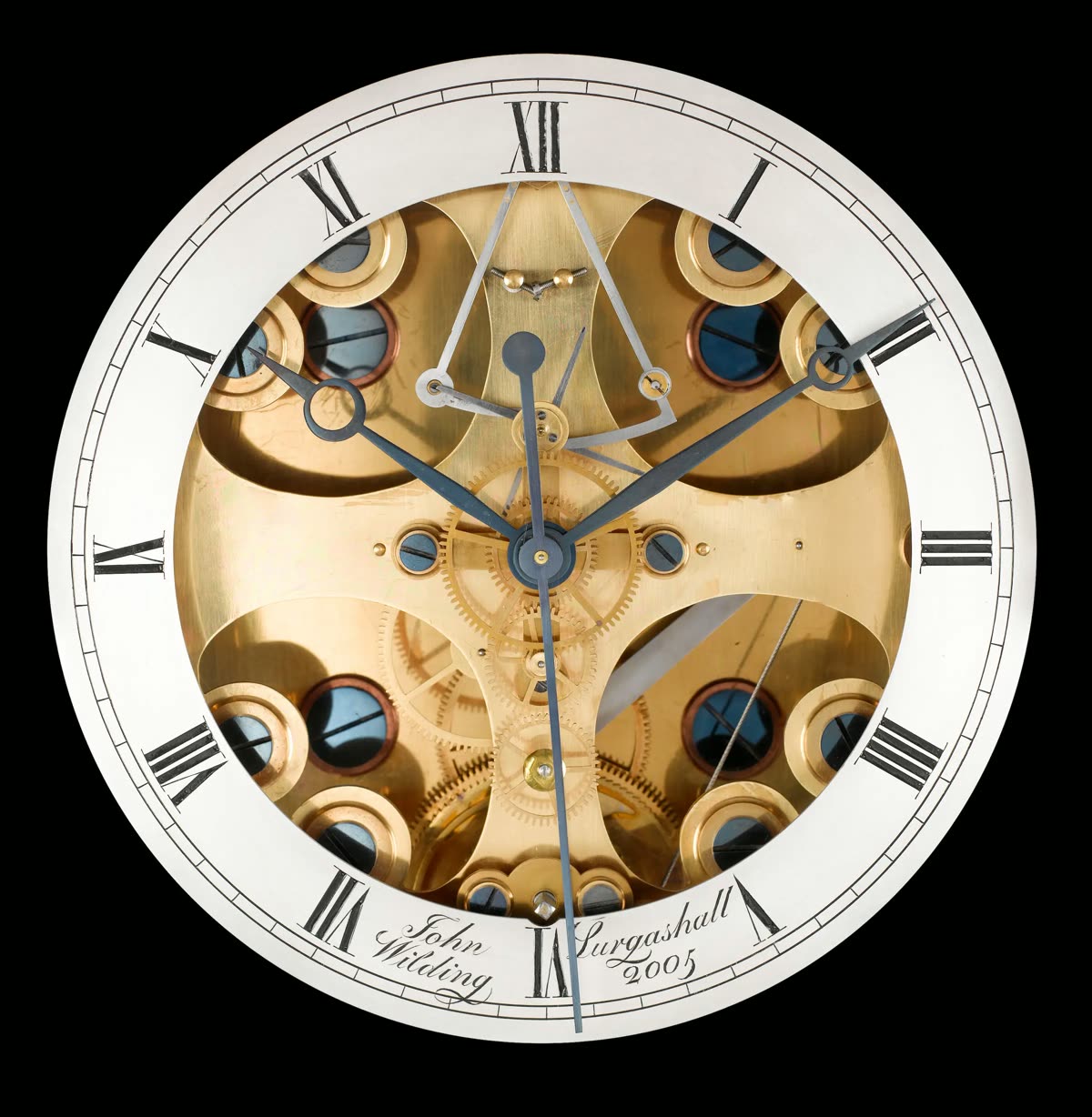
This eight-day longcase clock is signed by maker John Wilding in Lurgashall and dated 2005. According to the auction catalogue, the clock was built to a design by Claude Reeve originally published in Model Engineer. Bonhams reports that the movement is housed in an arched mahogany case featuring a glazed door above a plinth base, measuring 165 cm in total height. The skeletonised movement is constructed with cruciform brass plates united by large blued steel screws, operating an eight-day duration with a four-arm gravity escapement and five-crossing wheelwork. The dial features an open centre encircled by a 9.75-inch silvered Roman chapter ring, blued moon hands, and a centre seconds hand.

Dial and skeletonised gravity escapement movement of the John Wilding longcase clock
Dial and skeletonised gravity escapement movement of the John Wilding longcase clock — Bonhams. Rights pending — permission not yet requested. Original source

Catalogue identity

Source
www.bonhams.com
Category
Clock · Longcase clock
Maker / attribution
John Wilding
Reference
Not recorded
Catalogue / lot identifier
274
Source-reported date
2005
Country
United Kingdom

Source-reported attribution and specifications are not independent authentication. A listing does not establish present ownership, current display, availability or permission to reproduce.

Object description

Identity and Design Origins

The clock is an eight-day longcase clock attributed to maker John Wilding and inscribed with the location and date 'Lurgashall 2005'. According to catalogue footnotes, the mechanism is based on a horological design by Claude Reeve that was previously serialised in Model Engineer.

The footnotes record a first-person statement indicating that the author produced full-size drawings and an expanded description to broaden the build's popularity beyond the original serialisation.

Evidence for this section
  • “John Wilding, Lurgashall 2005”
  • “This clock was a design of Claude Reeve. Although it was serialised in Model Engineer I felt that a set of full size drawings plus a more detailed description of the construction would make the clock more popular.”

Dial and Visual Architecture

The dial assembly incorporates a 9.75-inch silvered Roman chapter ring with an open centre that leaves the movement plate visible. Directly observed on the dial, the chapter ring carries engraved Roman hour markers, signed 'John Wilding' across VII and 'Lurgashall 2005' across V.

Handwork consists of blued steel moon-tipped hour and minute hands, partnered with a long blued steel centre seconds hand extending past the outer minute track.

Evidence for this section
  • “the 9.75 inch signed silvered Roman chapter ring with moon hands”
  • “The silvered chapter ring is engraved with Roman numerals, signed 'John Wilding' across VII and 'Lurgashall 2005' across V.”
  • “A long blued steel centre seconds hand extends past the outer minute track.”

Movement Construction and Escapement

The movement features a skeletonised layout structured around cruciform plates fastened by large blued steel screws. The wheelwork comprises five-crossing wheels operating in conjunction with a four-arm gravity escapement.

Direct visual observation confirms that the pierced brass cruciform plate reveals internal wheelwork and is secured with large blued steel screws.

Evidence for this section
  • “cruciform plates united by large blued steel screws, the four arm gravity escapement and skeletonised movement with five crossing wheelwork.”
  • “The pierced brass cruciform plate reveals internal wheelwork and is secured with large blued steel screws.”

Open research questions

  • What specific suspension setup, rod material, and bob configuration were used for the pendulum in this build?
  • Does the glazed mahogany case retain any maker's plates or labels confirming whether the case was constructed by John Wilding or another maker?
  • What driving weight system and cable or cord arrangement are used to power the eight-day train?

Source evidence

Recorded claims and source quotations for John Wilding gravity escapement longcase clock
FieldSource-reported valueSource quotation
Maker and OriginJohn Wilding, Lurgashall, 2005“John Wilding, Lurgashall 2005”
Escapement and DurationEight-day gravity escapement with centre seconds“An eight day gravity escapement longcase clock with centre seconds”
CaseArched mahogany case with glazed door over plinth base“The arched mahogany case with glazed door over the plinth base”
Dial9.75-inch signed silvered Roman chapter ring with moon hands“the 9.75 inch signed silvered Roman chapter ring with moon hands”
Movement ConstructionCruciform plates, large blued steel screws, four-arm gravity escapement, five-crossing wheelwork“cruciform plates united by large blued steel screws, the four arm gravity escapement and skeletonised movement with five crossing wheelwork.”
Dimensions165 cm (65 in)“165cm (65in)”
Design SourceClaude Reeve (serialised in Model Engineer)“This clock was a design of Claude Reeve. Although it was serialised in Model Engineer”
Auction ResultSold for £2,040 inc. premium on 24 May 2011“24 May 2011, 12:00 BST London, Knightsbridge Sold for £2,040 inc. premium”

Visible details

  • The silvered chapter ring is engraved with Roman numerals, signed 'John Wilding' across VII and 'Lurgashall 2005' across V.
  • A long blued steel centre seconds hand extends past the outer minute track.
  • Blued steel moon-tipped hour and minute hands are mounted above an open cruciform front plate.
  • The pierced brass cruciform plate reveals internal wheelwork and is secured with large blued steel screws.

Research qualifications

  • The mahogany case, plinth base, pendulum, and drive weights reported in the auction description are not shown in this photograph.

Photograph identity and source facts were screened before import; rights clearance remains pending.

Terms in this record

Glossary explanations for terms named in this object’s record.