
Skip to content
The Encyclopedia of Horology

Tool · Latin-inscribed astrolabe

Johann Wagner Astrolabe

Partially verified

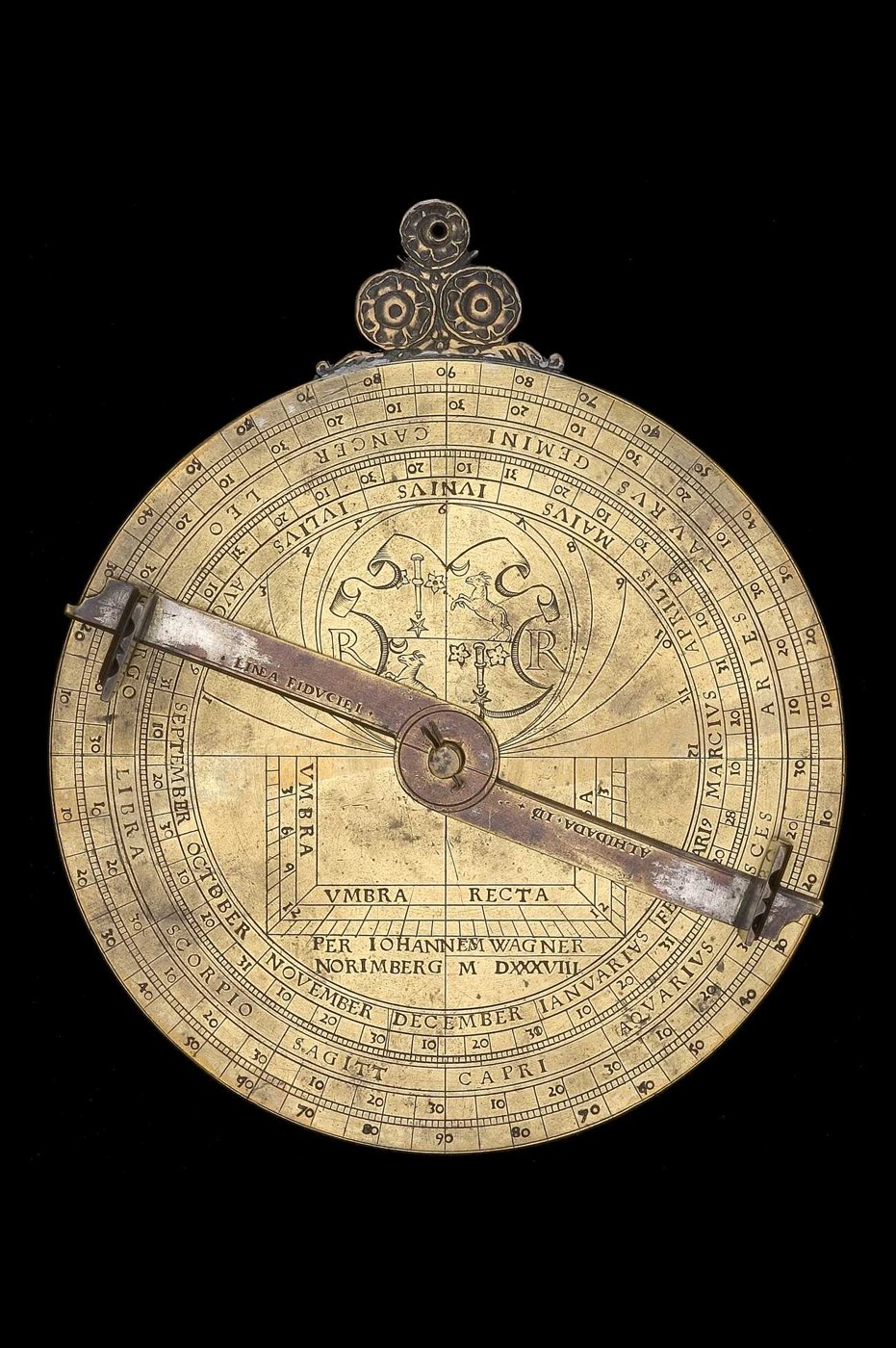
This brass astrolabe (inventory number 40443) was made in Nuremberg in 1538 by Johann Wagner. The construction features a three-lobed throne attached to the mater by a soldered base, with each lobe decorated with a five-petalled flower. The mater and limb are of two-piece, soldered construction. The instrument includes two plates with latitudes ranging from 45° to 51°. The back of the instrument features an unequal-hour diagram and a central coat of arms flanked by the letters 'R' and 'R'. It includes six primary scales: degree, zodiacal signs, calendar, shadow square, and unequal hours. The double-ended, counter-changed alidade is original to the piece and inscribed with the Latin text 'ALHIDADA ID LINEA FIDVCIEI'. The astrolabe was presented to the History of Science Museum by Lewis Evans in 1924, having been acquired by Evans from the Parisian collector R. Heilbronner in 1910.

The back of the Johann Wagner astrolabe showing the alidade, the coat of arms, and the signature.
The back of the Johann Wagner astrolabe showing the alidade, the coat of arms, and the signature. — History of Science Museum, University of Oxford. Rights pending — permission not yet requested. Original source

Catalogue identity

Source
www.mhs.ox.ac.uk
Category
Tool · Latin-inscribed astrolabe
Maker / attribution
Johann Wagner
Reference
Not recorded
Catalogue / lot identifier
40443
Source-reported date
1538
Source-reported place
Nuremberg

Source-reported attribution and specifications are not independent authentication. A listing does not establish present ownership, current display, availability or permission to reproduce.

Object description

Construction and Design

The astrolabe is constructed of brass and follows a traditional design for the period. Its throne is of a distinct three-lobed form, each lobe adorned with a five-petalled flower, and is securely attached to the mater via a soldered base. The main body, including the mater and the limb, is made of two separate pieces joined by solder.

The limb is calibrated for equal hours, with clear labels inscribed in Latin, such as 'HORE EQUALES' and cardinal directions including 'OCCIDENS' and 'MERIDIES'. Internally, the womb displays a table of horizons, with scales calibrated from 10 to 90 degrees, alongside plain line designations for the Equator and the Tropics, labeled in Roman Capital script.

Evidence for this section
  • “The throne is of the three-lobed type made of brass attached with soldered base”
  • “The mater and limb are of two pieces, soldered construction.”

Scales and Instrumentation

The rear of the instrument is equipped with six distinct scales to facilitate astronomical calculations. These include concentric degree and zodiacal scales, a calendar for tracking days of the year, and a shadow square for geometric measurements. The upper two quadrants contain a scale for unequal hours.

A double-ended, counter-changed alidade remains with the instrument, which is identified as original. This component features simple Gothic styling and is inscribed with its functional description, specifically denoting it as the fiducial line, or 'ALHIDADA ID LINEA FIDVCIEI'.

Evidence for this section
  • “The back contains 6 scales of the following types: Degree; Zodiacal signs; Calendar; Shadow square; Unequal hours.”
  • “Alidade Double-ended, counter-changed.”
  • “ALHIDADA ID LINEA FIDVCIEI”

Provenance and Marks

The instrument is marked with the maker's name and the date 1538. On the reverse, the central unequal-hour diagram features a large coat of arms, situated between two uppercase letters 'R'.

The provenance of this object traces back to 1910, when it was acquired by the collector Lewis Evans from R. Heilbronner in Paris. It was later donated to the History of Science Museum in 1924, where it is held under the accession number 1924-0/2025.

Evidence for this section
  • “In the centre of the unequal-hour diagram is a large coat of arms. On each side of the coat of arms is an upper case 'R'.”
  • “Evans bought it from R. Heilbronner, a dealer and collector of Paris, in 1910.”
  • “Presented by Lewis Evans in 1924”

Open research questions

  • What is the historical identity of the original owner represented by the 'R R' initials?
  • Are there extant pieces by Johann Wagner that confirm specific workshop practices in 1530s Nuremberg?

Source evidence

Recorded claims and source quotations for Johann Wagner Astrolabe
FieldSource-reported valueSource quotation
MakerJohann Wagner“Maker Johann Wagner”
Date1538“Date 1538”
Place of ManufactureNuremberg“Place Nuremberg”
MaterialBrass“Material Brass”
Inventory Number40443“Inventory number: 40443”
AcquisitionPresented by Lewis Evans in 1924“Presented by Lewis Evans in 1924”
Alidade InscriptionALHIDADA ID LINEA FIDVCIEI“ALHIDADA ID LINEA FIDVCIEI”

Visible details

  • Three-lobed throne decoration featuring five-petalled flowers
  • Double-ended, counter-changed alidade
  • Central coat of arms on back flanked by 'R' initials

Research qualifications

  • Specific original owner associated with 'R R' initials unverified
  • Attribution of coat of arms provenance relies on museum research

Photograph identity and source facts were screened before import; rights clearance remains pending.

Consulted source

Astrolabe, inventory 40443 (Nuremberg, 1538)

Reviewed 2026-10-26 · Record 8825b7bfc0

Terms in this record

Glossary explanations for terms named in this object’s record.