
Skip to content
The Encyclopedia of Horology

Pocket watch · Sector dial pocket watch

Jan Wanke Ecole d'Horlogerie de Genève Pocket Watch

Partially verified

This Swiss pocket watch is identified as a graduate's work by Jan Wanke at the École d'Horlogerie de Genève. Dating to approximately 1943, the watch is housed in an 18-carat gold case with a diameter of 51 mm and a total weight of 101 grams. The timepiece features a distinctive two-tone silvered sector dial with applied radial Roman numerals and gold hands. Internally, the watch is powered by a bridge-style movement equipped with a lever escapement and a Guillaume gold screw compensation balance. It bears the Poinçon de Genève hallmark, signifying adherence to regional quality standards of that era. The watch is a representative example of the Montre École tradition, where students at the Geneva School of Watchmaking independently designed, manufactured, and regulated a complete watch during their period of study.

Front view of the Jan Wanke pocket watch showing the sector dial, Roman numerals, and sub-seconds register.
Front view of the Jan Wanke pocket watch showing the sector dial, Roman numerals, and sub-seconds register. — Invaluable/The Auction House. Rights pending — permission not yet requested. Original source

Catalogue identity

Source
www.invaluable.com
Category
Pocket watch · Sector dial pocket watch
Maker / attribution
Jan Wanke
Reference
Poinçon de Genève, Cal. 43.20-5.50
Catalogue / lot identifier
210
Source-reported date
circa 1943
Source-reported place
Switzerland
Source-reported serial
1135

Source-reported attribution and specifications are not independent authentication. A listing does not establish present ownership, current display, availability or permission to reproduce.

Object description

Case and Dial Design

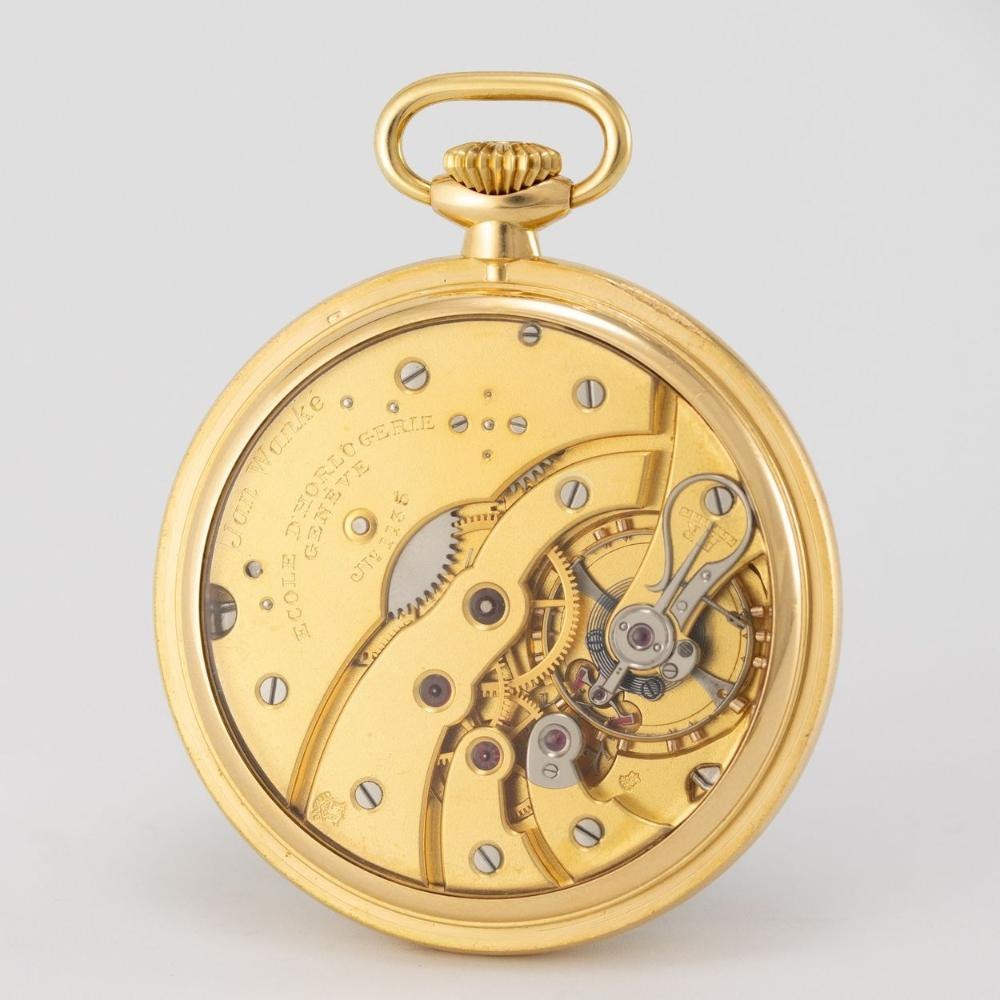
The pocket watch is presented in a smooth, 18-carat gold case measuring 51 mm in diameter. It features a push-back case design and includes a glazed back, which allows for visual access to the mechanical movement. The crown is positioned at the twelve o'clock position in the traditional pendant orientation.

The dial is configured as a two-tone silvered surface, characterized by a sector layout. It displays applied radial Roman numerals positioned on the outer perimeter of the dial, while the inner section houses the manufacturer's identification. Gold hands indicate the time, and a separate sub-seconds register is positioned at the bottom of the dial face.

Evidence for this section
  • “18 K gold, smooth, push back, glazed movement”
  • “Two-tone silvered, applied radial Roman numerals,”

Movement and Mechanical Details

The watch operates on a bridge movement architecture. Key technical components include a lever escapement designed for precision timekeeping. A notable feature of this calibre is the inclusion of a large Guillaume gold screw compensation balance, which was historically favored for its thermal stability properties in high-grade timepieces.

The movement carries the identifier 1135, matching the serial designation on the case. It is signed by Jan Wanke and marked with the institution of origin, the École d'Horlogerie de Genève. The auction description indicates that the movement is in good condition and capable of running, although professional cleaning is advised for continued optimal performance.

Evidence for this section
  • “Bridge movement, lever escapement, large Guillaume gold screw compensation balance”
  • “Movm.: very good, capable of running, cleaning recommended”

Provenance and Institutional Significance

This object is identified as a graduate's work from the École d'Horlogerie de Genève. This institution, established in 1824, is recognized for its role in Swiss precision mechanics and horological education.

This serves as an institutional authentication of the technical rigor applied during the creation of this piece, which has been dated by the source to circa 1943.

Evidence for this section
  • “tradition of the so-called Montre École (school clock), in which students independently design, manufacture, assemble, and regulate a complete watch”

Open research questions

  • What is the specific curriculum sequence or project requirement for Jan Wanke's class at the École d'Horlogerie de Genève in 1943?
  • Are there archival records at the Geneva School of Watchmaking that provide further biographical details on student Jan Wanke?

Source evidence

Recorded claims and source quotations for Jan Wanke Ecole d'Horlogerie de Genève Pocket Watch
FieldSource-reported valueSource quotation
MakerJan Wanke“Jan Wanke - École D'Horlogerie de Genève”
Case Material18-carat gold“18-carat gold case”
Movement Number1135“Movm. No. 1135”
Case Number1135“Case No. 1135”
Datecirca 1943“circa 1943”
Weight101 g“Weight 101 g”
Dial DescriptionTwo-tone silvered“Two-tone silvered”
EscapementLever“lever escapement”

Visible details

  • Two-tone silvered sector dial with sunken sub-seconds register
  • Visible bridge movement with Geneva-style finish
  • Applied radial Roman numerals on the dial periphery
  • Crown-wound mechanism with a bow and pendant setup

Research qualifications

  • Condition report notes the movement is capable of running but cleaning is recommended
  • The exact nature of the student-teacher collaboration remains undocumented beyond the 'graduate's work' description

Photograph identity and source facts were screened before import; rights clearance remains pending.

Consulted source

Jan Wanke - École D'Horlogerie de Genève

Reviewed 2026-10-26 · Record 3abe14dddd

Terms in this record

Glossary explanations for terms named in this object’s record.