
Skip to content
The Encyclopedia of Horology

Clock · Pendule Religieuse

Jacques Le Camus Pendule Religieuse

Partially verified

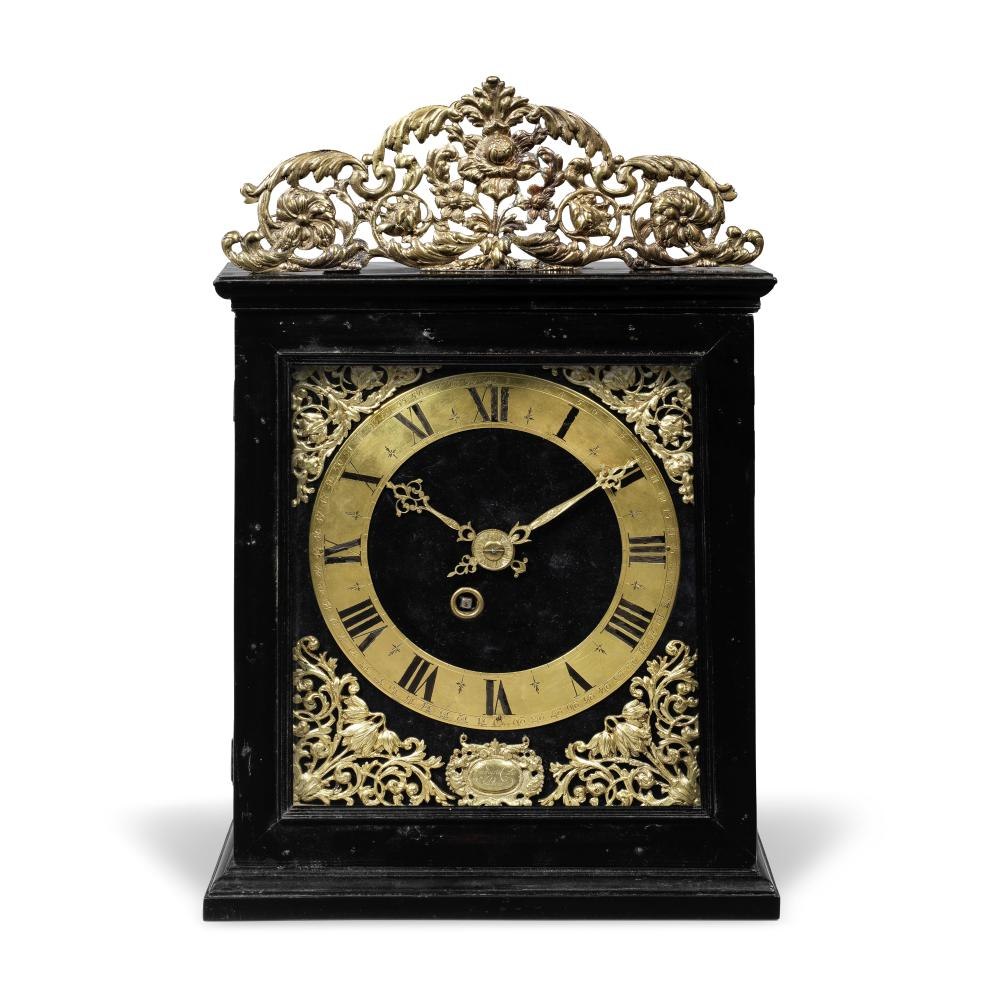
This late 17th-century pendule religieuse is attributed to the Parisian horologist Jacques Le Camus. The clock features a rectangular case veneered in ebony, incorporating a moulded cornice and plinth, with glazed side panels and twin suspension loops to the rear. The rear door is lined with walnut and ebony veneer. The 7.5-inch rectangular dial is velvet-covered and features foliate cast spandrels at each corner. The central chapter ring is 7 inches in diameter, displaying Roman hour numerals, cruciform half-hour markers, and an inner quarter-hour track, paired with pierced hands. The movement is constructed with four vase-shaped pillars, a 'tandem winding' barrel for both trains, a verge escapement with cycloidal cheeks, and a solid outside countwheel for the strike train. The clock is signed by Jacques Le Camus along the lower edge of the plates and includes a separate cast brass top mount.

A Pendule Religieuse clock by Jacques Le Camus featuring an ebony-veneered case, foliate brass spandrels, and a cast brass top mount.
A Pendule Religieuse clock by Jacques Le Camus featuring an ebony-veneered case, foliate brass spandrels, and a cast brass top mount. — Bonhams (via Invaluable). Rights pending — permission not yet requested. Original source

Catalogue identity

Source
www.invaluable.com
Category
Clock · Pendule Religieuse
Maker / attribution
Jacques Le Camus
Reference
Not recorded
Catalogue / lot identifier
34
Source-reported date
late 17th century
Source-reported place
Paris, France

Source-reported attribution and specifications are not independent authentication. A listing does not establish present ownership, current display, availability or permission to reproduce.

Object description

Case Construction and Appearance

The rectangular clock case is veneered in ebony and incorporates a moulded cornice and plinth. The rear door displays construction using both ebony lines and a walnut ground. The assembly includes glazed panels to the sides to allow visual access to the movement components. The top edge is designed to receive a separately provided cast brass mount.

The auction description reports that the case has undergone restoration and exhibits structural cracks consistent with age, specifically a vertical crack on the right side. The front door contains unused mounting holes indicating past hardware modifications. The original crisp definition of the case joints has softened over time due to natural material expansion and contraction.

Evidence for this section
  • “The rectangular case with twin suspension loops to the rear over a moulded cornice”
  • “the front door displays multiple spare holes where brass mounts were previously attached.”
  • “There are several cracks consistent with age-related wear, including a prominent one running vertically along the right-hand side”

Dial and Timekeeping Display

The 7.5-inch rectangular dial is currently dressed with a velvet backing. It is hinged on the left side and framed by foliate cast brass spandrels at each corner. An elaborate hinged signature plaque is centrally mounted between the spandrels, concealing a pendulum slot.

The 7-inch diameter chapter ring features Roman numerals for hours and cruciform markings for half-hours. The outer edge contains an engraved minute track, which is read using a set of pierced fancy hands. The chapter ring shows evidence of historical wax filling repairs.

Evidence for this section
  • “The 7.5 inch velvet-covered rectangular dial hinged on the left hand side”
  • “the 7 inch chapter ring with each minute hand engraved to the edge enclosing the Roman hours”
  • “with evidence of wax having been refilled in parts of the chapter ring.”

Movement and Escapement

The rectangular movement is held together by four vase-shaped pillars pinned to the back plate. It employs a 'tandem winding' system where both the going and strike trains are operated from a single barrel. The going train features a verge escapement with cycloidal cheeks mounted upon a decorated cock, with the verge arbor on a separate cock.

The strike train is governed by a solid outside countwheel with numbered hours. The movement plates are signed by the maker along the lower edge. The auction description reports that the movement remains in an unrestored state, showing tarnished plates but appearing complete and untouched.

Evidence for this section
  • “movement united by four vase shaped pillars pinned to the rear”
  • “the going with verge escapement with cycloidal cheeks set on a decorated cock”
  • “signed along the lower edge of the plates Jacques le Camus, Paris”

Open research questions

  • What specific archival evidence links the signature style on this movement to other known works of Jacques Le Camus?
  • Were the spare holes on the front door intended for clockwork mounts or purely decorative fittings typical of the period?

Source evidence

Recorded claims and source quotations for Jacques Le Camus Pendule Religieuse
FieldSource-reported valueSource quotation
MakerJacques Le Camus“Jacques Le Camus, Paris”
Datelate 17th century“A rare late 17th century ebony veneered 'Pendule Religieuse'”
Dimensions31 cm high“31cms (12.5ins) high”
Movement typeVerge escapement with cycloidal cheeks“the going with verge escapement with cycloidal cheeks set on a decorated cock”
Case materialsEbony veneer on a walnut ground“the rear door veneered inside and out with ebony lines on a walnut ground”
Strike trainSolid outside countwheel“the strike train with solid outside countwheel with each hour numbered”
Winding systemTandem winding“both wheel trains wound via a single 'tandem winding' barrel”

Visible details

  • Large foliate cast brass ornament mounted to the top of the case.
  • Brass corner spandrels featuring foliate motifs.
  • Engraved Roman numerals on the chapter ring with an inner minute track.
  • Pierced fancy metal clock hands.

Research qualifications

  • The auction description suggests the velvet dial backing is a later replacement.
  • The auction description reports the top of the case might have been replaced or reworked.
  • The exact extent of historical case restoration is not fully documented.

Photograph identity and source facts were screened before import; rights clearance remains pending.

Consulted source

A rare late 17th century ebony veneered 'Pendule Religieuse' Jacques Le Camus, Paris

Reviewed 2026-10-26 · Record 5f72adda6c

Terms in this record

Glossary explanations for terms named in this object’s record.