
Skip to content
The Encyclopedia of Horology

Tool · Italian quadrant

Italian Bronze Quadrant

Partially verified

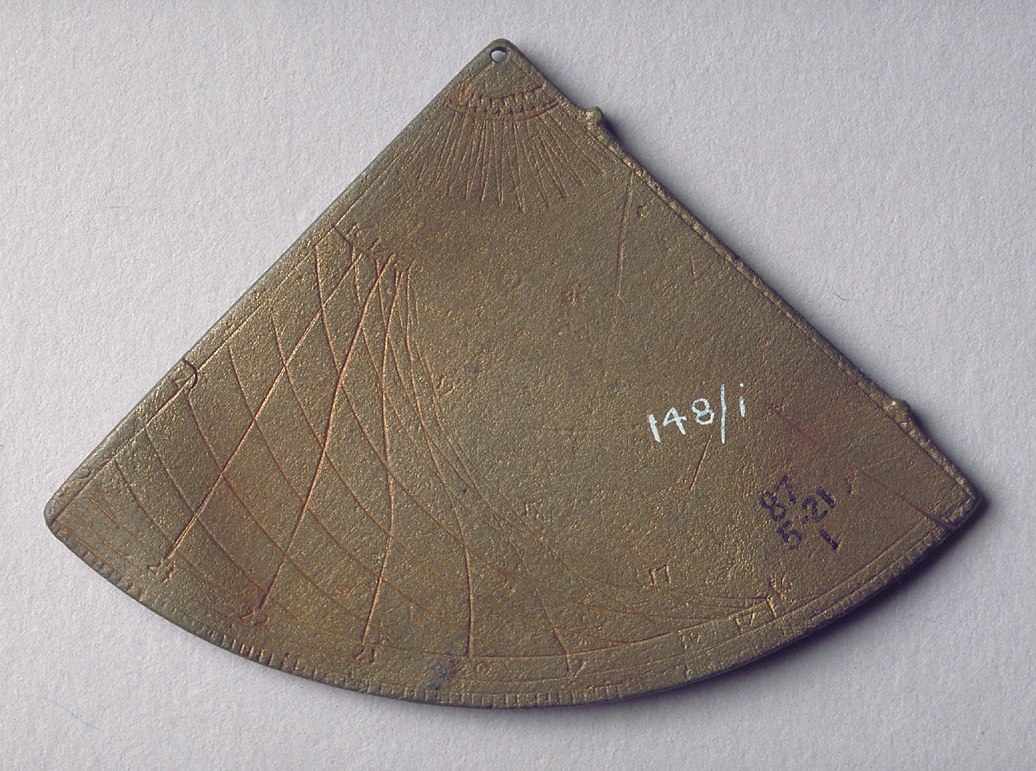
This unsigned quadrant, dating to the 15th century, is crafted from bronze or brass and measures 48 mm in radius. The instrument serves as a portable timekeeping device, featuring engravings on both faces. One side displays a table of the sun’s noon altitude throughout the year at three-day intervals, calculated for a latitude of 45 degrees. The reverse face is engraved with a scale of degrees along the limb and a series of hour lines ranging from 16 to 24. Constructional features include a small aperture near the apex intended for a plumb bob, which is now missing, and the remains of broken sights. Evidence of regional influence is noted in the month initials, suggesting a possible origin in the Venice or Bergamo area, where specific phonetic shifts are common. The object currently resides in the British Museum collection.

Front view of the quadrant showing the engraved hour lines and degree scale.
Front view of the quadrant showing the engraved hour lines and degree scale. — © British Museum, London. Rights pending — permission not yet requested. Original source

Catalogue identity

Source
www.mhs.ox.ac.uk
Category
Tool · Italian quadrant
Maker / attribution
Not established
Reference
Not recorded
Catalogue / lot identifier
MLA 1887, 5-21.1
Source-reported date
15th century ?
Source-reported place
Italy

Source-reported attribution and specifications are not independent authentication. A listing does not establish present ownership, current display, availability or permission to reproduce.

Object description

Engravings and Functional Layout

The quadrant is double-sided, with each face serving a specific astronomical or timekeeping function. One side is dedicated to a table documenting the sun's maximum altitude at noon across the calendar year, organized in three-day intervals. This table assumes a local latitude of 45 degrees, recording altitudes from a minimum of 23 in December to a maximum of 68 in June. Two moon-like shapes are positioned on the sides of this table.

The reverse side of the instrument features a degree scale along the curved limb and a sequence of hour lines numbered from 16 to 24. These lines are intended for the measurement of Italian hours. Near the apex of this side are decorative radiating lines. The engraving displays inconsistency in its script, as the number five is rendered in a Gothic style, while the remaining digits utilize a later form of lettering.

Evidence for this section
  • “One face of the quadrant has a table for the altitudes of the sun at noon during the year, at intervals of three days from 3 to 30.”
  • “The reverse of the quadrant is engraved with a scale of degrees on the limb, and hour lines from 16 to 24, numbered by one.”
  • “the number five is Gothic, but all the other digits are engraved in a later script.”

Regional Attribution and Iconography

The quadrant lacks a maker's mark, yet certain characteristics offer clues to its origin. The initials used for the months include 'Z' for both January and June, a departure from standard Italian naming conventions.

An ornamental shield is located near the apex of the instrument. While it has been tentatively associated with the Este or Gonzaga families, surface damage has obscured the fine details of the engraving, leaving the identification inconclusive. This iconography, combined with the linguistic evidence of the month labels, provides the primary basis for the current regional attribution.

Evidence for this section
  • “The initials of the names of the months are however unusual, with 'Z' for January and June”
  • “Since in the accent of the Venice and Bergamo area the letter 'g' followed by a vowel is pronounced 'z', the instrument is likely to have been made in that area.”
  • “Near the apex of the quadrant is a shield identified as the Este or Gonzaga, but it is too damaged to allow exact identification.”

Condition and Provenance

The physical state of the instrument reflects its age and use. The quadrant is noted as being slightly bent, and the original sights are broken off. Additionally, the small hole intended to house the plumb bob remains, though the bob itself is absent. These conditions are consistent with its status as a historical artifact held within the British Museum's collection.

The quadrant was acquired by the British Museum in 1887, having been presented by the Duke of Buccleugh. It is documented in F. A. B. Ward's 1981 publication, 'A Catalogue of European Scientific Instruments in the Department of Medieval and Later Antiquities of the British Museum', which serves as the primary scholarly reference for the item.

Evidence for this section
  • “There is a small hole for the plumb bob, now missing, and the sights are broken off.”
  • “The quadrant is slightly bent.”
  • “The instrument was presented by the Duke of Buccleugh in 1887, and is described in F. A. B. Ward, A Catalogue of European Scientific Instruments”

Open research questions

  • Can spectral analysis or metallurgical testing confirm the composition of the alloy to further narrow the regional origin?
  • Could high-resolution imaging of the shield reveal further details of the crest to confirm if it belongs to the Este or Gonzaga lineage?

Source evidence

Recorded claims and source quotations for Italian Bronze Quadrant
FieldSource-reported valueSource quotation
MaterialBronze or brass“Bronze or brass”
Radius48 mm“48 mm in radius”
Latitude45 degrees“corresponding to latitude 45?.”
Registration NumberMLA 1887, 5-21.1“Registration no. MLA 1887, 5-21.1”
Month InitialsZ, F, M, A, M, Z, L, A, S, O, N, D“The initials of the names of the months are 'Z, F, M, A, M, Z, L, A, S, O, N, D'.”
ProvenancePresented by the Duke of Buccleugh in 1887“The instrument was presented by the Duke of Buccleugh in 1887”

Visible details

  • Small hole for missing plumb bob at apex
  • Engraved sun altitude table for latitude 45
  • Hour lines numbered 16 to 24
  • Sights broken off from the instrument

Research qualifications

  • The exact provenance of the shield near the apex remains uncertain due to damage, preventing definitive identification as Este or Gonzaga.
  • The precise manufacturing date remains queried as 15th century.

Photograph identity and source facts were screened before import; rights clearance remains pending.

Consulted source

Quadrant

Reviewed 2026-10-26 · Record 7fbde4ee07

Terms in this record

Glossary explanations for terms named in this object’s record.