
Skip to content
The Encyclopedia of Horology

Tool · Italian quadrant

Gilt brass quadrant with compass and scaphe sundial

Partially verified

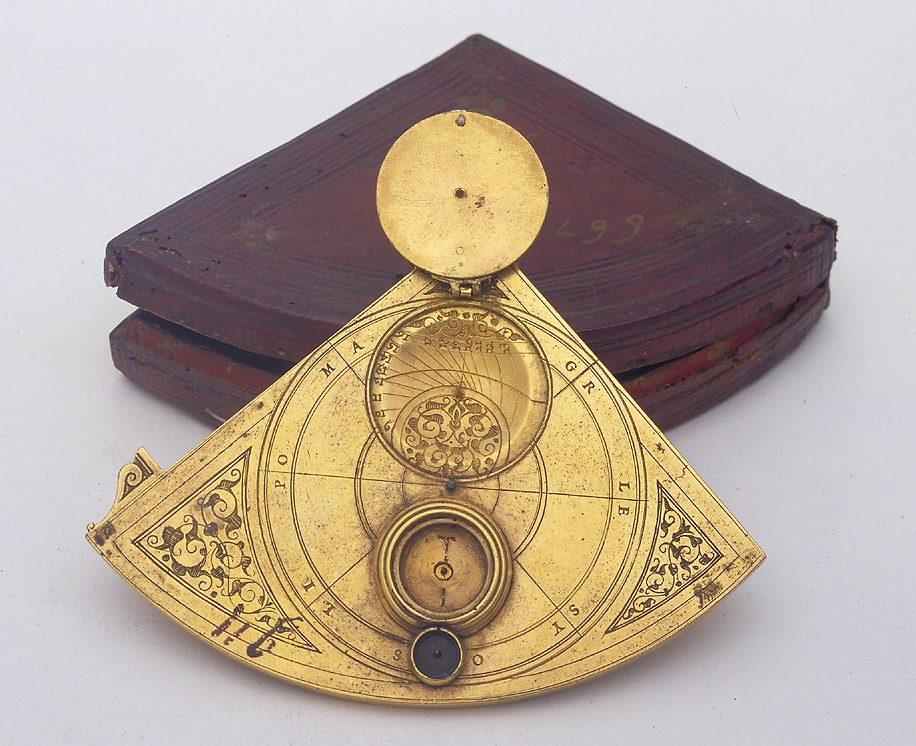
This gilt brass quadrant, measuring 90 mm in radius, was made by Giovanni Battista Giusti in Florence during the later 16th century. It is a multifunctional instrument featuring a compass and a scaphe sundial on the front face, which is adorned with a relief mask at the center. The opposite side includes a horary quadrant calibrated for a latitude of 42 degrees, corresponding to Rome, along with a magic square of three. The instrument is accompanied by its original red leather-lined velvet case. This object historically belonged to Pope Gregory XIII and is documented in the wardrobe inventory of Ferdinand I and the 1654 inventory of the Uffizi. The construction incorporates engraved scales, sundial diagrams for Italian hours, and scrolled foliate decoration, though the plumb line, cursors, needle, and glass are missing from the original assembly.

Gilt brass quadrant with open scaphe sundial cover and original case in the background.
Gilt brass quadrant with open scaphe sundial cover and original case in the background. — Istituto e Museo di Storia della Scienza, Firenze. Rights pending — permission not yet requested. Original source

Catalogue identity

Source
www.mhs.ox.ac.uk
Category
Tool · Italian quadrant
Maker / attribution
Giovanni Battista Giusti
Reference
Not recorded
Catalogue / lot identifier
2525
Source-reported date
Later 16th century
Source-reported place
Florence

Source-reported attribution and specifications are not independent authentication. A listing does not establish present ownership, current display, availability or permission to reproduce.

Object description

Instrument Construction and Features

The quadrant is constructed from gilt brass with a radius of 90 mm. One face features a horary quadrant graduated on the limb to 1 degree, marked for a latitude of 42 degrees. This face includes a diagram for an Italian hours dial and a magic square of three in the apex. The magic square sums to 15 in all directions and has a total of 45.

The reverse side contains a compass and a scaphe sundial. The scaphe dial is protected by a small hinged cover, and a relief mask is positioned at the instrument's center. Parts of the surface are decorated with cross-hatched, scrolled foliate patterns, and the instrument includes sights, one with a pinnule, along its edge.

Evidence for this section
  • “The quadrant side of the instrument is graduated on the limb with a 90? scale”
  • “In the apex is the magic square of three '4 9 2' / '3 5 7' / '8 1 6'”
  • “At the centre is a small relief depiction of a mask.”
  • “The free space in the corners of the quadrant and beneath the scaphe dial are filled with partly cross-hatched scrolled foliate decoration.”

Historical Provenance

The instrument is associated with Pope Gregory XIII. Following his ownership, it entered the Medici collections. It is identified in the wardrobe inventory of Ferdinand I as a gilt brass quadrant with an Italian clock that belonged to the Pope, stored in a leather case.

A subsequent mention appears in the 1654 inventory of the Uffizi, which describes the item in detail, noting it as a gilt brass quadrant with a horizontal clock, a compass, and a solar clock, noting that the plumb line is missing. It remains preserved within its original red leather case lined with velvet.

Evidence for this section
  • “This precious instrument belonged to Pope Gregory XIII.”
  • “mentioned in the Wardrobe Inventory of Ferdinand I (Inv. Guard. Med. N. 190 car 39)”
  • “in the 1654 inventory of the Uffizi as 'Un quadrante di ottone dorato”
  • “The original box has a six roll frame around the edge enclosing a central symmetrical leaf motif”

Condition and Completeness

The auction description reports several losses affecting the instrument's original utility. The compass component is incomplete, lacking both its needle and the glass cover. Additionally, the instrument is missing its plumb line and cursor lines.

The object retains its original red leather case, which is lined with velvet. The case features decorative elements including a six-roll frame, a central symmetrical leaf motif, and small five-petal flowers in the corners.

Evidence for this section
  • “Below this dial is a partly inset compass (lacks needle and glass)”
  • “The plumb and cursors line are missing.”
  • “The original box has a six roll frame around the edge enclosing a central symmetrical leaf motif”

Open research questions

  • What is the purpose of the subsidiary bowl located at the south point of the compass?
  • Are there any identifiable marks on the instrument besides the signature that verify the Medici collection accession?

Source evidence

Recorded claims and source quotations for Gilt brass quadrant with compass and scaphe sundial
FieldSource-reported valueSource quotation
MakerGiovanni Battista Giusti“Signed by Giovanni Battista Giusti”
MaterialGilt brass“Gilt brass; 90 mm in radius”
Latitude42 degrees“horary quadrant for a latitude of 42? ( Rome )”
ProvenancePope Gregory XIII“This precious instrument belonged to Pope Gregory XIII.”
Inventory Number2525“Inventory number: 2525”
Magic Square3x3“In the apex is the magic square of three '4 9 2' / '3 5 7' / '8 1 6'”
DateLater 16th century“Later 16th century; Florence”

Visible details

  • Relief mask at the center of the front face
  • Magic square in the apex of the horary quadrant side
  • Hinged flap concealing the scaphe sundial
  • Scrolled foliate decoration in the instrument corners

Research qualifications

  • The needle and glass are missing from the compass
  • The plumb and cursor lines are missing

Photograph identity and source facts were screened before import; rights clearance remains pending.

Consulted source

Quadrant

Reviewed 2026-10-26 · Record 5b56b35f85

Terms in this record

Glossary explanations for terms named in this object’s record.