
Skip to content
The Encyclopedia of Horology

Tool · Scientific instrument

Inclining dial

Partially verified

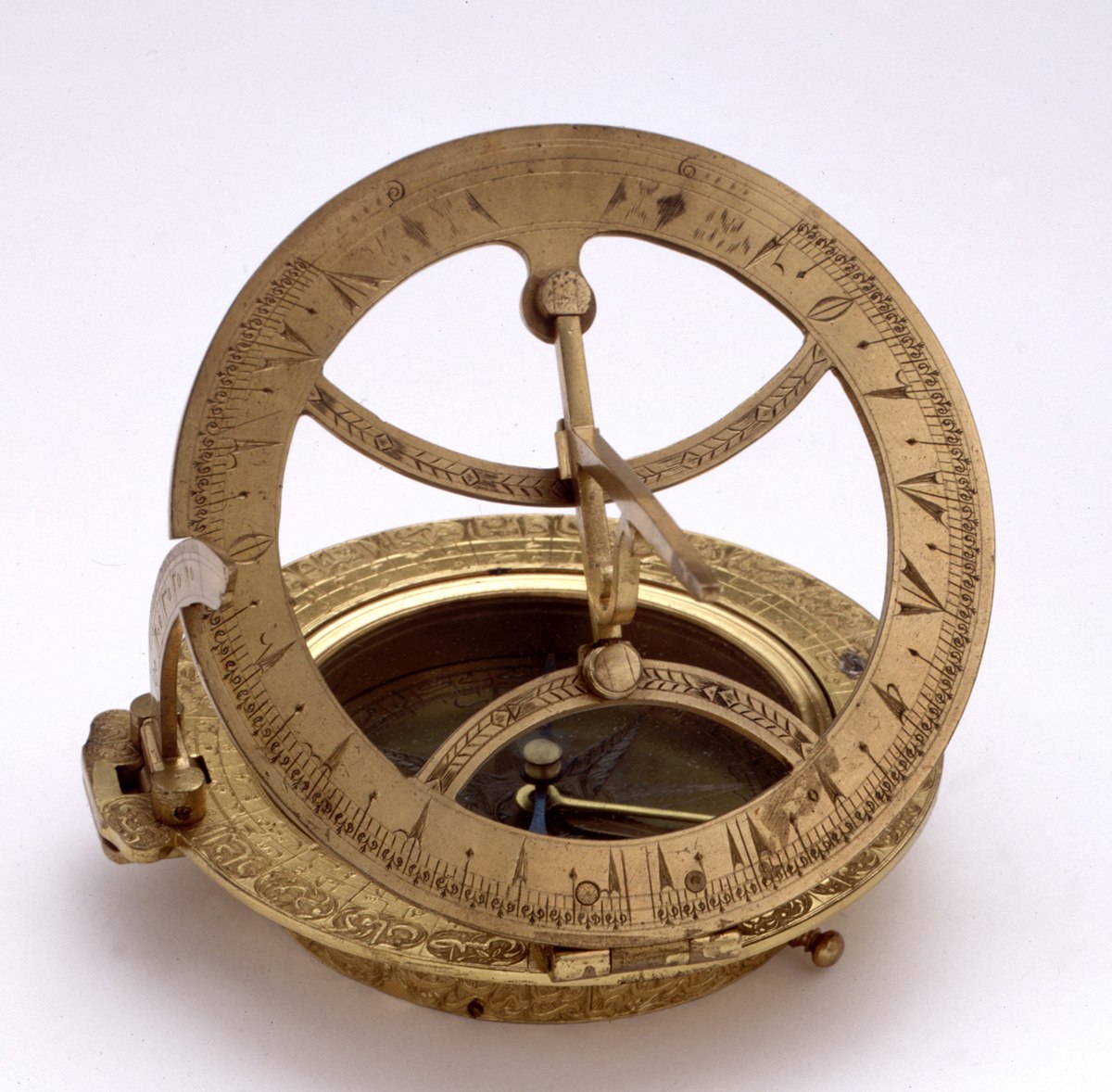
This brass and gilt-brass inclining dial is configured for latitudes between 0° and 60° North, combining European structural forms with Arabic inscriptions. The circular base houses a compass fitted with an eight-point rose, degree divisions using abjad numerals, and a leaf-shaped qibla pointer. Hinged to the northern side of the base plate is an hour circle inscribed with Turkish numerals, supporting the gnomon on circular arcs. A hinged curved latitude scale facilitates inclination adjustment. The base plate rim lists nineteen Middle Eastern localities with their respective coordinates, and the side is inscribed with a Persian poem regarding constellations and qibla orientation.

Oblique view of the brass inclining dial showing the raised hour circle, gnomon, latitude arc, and inset compass
Oblique view of the brass inclining dial showing the raised hour circle, gnomon, latitude arc, and inset compass — National Maritime Museum, Greenwich, London, Caird Collection. Rights pending — permission not yet requested. Original source

Catalogue identity

Source
www.rmg.co.uk
Category
Tool · Scientific instrument
Maker / attribution
Not established
Reference
AST0353
Catalogue / lot identifier
Source URL identifies the listing
Source-reported date
1750-1800
Country
Not established

Source-reported attribution and specifications are not independent authentication. A listing does not establish present ownership, current display, availability or permission to reproduce.

Object description

Structural Identity and Design

This instrument is a brass and gilt-brass inclining dial intended for use between 0° and 60° North. It is described as a mixture of typical European—possibly English—inclining dial architecture with an Arabic hand.

The base contains a glazed compass with an eight-point rose and a degree scale using abjad numerals. An hour circle is hinged to the north side of the base, featuring Turkish numerals and a gnomon supported by circular arcs. A latitude arc is hinged to the east side, also featuring Turkish numerals.

Evidence for this section
  • “represents a strange mixture of what appears to be a genuine Arabic hand and a typical European, probably English, inclining dial.”
  • “Hinged to the North side of the base-plate is an hour-circle numbered in Turkish numerals, on which the gnomon is supported by circular arcs.”
  • “The latitude arc is hinged to the East side of the dial-plate and has a degree scale numbered by Turkish numerals.”

Operational Features

The instrument includes a compass needle that can be secured by a radial brass arm, activated by an external lever. Prayer orientation is assisted by a leaf-shaped brass qibla pointer.

Lists of nineteen locations in the Middle East, including their latitudes, inhirafs, and jihas, are engraved on the base-plate rim and the underside of the hour circle.

Evidence for this section
  • “The needle can be locked by a radial brass arm that is operated by a lever on the outside of the instrument.”
  • “A leaf-shaped brass pointer acts as a 'qibla' indicator.”
  • “On the rim of the base-plate is a list of 19 places in the Middle East with their latitudes, 'inhirafs' and 'jihas', that is continued on the underside of the hour-circle.”

Epigraphy and Cultural Attribution

The instrument is unsigned. Inscriptions include a Persian poem on the side of the base concerning constellations and the qibla.

The center of the reverse side contains an inscription which the source identifies as reflecting a Shiite rather than Sunnite perspective, referencing a statement attributed to Ali.

Evidence for this section
  • “The sides of the base-plate are inscribed with a Persian poem about constellations and the position of the 'qibla'”
  • “Though unsigned, an inscription in the centre of the reverse side shows that the maker was a Shiite rather than Sunnite. This inscription quotes a remark associated with Muhammad's son-in-law Ali”

Open research questions

  • Does technical analysis confirm that the Arabic engravings were added to a pre-existing European dial or produced simultaneously?
  • Do the specific inhiraf and jiha values provided in the lists correspond to a specific astronomical table common in the 18th century?

Source evidence

Recorded claims and source quotations for Inclining dial
FieldSource-reported valueSource quotation
Latitude range0°-60° North“Inclining dial for latitudes 0°-60° North.”
MaterialsGilt-brass; Brass; Glass“Materials: Gilt-brass ; Brass Glass”
Overall dimensions24 x 94.5 mm“Measurements: Overall: 24 x 94.5 mm”
Date made1750-1800“Date made: 1750-1800”
Compass featuresEight-point rose, abjad numerals, and qibla pointer“the compass has an eight-point rose and a degree scale numbered with 'abjad' numerals. The needle can be locked by a radial brass arm that is operated by a lever on the outside of the instrument. A leaf-shaped brass pointer acts as a 'qibla' indicator.”
Date range1750-1800“Date made: 1750-1800”
Measurements24 x 94.5 mm“Measurements: Overall: 24 x 94.5 mm”
Comparative exampleMHS, Oxford (new inventory no. 33518)“virtually identical example in the MHS, Oxford (new inventory no. 33518)”

Visible details

  • Hinged circular brass hour circle raised on circular arc supports with an integrated gnomon.
  • Glazed inset compass capsule visible in the center of the base plate.
  • Curved graduated latitude scale hinged at the perimeter of the base.
  • Engraved Arabic script and decorative motifs covering the rim and outer edge of the instrument.

Research qualifications

  • The maker is unknown; the source notes an inscription indicates a Shiite cultural association, but the maker is unsigned.
  • The source reports the object combines European inclining dial architecture with an Arabic hand, but the exact country of origin is not specified.

Photograph identity and source facts were screened before import; rights clearance remains pending.

Consulted source

Inclining dial | Royal Museums Greenwich

Reviewed 2026-10-25 · Record c0baa4d76a

Terms in this record

Glossary explanations for terms named in this object’s record.